Startup cost
$50k–$75k
TRUiC Business Ideas
Decision Snapshot
Idea Score
54
Startup cost
$50k–$75k
Profit margin
14%
Break-even
18 mo–36 mo
Time to launch
36 wk–52 wk
Demand trend
Stable
5-yr failure rate
—
Capital intensity
High
Time commitment
Full time
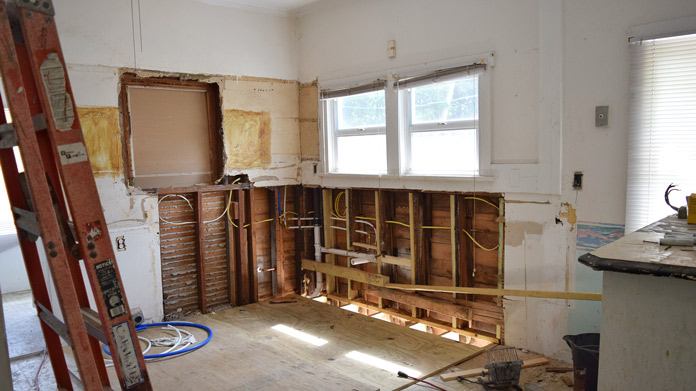
Your remodeling business might be a one person show where you personally complete kitchen, bathroom, bedroom remodels or additions to homes and businesses. In another business model, you could serve as a general contractor and hire employees or subcontractors to help complete jobs in a more efficient manner.
Our guide is in 3 parts:
If you are simply offering up your own skills and time as a part-time remodeler, the start-up cost will be around $50,000 to $75,000 as you will need a complete set of tools, a vehicle for transporting tools and supplies, and the proper licensing and insurance in order to operate in your state and locality. If you are looking to enter the business world offering major renovation services, expect to have start-up capital of $250,000 to $500,000 as you’ll need to be able to purchase your first few orders of materials and hire staff before your customer pays you for the completed job.
You will need to maintain accounts with material suppliers, pay your crews on a regular basis, and maintain vehicles and tools. Fortunately, your office space can be fairly minimal.
Home and business owners who are seeking to have their property professionally renovated and are willing to pay a fair price for labor and materials. Large businesses that need renovating may have more space, allowing you to charge more for your work.
Your remodeling business generates income by charging your customers for labor and materials for their renovation. You are responsible for providing your own tools, as part of your trade. However paint, hardware, lumber, flooring, and other supplies are purchased by you at wholesale prices and then you charge your customer for them at a premium price. Your hourly labor costs will be determined by level of expertise, the type of job that is being completed, and local competitive rates.
Your rates will vary depending on size and complexity of the job. Rates vary from $45/hr to $85/hr and can be lower or higher. You will want to complete an extensive competitive comparison to ensure your client is getting a good value. The average renovation project costs between $3,000 and $15,000.
The typical markup on materials is 15%. Income for a one-man company can be around $20,000 a year working part-time while a large contractor with multiple crews can see income in the seven figure range when they complete multiple large jobs over the year.
Ensuring quality work that completely satisfies your customer is the number one means of generating more business, and therefore additional profit. You will need to ensure the quality control and customer service are always of top priority for your successful remodeling business.
Whether you simply manage the business or are swinging a hammer with the crew, you might be expected to:
Participate in demolition, installation of flooring, walls, and cabinetry
Source supplies and materials for the job site
Maintain open communication channels with the customer, updating them on progress
Schedule your reliable crews and subcontractors in a time-efficient manner
Maintain proper licensing to operate in your state
Train new crew members to maintain your high standards
Complete punch lists after you finish a job
Establish relationships with tool and materials vendors/suppliers
Maintain payroll records/pay your crews on a timely basis
Collect payment from customers
Create contracts for customer approval
Promote your business to generate new jobs for the future
Your remodeling business will find greater success when you have a wide range of skills under your belt as the owner/operator. These may include, but are not limited to:
Solid understanding and experience in construction techniques with regards to kitchen, bathrooms, siding, windows, additions, and flooring
Appreciation and knowledge of quality materials and their fair pricing structure
Good accounting knowledge to maintain accurate records for accounts payable/receivable and payroll requirements
Excellent time management that lines up additional crews to complete the next phase of construction without waiting
Good ability to establish and maintain positive relationships with customers by providing clear and honest communication throughout the remodel
Ability to identify experienced crew members you are hiring as subcontractors or as employees
Knowledge of safety standards, permits, and licenses required to operate a safe workplace
Some individuals work on a part-time basis by themselves completing renovations for local homeowners. However, with the right business model in place you can be responsible for finishing interiors of apartment buildings, entire subdivisions, and large commercial spaces. The quality of your work and responsiveness of service will build your reputation, helping to land larger contracts able to expand your small business into a major general contracting business.
You will need to network with other contractors and potential customers. Attend the next Home Show and rent a booth as an exhibitor to get your name out and about. Ask to leave your flyer and business contact at local hardware/DIY stores and reach out to local plumbers, electricians, and even general contractors who may need help on their next big job. Word of mouth is often responsible for finding your next customer, so you’ll need to work hard to build a positive reputation.
As soon as you cannot keep up with demand, start putting out feelers for qualified carpenters and installers. Do not hesitate to complete background checks and ask for references from verifiable sources.
Business Evaluation & Strategy Tool
We'll walk you through the four pillars every business needs: Points of Leverage, Marketing Strategy, Financial Model, and Personal Compatibility. At the end you'll see a personalized report and your action plan below will be tailored to your answers.
Every viable business has natural advantages. Below are common leverage points across four categories. Pick the ones that apply to your Remodeling business. We've pre-suggested a few based on your idea — review and adjust.
Without a way to connect with customers, even great businesses fail. Pick the channels you plan to use to reach your customers.
Enter your monthly baseline costs — the minimum overhead to keep the business running. Then we'll calculate how many sales per month you need to break even.
A business that doesn't fit your life will fail no matter how good the numbers look. Tell us how this business fits you.
Complete the four pillars and your personalized summary will appear here.
Nine concrete steps to take you from idea to open business, grouped into 30-day phases. Complete the planner above and we'll highlight what's most important for your situation.
An LLC keeps your personal assets separate from business debts and lawsuits — the most common reason small business owners choose this structure. Sole proprietorships and partnerships do not provide this protection.
Apply for your free Employer Identification Number through the IRS, then register for any state or local taxes that apply to your business (sales tax, franchise tax).
A dedicated business account is required to maintain personal asset protection. Mixing personal and business finances ('piercing the corporate veil') can void your LLC's liability shield.
Recording expenses and income from day one makes tax filing easier and lets you see when the business is actually profitable. Use software (QuickBooks, Wave) or a part-time bookkeeper.
State and local requirements vary widely. Brick-and-mortar businesses typically need a Certificate of Occupancy; service businesses may need specific professional licensing; food businesses need health permits.
General Liability Insurance is the most common starting point. If you'll have employees, most states require Workers' Compensation. Specific industries need additional coverage (product liability, professional liability, etc.).
Your brand is how customers perceive and remember you. A clear name, logo, and visual identity make every later marketing decision easier and protect you legally as you grow.
Every legitimate business needs a website. Social media pages are not a substitute — you don't own the platform. Modern website builders mean you can launch a clean site in a weekend without a developer.
A dedicated business number keeps your personal life private, makes the business look legitimate, and lets you route calls professionally. Cloud phone services start under $20/month.
Starting a Remodeling business typically costs $50,000 to $75,000. It is considered a high capital-intensity business.
A Remodeling business runs roughly a 14% net profit margin, and most owners reach break-even in about 18 to 36 months.
You can usually launch a Remodeling business in about 36 to 52 weeks, and it is commonly run full time.
A Remodeling business is generally an intermediate-skill business to start, with stable demand. TRUiC rates it 54 out of 100 on our Idea Score.
Most Remodeling businesses register as an LLC or other legal entity and obtain a general business license. Depending on your state and city you may also need industry-specific permits, sales tax registration, and zoning or health approvals, so check your local requirements before you launch.