Startup cost
$50k–$500k
TRUiC Business Ideas
Decision Snapshot
Idea Score
39
Startup cost
$50k–$500k
Profit margin
14%
Break-even
4 mo–12 mo
Time to launch
12 wk–36 wk
Demand trend
Stable
5-yr failure rate
—
Capital intensity
Very high
Time commitment
Full time
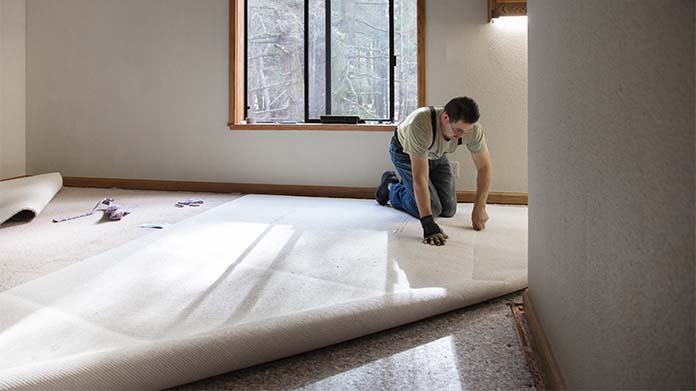
Installing carpet can be a difficult and time-consuming project to do yourself, which is why many turn to a professional when they reach this stage of home renovation. It’s much easier to hire someone to haul heavy carpet, stretch it, cut and nail it down than to wrestle with the materials and second guess the process yourself. It’s not a job everyone wants to do (or is capable of), making it a great choice for a small business.
Our guide is in 3 parts:
First and foremost, you will need to make an investment in equipment. You will need tackless strips, hammers, work gloves, knee pads, power stretchers, seam tape, strip cutters, and a steam roller. You won’t need all of these immediately. Some of these are simply to make the job easier and can be acquired over time.
There are several ongoing expenses to consider. You will need a dependable truck to haul the carpet and yourself to the job site. It will require insurance. Commercial truck insurance is going to cost approximately $1,500 per year. Maintenance such as oil changes, tires, and brakes should also be considered.
You will also need supplies. Professionals in the field estimate their cost to be between 45 and 55 cents per yard. You will also need liability insurance which will amount to approximately 5% of your payroll if you have employees.
Your business can serve both residential and commercial clients. You will also find it helpful to develop a professional relationship among carpet sellers and commercial construction companies. Many homeowners expect to arrange installation service when they buy their carpet. You want to be the one they recommend and call when they need expert carpet installation.
A carpet installation business can have many sources of revenue. You will be able to charge for other services in addition to carpet installation. Your customers will have other needs ranging from carpet removal, replacement, and carpet pad installation.
The cost to install a carpet ranges from $756 and $2,569, averaging $1,652. Most homeowners pay $3.50 to $11 per square foot or $32 to $100 per square yard. Carpet materials average $2 to $7 per square foot with a broad range of $1 to $20 per square foot. Labor adds $0.50 to $1 per square foot.
The average carpet installer salary is $46,318. You will see vastly more profit with effective marketing, strategy, competent employees, and positive advertising via word of mouth.
You should also consider one of the many franchise options available. New small business owners sometimes lack the expertise and resources to thrive in a competitive business environment. Franchised startups have an edge over other startups because they launch with many resources already in place.
Depending on the number of carpets you are installing and your business’s size, you may find yourself going to job sites and installing the carpets yourself. If you have a small team, your time will most likely be spent scheduling and interviewing potential clients and examining job sites to give estimates. If you scale out your business to a greater degree, you will find yourself more involved in your business’s bookkeeping side and managing teams of people at multiple locations.
Carpet installation can be a talent, but to use it in a business, your skills can be no less than excellent. You should have above average handyman skills and customer service experience.
Growing a carpet installation business will depend on your marketing, people skills, and quality of service. Everything starts small. Start by marketing your service to individual houses. You will need to make contacts that will give referrals if any of their friends, family, or neighbors need your service.
If you are interested in starting a carpet installation business, it’s a good idea to talk to someone who is already in the business. A fellow entrepreneur who has started a carpet installation business in another town would be a good place to start and can be a great resource to you. Many experienced entrepreneurs enjoy offering advice to eager startups.
Since carpet is heavy and cumbersome, you will need to hire at least two or three people to get the job done well and in a reasonable amount of time. Seek out applicants with a strong work ethic, which you can determine through their work history and references. They should take direction well and work quickly and accurately.
Business Evaluation & Strategy Tool
We'll walk you through the four pillars every business needs: Points of Leverage, Marketing Strategy, Financial Model, and Personal Compatibility. At the end you'll see a personalized report and your action plan below will be tailored to your answers.
Every viable business has natural advantages. Below are common leverage points across four categories. Pick the ones that apply to your Carpet Installation business. We've pre-suggested a few based on your idea — review and adjust.
Without a way to connect with customers, even great businesses fail. Pick the channels you plan to use to reach your customers.
Enter your monthly baseline costs — the minimum overhead to keep the business running. Then we'll calculate how many sales per month you need to break even.
A business that doesn't fit your life will fail no matter how good the numbers look. Tell us how this business fits you.
Complete the four pillars and your personalized summary will appear here.
Nine concrete steps to take you from idea to open business, grouped into 30-day phases. Complete the planner above and we'll highlight what's most important for your situation.
An LLC keeps your personal assets separate from business debts and lawsuits — the most common reason small business owners choose this structure. Sole proprietorships and partnerships do not provide this protection.
Apply for your free Employer Identification Number through the IRS, then register for any state or local taxes that apply to your business (sales tax, franchise tax).
A dedicated business account is required to maintain personal asset protection. Mixing personal and business finances ('piercing the corporate veil') can void your LLC's liability shield.
Recording expenses and income from day one makes tax filing easier and lets you see when the business is actually profitable. Use software (QuickBooks, Wave) or a part-time bookkeeper.
State and local requirements vary widely. Brick-and-mortar businesses typically need a Certificate of Occupancy; service businesses may need specific professional licensing; food businesses need health permits.
General Liability Insurance is the most common starting point. If you'll have employees, most states require Workers' Compensation. Specific industries need additional coverage (product liability, professional liability, etc.).
Your brand is how customers perceive and remember you. A clear name, logo, and visual identity make every later marketing decision easier and protect you legally as you grow.
Every legitimate business needs a website. Social media pages are not a substitute — you don't own the platform. Modern website builders mean you can launch a clean site in a weekend without a developer.
A dedicated business number keeps your personal life private, makes the business look legitimate, and lets you route calls professionally. Cloud phone services start under $20/month.
Starting a Carpet Installation business typically costs $50,000 to $500,000. It is considered a very high capital-intensity business.
A Carpet Installation business runs roughly a 14% net profit margin, and most owners reach break-even in about 4 to 12 months.
You can usually launch a Carpet Installation business in about 12 to 36 weeks, and it is commonly run full time.
A Carpet Installation business is generally an intermediate-skill business to start, with stable demand. TRUiC rates it 39 out of 100 on our Idea Score.
Most Carpet Installation businesses register as an LLC or other legal entity and obtain a general business license. Depending on your state and city you may also need industry-specific permits, sales tax registration, and zoning or health approvals, so check your local requirements before you launch.