Startup cost
$25k–$250k
TRUiC Business Ideas
Decision Snapshot
Idea Score
45
Startup cost
$25k–$250k
Profit margin
10%
Break-even
4 mo–12 mo
Time to launch
12 wk–36 wk
Demand trend
Stable
5-yr failure rate
—
Capital intensity
Very high
Time commitment
Full time
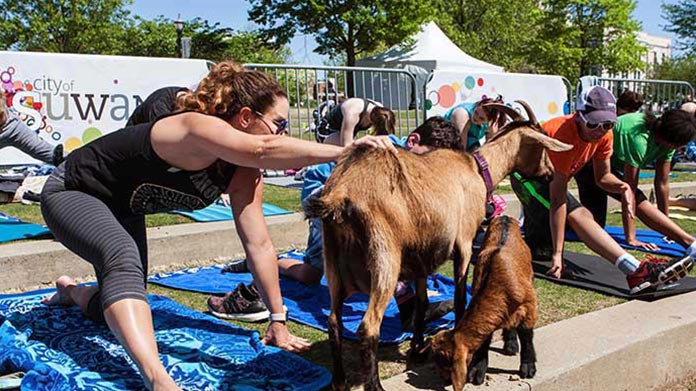
Goat yoga is a way to combine fun and fitness into one activity. The yoga routines are standard, but during a session, goats may climb on people, frolic with one another, or just snuggle with clients on their mats. The idea is that goats add an element of excitement to yoga, which can encourage people to choose goat yoga studios over more traditional yoga studios.
Our guide is in 3 parts:
Owners will need to take into account the expense of the space they use (both during class and after hours). You’ll also need to register the business, obtain necessary permits, and purchase commercial insurance with plenty of liability coverage. (Goats are notoriously gentle creatures, but they’re still animals who may become scared or anxious during classes.) You’ll also need to account for staff salaries, equipment, and the cost of marketing.
You’ll need to factor in the cost of caring for the goats, rent/utilities, insurance, and staff salaries. In addition, you’ll need to periodically replace or upgrade equipment.
The target market can be anyone who wants to be healthier, though it will be easier to market to clients who are already committed to traditional yoga. However, this ancient practice is excellent for focusing the mind and strengthening the body. You can appeal to potential customers on a number of different levels, including people who want to decrease their stress levels or improve their focus.
Goat yoga businesses charge customers either per class or for package deals. The cost should take into account daily expenses plus around 10% (or more) as a profit margin.
Clients are willing to pay about $12 extra per class for the addition of goats to their yoga experience. You may be able to charge between $25 to $40, depending on the going rates in your area.
Yoga facilities have an average profit margin of about 13%. So if you’re spending $50,000 a year on expenses, your profit would be about $6,500. A goat yoga business may have a slightly higher profit margin, especially if they already have the goats on the premises.
Consider offering a full experience to your goat yoga business. For example, some people will offer their farm space as a hotel, so people can get the full experience of living off the land. This is a great option for business owners, especially considering how nice it is to get a break from the everyday distractions of life.
A day in a goat yoga studio will be similar to that in a regular yoga studio. You’ll need to manage clients, take payments, and keep a schedule. However, you’ll also need to supervise the goats to ensure they’re not endangering or annoying customers.
Owners should be familiar with common yoga poses and routines, even if they don’t plan to teach classes. The ideal owner should also have extensive experience working with goats, so they can better predict their behaviors and temperaments.
Yoga is exceptionally popular, with the category growing about 5% in revenue every year. Those who can market this idea correctly may find their classes quickly selling out. Exercising can be difficult to both start and maintain. This is a creative way to get more people involved.
Goat yoga is not a trademarked business. Much like hot yoga, it’s a generic concept that owners can play with until they find the right balance. It’s much easier to start a goat yoga business if you have an old barn that could be converted into a studio, but you can also consider ‘renting’ goats from local owners who would be willing to spare them for several hours. Goats are fairly easy to care for, but they do need some degree of space and attention to thrive.
Before marketing your business, you should run several practices with a full class to experiment with the size of the space, number of goats, and the ideal routine to implement. This will give you time to work out the details before getting started. Start as a side business before scaling it to meet the needs of the community. Finally, make sure you have an iron-clad liability waiver for clients in case of accidents. This waiver won’t absolve you of all responsibility, but it can ward off unnecessary liability claims against you.
Your instructors will have a lot to do with the success of your studio. They should be fun, flexible, and experienced. Your team needs a relaxed manner if they’re going to shepherd the goats in and out of the facility. If you’re holding a few trial sessions, you can hold off on hiring instructors and conduct sessions yourself. However, you should strongly consider hiring instructors as soon as possible if the community response is large enough.
Business Evaluation & Strategy Tool
We'll walk you through the four pillars every business needs: Points of Leverage, Marketing Strategy, Financial Model, and Personal Compatibility. At the end you'll see a personalized report and your action plan below will be tailored to your answers.
Every viable business has natural advantages. Below are common leverage points across four categories. Pick the ones that apply to your Goat Yoga business. We've pre-suggested a few based on your idea — review and adjust.
Without a way to connect with customers, even great businesses fail. Pick the channels you plan to use to reach your customers.
Enter your monthly baseline costs — the minimum overhead to keep the business running. Then we'll calculate how many sales per month you need to break even.
A business that doesn't fit your life will fail no matter how good the numbers look. Tell us how this business fits you.
Complete the four pillars and your personalized summary will appear here.
Nine concrete steps to take you from idea to open business, grouped into 30-day phases. Complete the planner above and we'll highlight what's most important for your situation.
An LLC keeps your personal assets separate from business debts and lawsuits — the most common reason small business owners choose this structure. Sole proprietorships and partnerships do not provide this protection.
Apply for your free Employer Identification Number through the IRS, then register for any state or local taxes that apply to your business (sales tax, franchise tax).
A dedicated business account is required to maintain personal asset protection. Mixing personal and business finances ('piercing the corporate veil') can void your LLC's liability shield.
Recording expenses and income from day one makes tax filing easier and lets you see when the business is actually profitable. Use software (QuickBooks, Wave) or a part-time bookkeeper.
State and local requirements vary widely. Brick-and-mortar businesses typically need a Certificate of Occupancy; service businesses may need specific professional licensing; food businesses need health permits.
General Liability Insurance is the most common starting point. If you'll have employees, most states require Workers' Compensation. Specific industries need additional coverage (product liability, professional liability, etc.).
Your brand is how customers perceive and remember you. A clear name, logo, and visual identity make every later marketing decision easier and protect you legally as you grow.
Every legitimate business needs a website. Social media pages are not a substitute — you don't own the platform. Modern website builders mean you can launch a clean site in a weekend without a developer.
A dedicated business number keeps your personal life private, makes the business look legitimate, and lets you route calls professionally. Cloud phone services start under $20/month.
Starting a Goat Yoga business typically costs $25,000 to $250,000. It is considered a very high capital-intensity business.
A Goat Yoga business runs roughly a 10% net profit margin, and most owners reach break-even in about 4 to 12 months.
You can usually launch a Goat Yoga business in about 12 to 36 weeks, and it is commonly run full time.
A Goat Yoga business is generally an intermediate-skill business to start, with stable demand. TRUiC rates it 45 out of 100 on our Idea Score.
Most Goat Yoga businesses register as an LLC or other legal entity and obtain a general business license. Depending on your state and city you may also need industry-specific permits, sales tax registration, and zoning or health approvals, so check your local requirements before you launch.