Startup cost
$50k–$500k
TRUiC Business Ideas
Decision Snapshot
Idea Score
45
Startup cost
$50k–$500k
Profit margin
21%
Break-even
4 mo–12 mo
Time to launch
12 wk–36 wk
Demand trend
Stable
5-yr failure rate
—
Capital intensity
Very high
Time commitment
Full time
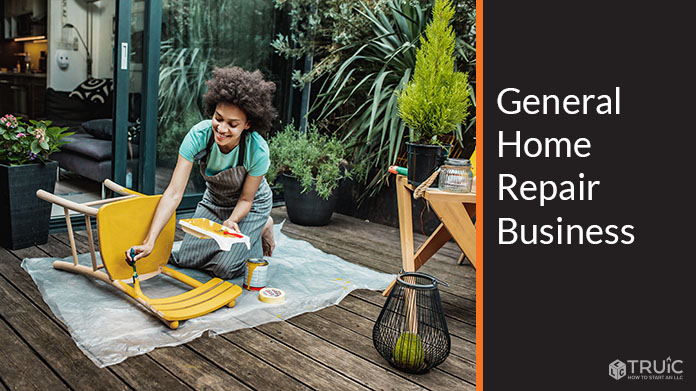
A general home repair business focuses on small to medium-sized home repair needs. From appliances and plumbing, to electrical, windows, and doors, a home repair handyman has to be able to wear many different hats.
Our guide is in 3 parts:
A general home repair company can start with and retain a low overhead operating cost. You’ll first need to get your contractor’s license, form an LLC, secure business insurance, and check to make sure you don’t need any other paperwork from your state or county to get started.
Next, you’ll want to spend money on marketing and advertising, build a website, and invest in quality tools. Consider wrapping your vehicle with your company logo or name as well as your contact information. Choose to invest in quality work tools, as well, so you have less problems while on the job. Use your website as a point of contact for customers and as a tool for showing off previous work you’ve completed.
Most expenses will pertain to materials, equipment costs, internet, cell phone, website services, fuel and vehicle maintenance, and annual insurance and licensing costs.
Local and regional homeowners of all ages.
General home repair businesses make money by completing customer jobs around the house.
Charging for work will depend on the type of work being performed. Your hourly rate for labor should be relative to other contractors in your area. $25-30 per hour may be a good starting rate, but look up what other local home repair services charge to set competitive rates.
Home repairs businesses can be lucrative, especially if you’re able to work in an area with more homeowners than renters. Work to retain low overhead costs, and your business could earn between $40,000 and $70,000, annually.
Offer deck and gazebo construction, as a service, if you have the experience and knowledge. Smaller construction projects can still keep your overhead low and will offer a different possibility for revenue.
A general repair business focuses on servicing customers and generating new leads for future jobs. Calling and communicating with customers will constitute some of your most important daily actions, as you need to keep current customers up to speed and inform future customers when you’ll be starting work.
You’ll also be visiting customer houses to assess what work needs to be done and to build quotes for the jobs. Additionally, expect to make frequent trips to various hardware stores and lumber yards. Customers will be looking for repairs to electrical systems and appliances throughout the house, including installing or repairing lights, fans, refrigerators, stoves, and garbage disposals. You may be called on to build or install cabinets, shelves, or closet organizers. Additionally, you may be asked to replace wall paneling of sheetrock. You may also be replacing sinks, replacing faucets, performing tile work, repiping plumbing, and replacing toilets.
As a home repair professional, you’ll need to have knowledge and experience in a wide variety of construction and machinery work. You’ll need a general knowledge of plumbing and electrical systems as well.
General home repair businesses can do well. Since many of the jobs you are completing are of a smaller scale, your materials costs will be minimal. Each job pays for the materials, in essence. You will also be able to operate successfully as an individual for most of your jobs, which avoids salary costs. Additionally, many homeowners aren’t equipped to do repairs themselves, making your services invaluable. All of these factors lead to a healthy job market for home repairs.
Advertise in hardware stores and lumber yards you use. Spread the word by talking with professionals and store associates you often see — they can recommend you to potential customers. Contractor service desks often let you post flyers for your business too.
Advertise in local homeowner magazines and newspapers. Your initial ad blitz needs to help your business name become recognizable.
As a home repair handyman, you’re often able to work independently for most jobs. You may want to have an assistant on call for jobs which need an extra set of hands. If you find you have consistent work, you may need an assistant to come on full time.
Business Evaluation & Strategy Tool
We'll walk you through the four pillars every business needs: Points of Leverage, Marketing Strategy, Financial Model, and Personal Compatibility. At the end you'll see a personalized report and your action plan below will be tailored to your answers.
Every viable business has natural advantages. Below are common leverage points across four categories. Pick the ones that apply to your General Home Repair business. We've pre-suggested a few based on your idea — review and adjust.
Without a way to connect with customers, even great businesses fail. Pick the channels you plan to use to reach your customers.
Enter your monthly baseline costs — the minimum overhead to keep the business running. Then we'll calculate how many sales per month you need to break even.
A business that doesn't fit your life will fail no matter how good the numbers look. Tell us how this business fits you.
Complete the four pillars and your personalized summary will appear here.
Nine concrete steps to take you from idea to open business, grouped into 30-day phases. Complete the planner above and we'll highlight what's most important for your situation.
An LLC keeps your personal assets separate from business debts and lawsuits — the most common reason small business owners choose this structure. Sole proprietorships and partnerships do not provide this protection.
Apply for your free Employer Identification Number through the IRS, then register for any state or local taxes that apply to your business (sales tax, franchise tax).
A dedicated business account is required to maintain personal asset protection. Mixing personal and business finances ('piercing the corporate veil') can void your LLC's liability shield.
Recording expenses and income from day one makes tax filing easier and lets you see when the business is actually profitable. Use software (QuickBooks, Wave) or a part-time bookkeeper.
State and local requirements vary widely. Brick-and-mortar businesses typically need a Certificate of Occupancy; service businesses may need specific professional licensing; food businesses need health permits.
General Liability Insurance is the most common starting point. If you'll have employees, most states require Workers' Compensation. Specific industries need additional coverage (product liability, professional liability, etc.).
Your brand is how customers perceive and remember you. A clear name, logo, and visual identity make every later marketing decision easier and protect you legally as you grow.
Every legitimate business needs a website. Social media pages are not a substitute — you don't own the platform. Modern website builders mean you can launch a clean site in a weekend without a developer.
A dedicated business number keeps your personal life private, makes the business look legitimate, and lets you route calls professionally. Cloud phone services start under $20/month.
Starting a General Home Repair business typically costs $50,000 to $500,000. It is considered a very high capital-intensity business.
A General Home Repair business runs roughly a 21% net profit margin, and most owners reach break-even in about 4 to 12 months.
You can usually launch a General Home Repair business in about 12 to 36 weeks, and it is commonly run full time.
A General Home Repair business is generally an intermediate-skill business to start, with stable demand. TRUiC rates it 45 out of 100 on our Idea Score.
Most General Home Repair businesses register as an LLC or other legal entity and obtain a general business license. Depending on your state and city you may also need industry-specific permits, sales tax registration, and zoning or health approvals, so check your local requirements before you launch.