Startup cost
$100k–$500k
TRUiC Business Ideas
Decision Snapshot
Idea Score
43
Startup cost
$100k–$500k
Profit margin
14%
Break-even
4 mo–12 mo
Time to launch
2 wk–12 wk
Demand trend
Stable
5-yr failure rate
—
Capital intensity
Very high
Time commitment
Flexible
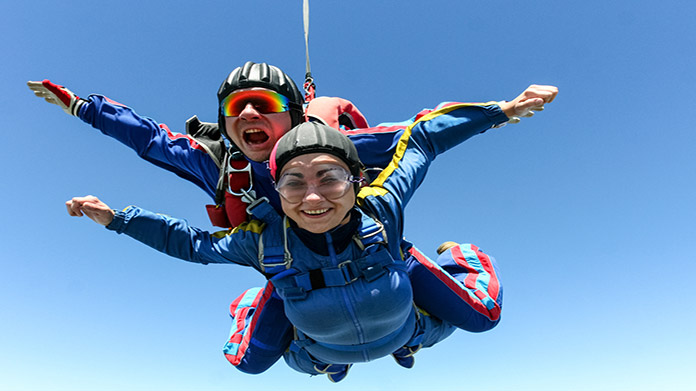
Customers of skydiving businesses receive access to the complete experience, either in tandem with an experienced jumper or solo. The entertainment package includes the airplane ride, all equipment, landing site—also known as the dropzone or DZ—and the leadership/coaching of a jumpmaster. Other products or services might also be offered through the business, from parachute training before the jump to photography or video production of the jump.
Skydiving businesses are also sometimes known as dropzone businesses or simply DZs.
Our guide is in 3 parts:
Skydiving business owners have reported starting up operation for as little as $10,000, but that’s usually when they already have their own airplanes and pilot’s license and can recruit volunteer jumpmasters. That’s a pretty barebones operation. More typical startup costs are much higher, and can include these elements.
Licenses, certification and legal costs — $5,000
Airplane and liability insurance — $6,000
Multiple rigs and gear — $40,000
Pilot, fuel, maintenance and plane rental or purchase – $50,000 to $100,000-plus to purchase small Cessna
Sales and marketing — $1,000
With startup costs as high as they are, it may be best to look into investing options. Considering the dangerous nature of this activity, though, confident investors may be hard, but not impossible, to find.
Your largest ongoing expense is likely to be plane fuel and other expenses related to your air costs. One business owner spoke of spending $200,000 a year on fuel, but your costs will be highly variable depending on your annual number of days of operation and flights per day as well as prevailing fuel costs, which can rise and drop unexpectedly.
As your business grows, you’ll also encounter the cost of hiring employees for such duties as packing parachutes, conducting training classes and generating sales. These positions might also be filled by experienced skydivers who’ll work for free jumps.
Your customers are adventurers—or at least want to be seen that way. They can be of any age or gender, but younger (20-45) males are the most common demographic for this type of business.
The main source of revenue is the initial instruction and jump fee, which can start at $250-$350 range or more for tandem jumps with an experienced skydiver. Add-on products and services can generate additional revenue, from DVDs of the jump to commemorative t-shirts and advanced jump training for certification.
The sport is recognized as being expensive, and for many of your customers it’s a lifetime dream, so rates can be placed high (and must be since your costs are significant). You can see from pricing information at Chattanooga Skydiving Company and Skydive Tecumseh that student tandem jumpers can pay several hundred dollars for initial training and the first jump.
Additional fees are often charged for videotaping the jump, a cost that can add at least a few hundred dollars more to the transaction.
Profitability is highly variable depending on your location and business model, but here’s an interesting web article on how one very small skydiving company stayed in the black.
In addition to the add-on charges, consider making the most of your customers’ after-jump celebrations such as by opening a drinking establishment or snack bar on your premises.
Some skydiving businesses hire out their planes and skydivers for promotional purposes, such as for festivals, groundbreaking ceremonies, new business openings and television commercials.
While your friends and family might think of ownership of a skydiving company as being exciting work, it’s really a serious business. Here’s how your typical day might be consumed.
Hiring pilots or communicating with the day’s pilot as to availability of a fueled and ready plane
Conceiving new discounts and package deals to spur sales, and promoting those deals via the company website and social media
Paying bills for airplane rental and fuel, airport landing fees, payroll, etc.
Supervising parachute packing and meeting with the day’s customers to provide support and reassurance (especially to first-time jumpers)
Serving as jumpmaster for the day’s jump if that responsibility won’t go to an employee
In addition to having hundreds of hours of skydiving experience under your belt, you should have the patience, diplomacy and perseverance it will take to find investors and convince airport officials and community leaders of the safety and value of your operation. Many see skydiving as an extreme sport and will express concerns about legal liability in the event of accidents.
Registering and certifying your business can be complicated, so you should be detail-oriented. You can go here for regulatory and legal answers.
And finally, you and your people must be able to inspire the confidence and trust of your customers, many of whom will be skydiving for the first time and perhaps second-guessing their decision while in the air.
Word of mouth and repeat customers are key to your business’s success. Student jumpers will bring their friends if their first jumps are positive experiences. If you can keep more experienced jumpers loyal to your business, they’ll jump with you as often as their budgets allow.
Remember that your add-on products and services can sometimes be more profitable than the basic fee you’ll charge for a tandem or solo jump. For instance, while it costs relatively little to provide a DVD of the experience (a second jumper with a GoPro camera strapped to a helmet and basic editing software and skills) your customers might eagerly pay $180 or more for documentation of what’s perhaps a top bucket-list activity.
At the very least, your business will need two people—the pilot and jumpmaster. You can only serve in one of those capacities, so you’ll have to hire the services of the other even if you keep your operation small. As your business grows, you might want to add staff to conduct skydiving instruction classes, pack parachutes and undertake sales and customer service functions as revenue allows.
Business Evaluation & Strategy Tool
We'll walk you through the four pillars every business needs: Points of Leverage, Marketing Strategy, Financial Model, and Personal Compatibility. At the end you'll see a personalized report and your action plan below will be tailored to your answers.
Every viable business has natural advantages. Below are common leverage points across four categories. Pick the ones that apply to your Skydiving business. We've pre-suggested a few based on your idea — review and adjust.
Without a way to connect with customers, even great businesses fail. Pick the channels you plan to use to reach your customers.
Enter your monthly baseline costs — the minimum overhead to keep the business running. Then we'll calculate how many sales per month you need to break even.
A business that doesn't fit your life will fail no matter how good the numbers look. Tell us how this business fits you.
Complete the four pillars and your personalized summary will appear here.
Nine concrete steps to take you from idea to open business, grouped into 30-day phases. Complete the planner above and we'll highlight what's most important for your situation.
An LLC keeps your personal assets separate from business debts and lawsuits — the most common reason small business owners choose this structure. Sole proprietorships and partnerships do not provide this protection.
Apply for your free Employer Identification Number through the IRS, then register for any state or local taxes that apply to your business (sales tax, franchise tax).
A dedicated business account is required to maintain personal asset protection. Mixing personal and business finances ('piercing the corporate veil') can void your LLC's liability shield.
Recording expenses and income from day one makes tax filing easier and lets you see when the business is actually profitable. Use software (QuickBooks, Wave) or a part-time bookkeeper.
State and local requirements vary widely. Brick-and-mortar businesses typically need a Certificate of Occupancy; service businesses may need specific professional licensing; food businesses need health permits.
General Liability Insurance is the most common starting point. If you'll have employees, most states require Workers' Compensation. Specific industries need additional coverage (product liability, professional liability, etc.).
Your brand is how customers perceive and remember you. A clear name, logo, and visual identity make every later marketing decision easier and protect you legally as you grow.
Every legitimate business needs a website. Social media pages are not a substitute — you don't own the platform. Modern website builders mean you can launch a clean site in a weekend without a developer.
A dedicated business number keeps your personal life private, makes the business look legitimate, and lets you route calls professionally. Cloud phone services start under $20/month.
Starting a Skydiving business typically costs $100,000 to $500,000. It is considered a very high capital-intensity business.
A Skydiving business runs roughly a 14% net profit margin, and most owners reach break-even in about 4 to 12 months.
You can usually launch a Skydiving business in about 2 to 12 weeks, and it is commonly run flexible.
A Skydiving business is generally an intermediate-skill business to start, with stable demand. TRUiC rates it 43 out of 100 on our Idea Score.
Most Skydiving businesses register as an LLC or other legal entity and obtain a general business license. Depending on your state and city you may also need industry-specific permits, sales tax registration, and zoning or health approvals, so check your local requirements before you launch.