Startup cost
$3k–$50k
TRUiC Business Ideas
Decision Snapshot
Idea Score
61
Startup cost
$3k–$50k
Profit margin
14%
Break-even
4 mo–12 mo
Time to launch
2 wk–12 wk
Demand trend
Stable
5-yr failure rate
—
Capital intensity
High
Time commitment
Flexible
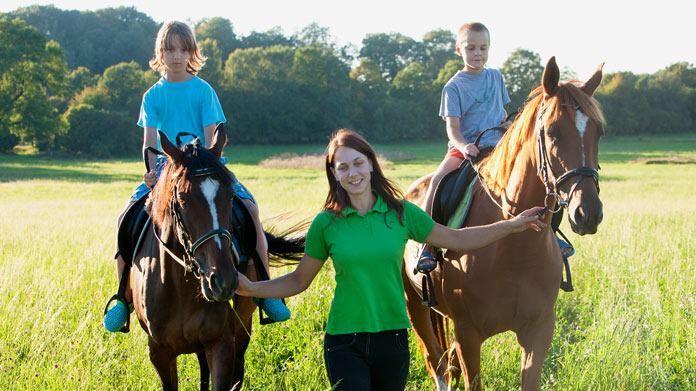
A horseback riding business offers lessons to people of all skills, from someone who has never been near a horse before to the experienced rider who wants to improve on a skill or learn a new skill, such as a different style of riding.
Our guide is in 3 parts:
Opening a horseback riding business is a costly venture. You’ll have to buy land if you don’t have it, and you’ll have to build stables if you don’t have them. You could expect to spend $3,000 and up per acre for good flat land, and about $100 square foot for stables and indoor arenas, depending on your location. Additional costs include:
Any licenses and permits, including a certificate of occupancy and a sales tax certificate. These fees vary from county to county and state to state.
Liability insurance.
Horses that are fit for giving lessons. Prices for horses range from under $1,000 to well over $10,000, depending on bloodlines and previous training.
Horses that are fit for trail riding;
Fencing required to build rings and paddocks. Depending on the type of fencing you build, this could run anywhere from $20 a linear foot to over $40 a linear foot.
Tack for each horse. Tack varies on brand and quality. In this case, you do get what you pay for.
Inventory if you are selling tack and accessories.
Horse feed.
Watering troughs.
A truck and trailer. You’ll need a minimum of a 2500 HD full size pickup, but should preferably have a 3500 HD pickup. You could expect to spend upwards of $50,000 or more for a good truck.
Tractor (optional – this comes in handy while mucking stalls). You might find a good used tractor with low hours for about $15,000 to $20,000.
Barns.
Indoor and/or arena(s).
Utilities for the barns and arenas.
Payroll for help if you are not running the operation by yourself.
The ongoing expenses are high for a horseback riding business and include:
Utilities
Mortgage payments on land and barns
Maintenance
Inventory
Liability insurance
Payroll
Additional horses
Tack for your horses – you’ll need different sized saddles for kids and adults
Vet care
Feed
Customers my range from the very young to elderly. Experience may vary from none to years of riding experience. Your customers may be well off and prefer to pay for all of the services you offer for boarding and more, or you may have customers that prefer mucking their own stalls, using their own vets, and feeding their own food, whether for financial reasons or because they are used to caring for their own horses.
A horseback riding business makes money in several ways; though the largest stream of income comes from giving lessons and boarding horses. Other streams of income include doing special parties, trail riding, selling tack and feed, and training.
The national average for horseback riding lessons ranges between $45 to $60 an hour, depending on your location, the student’s skill, and what you need to charge to cover your overhead.
Profit is dependent on you. You need to figure the costs of running the business for a year and then divide that by 12. Subtract boarding fees that you receive. That will tell you how much you need to make with lessons, training, and retail to make the profit you envision. If your overhead is $36,000 per year, or $3,000 per month, you will need to sell 60 lessons at $50 to break even.
Make your business more profitable by keeping expenses low, adding more stables for boarding, marketing your operation to sell more lessons, and building up your retail store, if you choose to have one.
Most days will be spent doing several activities. Some of these, you may do less frequently and will depend on the type of business you will be running in conjunction with a horseback riding business.
Mucking stalls
Feeding and watering horses
Turning out horses
Giving riding lessons
Going on trail rides
Cleaning the barn
Caring for the turf in areas
Ordering inventory
Customer service
Planning birthday parties if you offer birthday party rides
Training horses
Breaking green horses and/or training problem horses
Keeping fields and courses mowed and maintained
Ensuring watering troughs don’t freeze
Cleaning feed buckets and watering troughs
Slinging hay
Preparing for horse shows
Maintaining any special equipment you might use for therapy riding
Maintaining tack
Trailering horses to and from your facility, whether for shows or to help customers get their horses to your facility
Vehicle maintenance, including trucks, tractors, trailers and landscaping equipment.
You may be really good at riding and training horses, but you also need to be able to teach others how to ride or how to get ready for a show. You’ll also need horse training skills; basic medical skills to help horses in an emergency; retail, marketing, and customer service skills; and business management skills.
The growth potential is unlimited if you have the space to expand and if you are boarding, training, and giving lessons. If your facility gives only lessons, the growth potential is high. Lessons are usually an hour long and many stables offer lessons for a person once or twice a week. Adding other businesses on the side, such as boarding, selling tack, and training horses significantly increases your growth potential.
Insider tips include knowing your horses and planning ahead to make it easier to expand. Instead of starting with a barn with a few stalls, if you plan on expanding, build the barn with 30 stalls right away. You’ll end up saving money in the long run.
Knowing your horses is an important part of starting a horseback riding business. Some horses are great for trail riding but not so great for giving lessons to people who have little to no experience.
Also, be sure to have all of the equipment needed to clean stalls and care for the horses. Have a vet that will come to your facility lined up for emergencies. You may not be able to get a sick horse into a trailer. For boarders, be sure to have a contract that has been reviewed by an attorney ready to sign before you allow a horse to stay one night in your stables.
If you find yourself running out of space, you may want to add more barns and more services. If you are considering adding more barns, you should have the income to hire paid help. Be sure to thoroughly vet each person you consider hiring. Remember, not only are thousands of dollars at stake with liability and the value of the horses and equipment, but a horse’s life could be at stake if you hire someone who doesn’t have experience.
Business Evaluation & Strategy Tool
We'll walk you through the four pillars every business needs: Points of Leverage, Marketing Strategy, Financial Model, and Personal Compatibility. At the end you'll see a personalized report and your action plan below will be tailored to your answers.
Every viable business has natural advantages. Below are common leverage points across four categories. Pick the ones that apply to your Horseback Riding Lessons business. We've pre-suggested a few based on your idea — review and adjust.
Without a way to connect with customers, even great businesses fail. Pick the channels you plan to use to reach your customers.
Enter your monthly baseline costs — the minimum overhead to keep the business running. Then we'll calculate how many sales per month you need to break even.
A business that doesn't fit your life will fail no matter how good the numbers look. Tell us how this business fits you.
Complete the four pillars and your personalized summary will appear here.
Nine concrete steps to take you from idea to open business, grouped into 30-day phases. Complete the planner above and we'll highlight what's most important for your situation.
An LLC keeps your personal assets separate from business debts and lawsuits — the most common reason small business owners choose this structure. Sole proprietorships and partnerships do not provide this protection.
Apply for your free Employer Identification Number through the IRS, then register for any state or local taxes that apply to your business (sales tax, franchise tax).
A dedicated business account is required to maintain personal asset protection. Mixing personal and business finances ('piercing the corporate veil') can void your LLC's liability shield.
Recording expenses and income from day one makes tax filing easier and lets you see when the business is actually profitable. Use software (QuickBooks, Wave) or a part-time bookkeeper.
State and local requirements vary widely. Brick-and-mortar businesses typically need a Certificate of Occupancy; service businesses may need specific professional licensing; food businesses need health permits.
General Liability Insurance is the most common starting point. If you'll have employees, most states require Workers' Compensation. Specific industries need additional coverage (product liability, professional liability, etc.).
Your brand is how customers perceive and remember you. A clear name, logo, and visual identity make every later marketing decision easier and protect you legally as you grow.
Every legitimate business needs a website. Social media pages are not a substitute — you don't own the platform. Modern website builders mean you can launch a clean site in a weekend without a developer.
A dedicated business number keeps your personal life private, makes the business look legitimate, and lets you route calls professionally. Cloud phone services start under $20/month.
Starting a Horseback Riding Lessons business typically costs $3,000 to $50,000. It is considered a high capital-intensity business.
A Horseback Riding Lessons business runs roughly a 14% net profit margin, and most owners reach break-even in about 4 to 12 months.
You can usually launch a Horseback Riding Lessons business in about 2 to 12 weeks, and it is commonly run flexible.
A Horseback Riding Lessons business is generally an intermediate-skill business to start, with stable demand. TRUiC rates it 61 out of 100 on our Idea Score.
Most Horseback Riding Lessons businesses register as an LLC or other legal entity and obtain a general business license. Depending on your state and city you may also need industry-specific permits, sales tax registration, and zoning or health approvals, so check your local requirements before you launch.