Startup cost
$5k–$15k
TRUiC Business Ideas
Decision Snapshot
Idea Score
58
Startup cost
$5k–$15k
Profit margin
14%
Break-even
4 mo–12 mo
Time to launch
12 wk–36 wk
Demand trend
Stable
5-yr failure rate
—
Capital intensity
Medium
Time commitment
Flexible
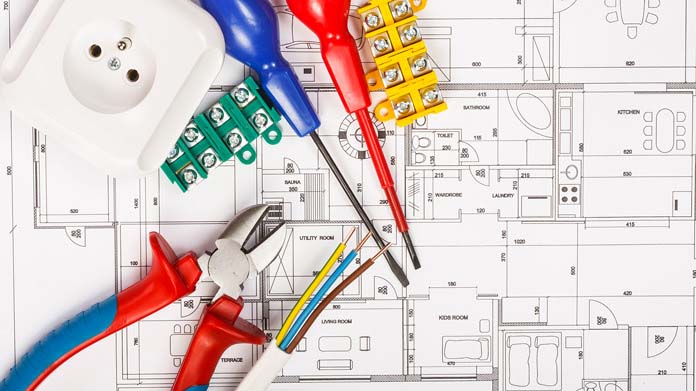
Electrician businesses focus primarily on servicing electrical systems in homes and businesses. Because it is a trade business, it is highly specialized. Furthermore, local and state governments typically restrict non-tradesmen from working on electrical systems. Due to these factors, skilled electricians are typically in high demand.
Our guide is in 3 parts:
The costs for starting an electrician business vary, but generally include licensing, insurance, fees for union dues, overhead and equipment costs, and rent for office space. In general, many startup companies spend at least $5,000 to get started. These costs do not include schooling or apprenticeship, which can range anywhere from $3,000 to upwards of $20,000, depending on whether you choose to attend a community college, a technical school, or a private university.
Ongoing expenses of running an electrician business are minimal. Most businesses must cover the cost of rent, licensing, and insurance. License renewal can cost up to $200 – $300 per year, depending on your state. You should budget $1,500 – $2,000 for annual insurance premiums. Rent costs will vary dramatically depending on your location. Price per square foot of office space can range anywhere from $1.50 – $6.00 or more. The best way to cut down costs would be to work from home or share office space with other small business owners.
Electricians make money by charging customers for their services. They may charge on an hourly basis, or they may request a flat fee for services.
Preferred client types for this business are commercial accounts. However, residential customers can also be an ongoing source of income, provided that the business can service a rotating base of clients. This could involve contracting with a Homeowners Association, or some other organized community, to service residential customers.
Electricians may charge a wide range of fees, depending on their level of skill, the average local rates, and the type of work involved. However, most will charge between $40 and $100 per hour, with master electricians charging $100 to $150 per hour or more.
Profit for an established electrician business ranges from between 1.5% to 2.0%, depending on the size of the company. Larger companies have lower margins, while smaller companies tend to have higher margins.
Expanding your team with some entry-level electrician helpers to take care of simpler jobs can help you increase your overall efficiency and take on more jobs. Adding additional, ancillary services, might also help. For example, consider partnering with a professional plumber and carpenter to take on larger jobs.
Day-to-day activities of an electrician include repairing or replacing electrical systems, including main systems, fuse and breaker box panels, running electrical wiring, repairing and maintaining electrical wiring, transformers, and related systems. Electricians also spend a fair amount of their time on a job troubleshooting electrical problems.
Because wiring in a home or business is often hidden behind walls, electricians need to know how to diagnose what might be wrong with a system before fixing it. They may not have the luxury of taking down all the walls in a building to solve the problem, either.
Becoming an electrician is the first step in starting an electrician business. There are two paths to do this: apprenticeship and college.
An apprenticeship is a long-term training program, typically run by a professional organization or a business. There are three types:
Unionized apprenticeships, which are usually run by a group called the International Brotherhood of Electrical Workers (IBEW).
Non-unionized apprenticeships, such as the Associated Builders and Contractors (ABC) and Independent Electrical Contractors (IEC).
Local apprenticeships, which are offered by the federal government.
During your apprenticeship, you will learn everything you need to know to become a professional electrician. This includes knowledge of electrician-specific tools, techniques, and methods. A further advantage of an apprenticeship is that it gives you the benefit of on-the-job training (OJT). You also get classroom instruction, and and the opportunity to study under a master electrician. In total, apprenticeship can last up to 5-6 years.
The major drawback on choosing the apprenticeship route is that competition is fierce. It’s very difficult to get an apprenticeship, which is why many people opt for formal schooling at a community college or university. All you need is a high school diploma or a GED to apply.
Either route you take, you start as a journeyman and progress to a master electrician.
General skills that are valuable to an electrician include strong problem-solving skills, strong conceptual skills, communication skills, the ability to work in harsh and unpredictable environments, and strong spacial and mathematical skills.
Most electrician businesses are run as owner/operator businesses. However, you can take on an apprentice or work with many different partners and establish a higher-volume business. Some electrician businesses are also run as franchise operations. If you go this route, you should be prepared to pay a substantial amount of money upfront. However, franchises do offer several great benefits, such as an established brand name, protected service territories, and ongoing marketing support.
One of the greatest resources an entrepreneur can have is quality mentorship. As you start planning your business, connect with a free business resource near you to get the help you need.
Having a support network in place to turn to during tough times is a major factor of success for new business owners.
Want to learn more about starting a business from entrepreneurs themselves? Visit Startup Savant’s startup founder series to gain entrepreneurial insights, lessons, and advice from founders themselves.
There are many resources out there specifically for women entrepreneurs. We’ve gathered necessary and useful information to help you succeed both professionally and personally:
To get into this business quickly, consider buying into a franchise after completing formal schooling. This will cut down on the learning curve since you won’t have to worry about marketing, branding, and overhead. The downside, of course, is franchises tend to cost more money up front than if you were to start from scratch.
Many electrician businesses never outgrow the owner. However, there’s no reason to stay a small business. Hire more electricians as you can afford them. The theoretical upper limit in terms of revenue and size is unlimited.
Business Evaluation & Strategy Tool
We'll walk you through the four pillars every business needs: Points of Leverage, Marketing Strategy, Financial Model, and Personal Compatibility. At the end you'll see a personalized report and your action plan below will be tailored to your answers.
Every viable business has natural advantages. Below are common leverage points across four categories. Pick the ones that apply to your Electrician business. We've pre-suggested a few based on your idea — review and adjust.
Without a way to connect with customers, even great businesses fail. Pick the channels you plan to use to reach your customers.
Enter your monthly baseline costs — the minimum overhead to keep the business running. Then we'll calculate how many sales per month you need to break even.
A business that doesn't fit your life will fail no matter how good the numbers look. Tell us how this business fits you.
Complete the four pillars and your personalized summary will appear here.
Nine concrete steps to take you from idea to open business, grouped into 30-day phases. Complete the planner above and we'll highlight what's most important for your situation.
An LLC keeps your personal assets separate from business debts and lawsuits — the most common reason small business owners choose this structure. Sole proprietorships and partnerships do not provide this protection.
Apply for your free Employer Identification Number through the IRS, then register for any state or local taxes that apply to your business (sales tax, franchise tax).
A dedicated business account is required to maintain personal asset protection. Mixing personal and business finances ('piercing the corporate veil') can void your LLC's liability shield.
Recording expenses and income from day one makes tax filing easier and lets you see when the business is actually profitable. Use software (QuickBooks, Wave) or a part-time bookkeeper.
State and local requirements vary widely. Brick-and-mortar businesses typically need a Certificate of Occupancy; service businesses may need specific professional licensing; food businesses need health permits.
General Liability Insurance is the most common starting point. If you'll have employees, most states require Workers' Compensation. Specific industries need additional coverage (product liability, professional liability, etc.).
Your brand is how customers perceive and remember you. A clear name, logo, and visual identity make every later marketing decision easier and protect you legally as you grow.
Every legitimate business needs a website. Social media pages are not a substitute — you don't own the platform. Modern website builders mean you can launch a clean site in a weekend without a developer.
A dedicated business number keeps your personal life private, makes the business look legitimate, and lets you route calls professionally. Cloud phone services start under $20/month.
Starting an Electrician business typically costs $5,000 to $15,000. It is considered a medium capital-intensity business.
An Electrician business runs roughly a 14% net profit margin, and most owners reach break-even in about 4 to 12 months.
You can usually launch an Electrician business in about 12 to 36 weeks, and it is commonly run flexible.
An Electrician business is generally an intermediate-skill business to start, with stable demand. TRUiC rates it 58 out of 100 on our Idea Score.
Most Electrician businesses register as an LLC or other legal entity and obtain a general business license. Depending on your state and city you may also need industry-specific permits, sales tax registration, and zoning or health approvals, so check your local requirements before you launch.