Startup cost
$25k–$250k
TRUiC Business Ideas
Decision Snapshot
Idea Score
49
Startup cost
$25k–$250k
Profit margin
8%
Break-even
4 mo–12 mo
Time to launch
12 wk–36 wk
Demand trend
Rising
5-yr failure rate
—
Capital intensity
Very high
Time commitment
Full time
Musical instrument ownership in the United States is high. According to a 25-year-anniversary report from the International Music Products Association, about half (52%) of US households have at least one instrument-owning musician. Of those that have a musician, about half (48%) have two or more family members who play something.
Although this report is from 2003, instrument ownership has remained high since the report was issued. Lots of people in the U.S. own instruments — and some of those instruments break down.
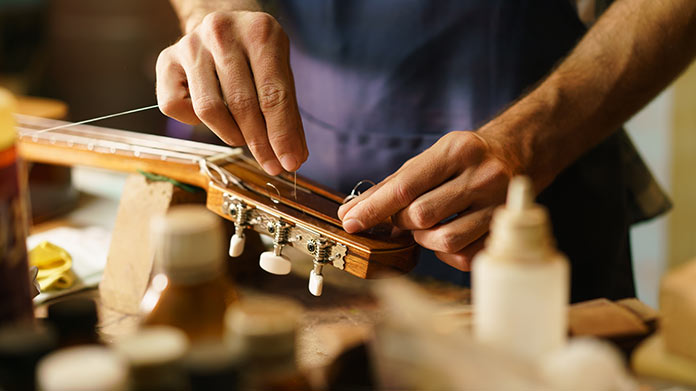
Musical instrument repair businesses service and repair instruments when they need routine maintenance or break. With so many people owning instruments, there is high demand for repair work.
Our guide is in 3 parts:
The startup costs for a musical instrument repair business are manageable. Some of the biggest expenses include:
Securing a space for repairing instruments
Purchasing tools for making repairs
Advertising the business’ repair services
Business owners who have limited initial capital can keep these costs minimal by setting up a repair workshop in their home and using tools they already own. A few specialty tools may be needed, but a good set of screwdrivers and variously sized pliers will do a lot of the work. Many of the specialty tools that are required either don’t cost a lot new or are available used at a discounted price.
Business owners who don’t want to start their operation from scratch might purchase an existing musical instrument repair business. These businesses are often affordable compared to other businesses’ purchase prices. For instance, one instrument repair business is listed at $75,000.
The ongoing expenses for a musical instrument repair business are minimal. They primarily include utilities and rent. Parts costs are built into customers’ bills.
The target market for a musical instrument repair business is local musicians. Because musical instruments are large and valuable, musicians normally won’t ship them into repair facilities. Instead, they’ll bring them to a repair professional in the area.
A musical instrument repair business makes money by charging customers for fixing their instruments. There are different levels of repair:
“Play condition” repairs mechanically fix an instrument but don’t make aesthetic improvements
“Professional quality” repairs fix an instrument technically and aesthetically
“Overhauls” completely rebuild an instrument so that it’s like-new
Most musical instrument repair businesses have a multi-tiered fee system. They might:
Perform small, quick fixes for free
Offer a basic service for a flat fee per instrument
Offer common services (e.g. repadding woodwinds) for a flat fee per instrument
Have an hourly rate for all other work
The Cayuga Music Shop has an hourly rate of $60, and most of their basic services range from $15 to $100. Repadding woodwinds costs several hundred dollars. These costs are representative of what other businesses charge.
A musical instrument repair business can bring in a nice annual revenue for a small business. The business mentioned above as being for sale has an annual revenue of $88,160. Because ongoing expenses are low, most revenue is profit.
A musical instrument repair business may increase revenue by selling new and/or used instruments. Some businesses also rent instruments to students.
A typical day at a musical instrument repair business involves:
talking to customers about issues their instruments are having
ordering supplies needed for fixing instruments
repairing and servicing instruments
testing instruments after they’re repaired
A successful business owner will be both an experienced musician and trained in the specifics of musical instrument repair.
Business owner’s don’t need to be Grammy-winning artists, but they ought to have studied music during college. Without this level of knowledge, business owner’s won’t be able to help professional musicians much.
To learn instrument repair, business owners should look for a local instrument repair class. Some vocational schools and junior colleges offer these classes, but they aren’t available everywhere. If attending a class isn’t possible, the next-best option is to find an instrument repair technician who’s willing to set up an apprenticeship. Online classes aren’t ideal because repairing instruments is a hands-on process.
After learning the basic skills of musical instrument repair, business owners should practice — and a lot. Practice will help refine skills, and it will show business owners what they can and can’t do with their skill set. EBay is a good place to find inexpensive instruments that can be torn down and rebuilt.
Ultimately, business owners should aim to become certified. The National Association of Professional Band Instrument Repair Technicians offers certification in the field. More instrument-specific groups include the Guild of American Luthiers and the International Double Reed Society. Some instrument manufacturers, such as Straubinger, offer workshops and certifications for working on their particular instruments.
A music instrument repair business can be a small, one-person operation that maintains part-time hours, or it can grow to have multiple locations in different states. The Cayuga Music Shop is an example of a local repair business. Sam Ash is a larger company that has locations in sixteen states. Sam Ash, like most larger companies, sells instruments and provides lessons in addition to making repairs.
When starting a new musical instrument repair business, providing every customer with the highest level of service is essential. Most business will come by word of mouth. Impressing a customer will keep them returning for future work, and it’ll lead to referrals.
Most musical instrument repair businesses start out as a one-person operation. As demand and revenue grow, business owners may hire a part- or full-time employee.
Business Evaluation & Strategy Tool
We'll walk you through the four pillars every business needs: Points of Leverage, Marketing Strategy, Financial Model, and Personal Compatibility. At the end you'll see a personalized report and your action plan below will be tailored to your answers.
Every viable business has natural advantages. Below are common leverage points across four categories. Pick the ones that apply to your Musical Instrument Repair business. We've pre-suggested a few based on your idea — review and adjust.
Without a way to connect with customers, even great businesses fail. Pick the channels you plan to use to reach your customers.
Enter your monthly baseline costs — the minimum overhead to keep the business running. Then we'll calculate how many sales per month you need to break even.
A business that doesn't fit your life will fail no matter how good the numbers look. Tell us how this business fits you.
Complete the four pillars and your personalized summary will appear here.
Nine concrete steps to take you from idea to open business, grouped into 30-day phases. Complete the planner above and we'll highlight what's most important for your situation.
An LLC keeps your personal assets separate from business debts and lawsuits — the most common reason small business owners choose this structure. Sole proprietorships and partnerships do not provide this protection.
Apply for your free Employer Identification Number through the IRS, then register for any state or local taxes that apply to your business (sales tax, franchise tax).
A dedicated business account is required to maintain personal asset protection. Mixing personal and business finances ('piercing the corporate veil') can void your LLC's liability shield.
Recording expenses and income from day one makes tax filing easier and lets you see when the business is actually profitable. Use software (QuickBooks, Wave) or a part-time bookkeeper.
State and local requirements vary widely. Brick-and-mortar businesses typically need a Certificate of Occupancy; service businesses may need specific professional licensing; food businesses need health permits.
General Liability Insurance is the most common starting point. If you'll have employees, most states require Workers' Compensation. Specific industries need additional coverage (product liability, professional liability, etc.).
Your brand is how customers perceive and remember you. A clear name, logo, and visual identity make every later marketing decision easier and protect you legally as you grow.
Every legitimate business needs a website. Social media pages are not a substitute — you don't own the platform. Modern website builders mean you can launch a clean site in a weekend without a developer.
A dedicated business number keeps your personal life private, makes the business look legitimate, and lets you route calls professionally. Cloud phone services start under $20/month.
Starting a Musical Instrument Repair business typically costs $25,000 to $250,000. It is considered a very high capital-intensity business.
A Musical Instrument Repair business runs roughly a 8% net profit margin, and most owners reach break-even in about 4 to 12 months.
You can usually launch a Musical Instrument Repair business in about 12 to 36 weeks, and it is commonly run full time.
A Musical Instrument Repair business is generally an intermediate-skill business to start, with rising demand. TRUiC rates it 49 out of 100 on our Idea Score.
Most Musical Instrument Repair businesses register as an LLC or other legal entity and obtain a general business license. Depending on your state and city you may also need industry-specific permits, sales tax registration, and zoning or health approvals, so check your local requirements before you launch.