Startup cost
$50k–$500k
TRUiC Business Ideas
Decision Snapshot
Idea Score
39
Startup cost
$50k–$500k
Profit margin
14%
Break-even
4 mo–12 mo
Time to launch
12 wk–36 wk
Demand trend
Stable
5-yr failure rate
—
Capital intensity
Very high
Time commitment
Full time
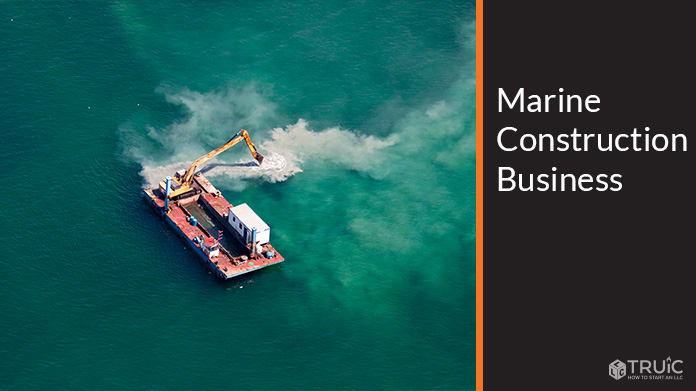
A marine construction business focuses on creating structures which will remain submerged, partially submerged, or adjacent to water.
Our guide is in 3 parts:
Marine construction requires much of the same startup costs of traditional construction but has more specific needs because of the nature of the construction. Costs typically consists of the following:
Business LLC and Contractor licensing are usually first. You’ll need a certified marine contractor’s license and will likely have to attend some training courses to receive certification for performing this type of work. Waterways can be environmentally sensitive and have more rules and precautions than inland construction. Check locally to see about other specific licensing and paperwork filings.
Heavy machinery operation certification and licensing. More than likely, you’ll need to know how to operate heavy machinery for this career. Proper certification ensures you operate safely and follow OSHA standards.
Building equipment, tools, and vehicles. You may be building retention walls or buttresses at a shoreline, but you may also be setting pilings and building a dock. Building in water requires you to have a floating surface to work from, such as a small barge. You will also likely need to purchase a boat.
A warehouse or building for meeting with clients and storing tools, equipment, and materials.
Salaries for your crew and office staff. You may start relatively small, but you’ll need some team members from the very start.
Marketing and advertising. It’s last on this list but will be one of your first big investments. People need to know about your business. Plan on marketing heavily in the first few months, even years, to garner customer attention and jobs.
Most ongoing expenses will be the rent or mortgage on your shop and warehouse, employee salaries, business insurance, equipment maintenance, and marine contractor licensing. Additionally, you’ll need a budget for advertising and maintaining communication services, like cell phones and the internet. Most building supplies will be ordered as jobs are scheduled, but you may keep some stock of nails, bolts, and fasteners, or other items you regularly use for jobs.
Your target market is businesses and homeowners on or near water. Whether fresh, salt, or brackish, you’ll want to focus on showing how you can keep the elements from destroying customer structures and property.
A marine construction business makes money through the sale and completion of customer jobs.
A marine construction company performs a specific set of tasks. Rates will vary based on your location and cliente, and your rates can be priced higher for custom projects. Large, niche projects will cost more in time and resources than standard projects like dock construction and installation.
Marine construction businesses do have considerable overhead for maintenance of tools and machines, as well as fluctuating materials costs. But, the potential to make substantial profits definitely exists. A successful, established company can see profits anywhere from $300,000 to a million annually.
Offer maintenance plans for your customers. A regularly scheduled maintenance plan can detect damaged hardware and replace these pieces for a fraction of the cost of replacing an entire dock section. Plus, properly maintained marine builds will better withstand storms.
Marine construction businesses focus on estimating and building out customer jobs. Much of your daily activities will focus on these aspects:
Meeting with clients and estimating their required work. You will often be traveling to a customer’s location to see what their property will require, both materially and financially.
Ordering materials and scheduling job site deliveries. Once you and the customers agree on what you’re building, you’ll most likely want the materials delivered directly to the jobsite.
Monitoring crew/job progress. A marine construction build can be affected by natural conditions, sometimes out of your control, such as tides or storms. Informing your customers of varying timelines is critical for customer satisfaction.
Managing paperwork, marketing and advertising, and communicating with material supply vendors are also necessary tasks needed for maintaining a balanced budget and promoting company growth.
Marine construction is a specialized field of construction because of the constant forces of nature acting on the structures you build. Water, oxidation, rust, and shifting sands all contribute to the difficulties in building a longstanding structure in or near water. Key skills include:
Prior experience in construction, especially in foundational planning. This knowledge will help greatly in priming your understanding and implementation of the techniques and materials necessary for success in this line of construction.
Experience driving and operating heavy machinery, such as cranes, backhoes, excavators, tractors, and boats with barges will also be necessary. If you don’t have experience in these areas, you’ll probably want to take some training courses.
Customer service and communication is important. Customers want to ask questions. You need to be able to explain, often in layman’s terms, what will happen and how long it will take. Following up with customers is also necessary for company growth.
Experience and education in business management is also important for structuring and implementing your business model.
Marine construction businesses can be profitable and grow in size and scope, depending on your location and competition. Areas with rivers, lakes, bays, and oceans nearby may be great for you to create a lucrative career. You’ll also need to see what kind of competition is present, and make sure you’ll have enough clients asking for your services. Your business can encompass residential and commercial marine construction or just focus on a specific customer base.
Market and promote near the places you’ll be doing most of your work. You’ll need customers to know you’re available right away. If you are performing commercial applications, ask your clients to share their experience with their industry groups. Word-of-mouth recommendations go a long way towards jump starting a career.
Use the internet to share pictures and videos of your work. Social media and a company website are relatively inexpensive methods for broadcasting your business.
Marine construction is hard work. It is also precise work with big machines. You’ll need a qualified construction crew of three to four people to get started. As you grow, you can create multiple teams. You’ll also need an office staff to take care of the financials, paperwork, and day-to-day office activities, such as ordering supplies for customer jobs.
Business Evaluation & Strategy Tool
We'll walk you through the four pillars every business needs: Points of Leverage, Marketing Strategy, Financial Model, and Personal Compatibility. At the end you'll see a personalized report and your action plan below will be tailored to your answers.
Every viable business has natural advantages. Below are common leverage points across four categories. Pick the ones that apply to your Marine Construction business. We've pre-suggested a few based on your idea — review and adjust.
Without a way to connect with customers, even great businesses fail. Pick the channels you plan to use to reach your customers.
Enter your monthly baseline costs — the minimum overhead to keep the business running. Then we'll calculate how many sales per month you need to break even.
A business that doesn't fit your life will fail no matter how good the numbers look. Tell us how this business fits you.
Complete the four pillars and your personalized summary will appear here.
Nine concrete steps to take you from idea to open business, grouped into 30-day phases. Complete the planner above and we'll highlight what's most important for your situation.
An LLC keeps your personal assets separate from business debts and lawsuits — the most common reason small business owners choose this structure. Sole proprietorships and partnerships do not provide this protection.
Apply for your free Employer Identification Number through the IRS, then register for any state or local taxes that apply to your business (sales tax, franchise tax).
A dedicated business account is required to maintain personal asset protection. Mixing personal and business finances ('piercing the corporate veil') can void your LLC's liability shield.
Recording expenses and income from day one makes tax filing easier and lets you see when the business is actually profitable. Use software (QuickBooks, Wave) or a part-time bookkeeper.
State and local requirements vary widely. Brick-and-mortar businesses typically need a Certificate of Occupancy; service businesses may need specific professional licensing; food businesses need health permits.
General Liability Insurance is the most common starting point. If you'll have employees, most states require Workers' Compensation. Specific industries need additional coverage (product liability, professional liability, etc.).
Your brand is how customers perceive and remember you. A clear name, logo, and visual identity make every later marketing decision easier and protect you legally as you grow.
Every legitimate business needs a website. Social media pages are not a substitute — you don't own the platform. Modern website builders mean you can launch a clean site in a weekend without a developer.
A dedicated business number keeps your personal life private, makes the business look legitimate, and lets you route calls professionally. Cloud phone services start under $20/month.
Starting a Marine Construction business typically costs $50,000 to $500,000. It is considered a very high capital-intensity business.
A Marine Construction business runs roughly a 14% net profit margin, and most owners reach break-even in about 4 to 12 months.
You can usually launch a Marine Construction business in about 12 to 36 weeks, and it is commonly run full time.
A Marine Construction business is generally an intermediate-skill business to start, with stable demand. TRUiC rates it 39 out of 100 on our Idea Score.
Most Marine Construction businesses register as an LLC or other legal entity and obtain a general business license. Depending on your state and city you may also need industry-specific permits, sales tax registration, and zoning or health approvals, so check your local requirements before you launch.