Startup cost
$15k–$60k
TRUiC Business Ideas
Decision Snapshot
Idea Score
60
Startup cost
$15k–$60k
Profit margin
11%
Break-even
4 mo–12 mo
Time to launch
12 wk–36 wk
Demand trend
Rising
5-yr failure rate
—
Capital intensity
High
Time commitment
Full time
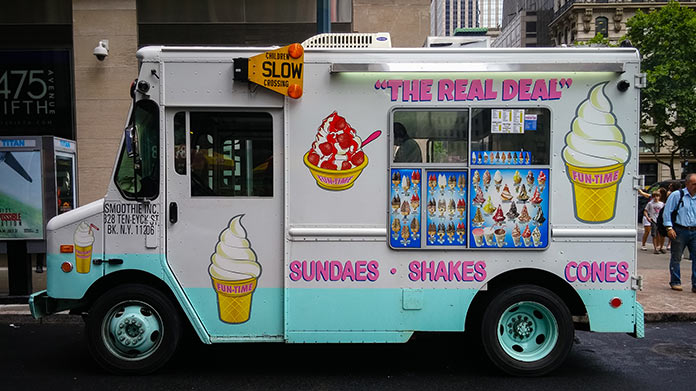
An ice cream truck business involves driving an ice cream truck around different neighborhoods to sell ice cream. An ice cream truck is like a mobile and specialized food truck. You must be able to prepare and store a variety of ice cream in freezers within your truck and then serve them through a window. You must also experiment with different routes so that you can discover the most profitable ones.
Our guide is in 3 parts:
Your biggest expense will be the ice cream truck itself. This typically has a minimum cost of $10,000, but fancier models can run to twice that cost. The truck must be insured, which can cost between $800 to $1500 every year. One of the attractive things about the business is that you can acquire your starting stock of ice cream for as little as $500 and simply order more as needed.
The ongoing expenses for an ice cream truck business are very straightforward. The primary expense is gas—to be completely safe, allot a budget of three dollars per gallon of gas and determine how far you will drive each month in order to get a reliable estimate of monthly fuel costs. You must also restock your ice cream, which should cost no more than the initial $500 (though you will order more as necessary, so periods of booming business may necessitate restocking more often).
As mentioned previously, your preferred clients will be children. In fact, most of your route research will focus on finding where and when large numbers of children will be.
The ice cream truck business model is simple: you sell clients ice cream and receive payment. Due to the nature of the business, most of the payments you receive will be in cash. However, devices such as Square allow you to take debit and credit card payments if you so desire.
While the exact amount will vary by region and exact product, you can typically charge customers between one and four dollars for the different products you sell. Higher priced items are those involving licensed characters, those considered premium or gourmet products, and those that are offer a greater quantity of ice cream. Some ice cream trucks will sell quarts of particular ice cream, for example, in addition to the typical selection of popsicles, ice cream sandwiches, and so on. You may consider adjusting prices based on season, such as making ice cream cheaper in the Fall, Winter, and Spring, and more expensive in the summer.
In one survey of average yearly profits, vendors were bringing in about $5000 a month and working about twenty days a month. Your own profit will have several variables, however. This includes how many days you work and, as mentioned above, how many rivals you have in your area. And, obviously, the longer you work, the more profit you make: your willingness to work long days during the summer or long into holiday weekends (when more children are free to buy ice cream) will dictate how much money you make.
Ways of making your business more profitable includes adding new routes and/or changing to more profitable routes, adding hours you work, adjusting the times that you visit certain neighborhoods, diversifying the products that you sell, and even just driving slower through your chosen neighborhoods.
If you do happen to live in a highly populated area, consider expanding by leasing or purchasing another truck and hiring additional help. Over the long term, growing your business like this could double or triple your profits.
The primary daily activities of an ice cream truck business are exactly what you’d imagine: most of your day will be spent driving different routes and selling ice cream. Other activities include ordering and storing ice cream as well as researching the best routes and delivery times to maximize your business.
The essential skills of an ice cream truck business, driving and vending, are actually very basic. However, certain skills can help you build your business more quickly. This includes previous experience as an ice cream vendor and a background in something like business or management. If you have an existing relationship with local organizations and businesses where children congregate (such as schools, churches, youth clubs, and so on), it will help you more quickly discover optimum delivery routes.
While the exact growth potential for ice cream truck businesses has not been quantitatively researched, businesses such as artisanal ice cream and food trucks have experienced slow but steady growth in the last decade. The exact potential for your own business will depend greatly on your local area—for instance, whether there are any/many rival ice cream trucks or standing ice cream vendors in town.
One good tip is to research the best routes ahead of time and then work them every day. As with any other business, regularity helps. That makes it easier for regular customers to find you at a certain time of day and buy your ice cream. Being friendly and talkative to customers also helps to establish a relationship with them—this is important when you are selling to close-knit neighborhoods that value relationships. Finally, don’t forget to have as much ice cream variety as you can get—we are in a golden age of food and customers can sometimes be very picky.
Unless you intend to build a fleet of ice cream trucks, this is a business that is traditionally operated by a single person. This is typically considered one of the advantages of this job, as it keeps your overhead low and removes the need to manage and coordinate other employees. If you do have enough money to acquire an additional truck and supplies, and you feel there are profitable routes that you aren’t currently covering on your current schedule, this would be an ideal time to expand your business and hire an additional driver.
Business Evaluation & Strategy Tool
We'll walk you through the four pillars every business needs: Points of Leverage, Marketing Strategy, Financial Model, and Personal Compatibility. At the end you'll see a personalized report and your action plan below will be tailored to your answers.
Every viable business has natural advantages. Below are common leverage points across four categories. Pick the ones that apply to your Ice Cream Truck business. We've pre-suggested a few based on your idea — review and adjust.
Without a way to connect with customers, even great businesses fail. Pick the channels you plan to use to reach your customers.
Enter your monthly baseline costs — the minimum overhead to keep the business running. Then we'll calculate how many sales per month you need to break even.
A business that doesn't fit your life will fail no matter how good the numbers look. Tell us how this business fits you.
Complete the four pillars and your personalized summary will appear here.
Nine concrete steps to take you from idea to open business, grouped into 30-day phases. Complete the planner above and we'll highlight what's most important for your situation.
An LLC keeps your personal assets separate from business debts and lawsuits — the most common reason small business owners choose this structure. Sole proprietorships and partnerships do not provide this protection.
Apply for your free Employer Identification Number through the IRS, then register for any state or local taxes that apply to your business (sales tax, franchise tax).
A dedicated business account is required to maintain personal asset protection. Mixing personal and business finances ('piercing the corporate veil') can void your LLC's liability shield.
Recording expenses and income from day one makes tax filing easier and lets you see when the business is actually profitable. Use software (QuickBooks, Wave) or a part-time bookkeeper.
State and local requirements vary widely. Brick-and-mortar businesses typically need a Certificate of Occupancy; service businesses may need specific professional licensing; food businesses need health permits.
General Liability Insurance is the most common starting point. If you'll have employees, most states require Workers' Compensation. Specific industries need additional coverage (product liability, professional liability, etc.).
Your brand is how customers perceive and remember you. A clear name, logo, and visual identity make every later marketing decision easier and protect you legally as you grow.
Every legitimate business needs a website. Social media pages are not a substitute — you don't own the platform. Modern website builders mean you can launch a clean site in a weekend without a developer.
A dedicated business number keeps your personal life private, makes the business look legitimate, and lets you route calls professionally. Cloud phone services start under $20/month.
Starting an Ice Cream Truck business typically costs $15,000 to $60,000. It is considered a high capital-intensity business.
An Ice Cream Truck business runs roughly a 11% net profit margin, and most owners reach break-even in about 4 to 12 months.
You can usually launch an Ice Cream Truck business in about 12 to 36 weeks, and it is commonly run full time.
An Ice Cream Truck business is generally an intermediate-skill business to start, with rising demand. TRUiC rates it 60 out of 100 on our Idea Score.
Most Ice Cream Truck businesses register as an LLC or other legal entity and obtain a general business license. Depending on your state and city you may also need industry-specific permits, sales tax registration, and zoning or health approvals, so check your local requirements before you launch.