Startup cost
$5k–$32k
TRUiC Business Ideas
Decision Snapshot
Idea Score
64
Startup cost
$5k–$32k
Profit margin
21%
Break-even
4 mo–12 mo
Time to launch
12 wk–36 wk
Demand trend
Stable
5-yr failure rate
—
Capital intensity
Medium
Time commitment
Full time
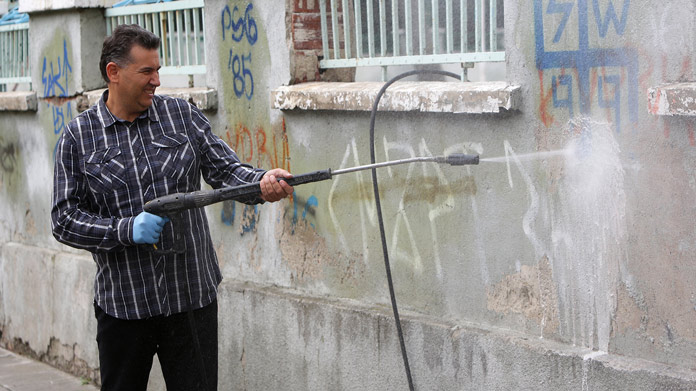
A graffiti removal business removes unwanted graffiti from a variety of surfaces and buildings. This is most commonly done via pressure washing and repainting. Even in smaller towns, graffiti is everywhere. Your removal business will be hired by business owners, school boards, city managers, and other authority figures to remove this unwanted graffiti.
Our guide is in 3 parts:
Arguably, one of the most attractive features of a graffiti removal business is the extremely low cost to get started. You will need a truck large enough to transport your equipment, which should cost no more than $32,000 (although if you already have a suitable vehicle, you can simply us that). You will need a pressure washer, which will be no more than $1000 (and this is for some of the fanciest models—there are washers as low as $100). And you will need to buy paint to help with repainting, which you will likely purchase as you go along (so that you can determine the exact colors you will need to repaint a surface). You may decide to spend a few thousand on traditional advertising, but your business can get a lot of attention via a free or low-cost website and a social media account—these highly-visual mediums can let you showcase the “before and after” photos of your work, which is a great way to advertise.
Along with the relatively low cost to start your business, the low ongoing expenses are very attractive. Month to month, you are basically paying for fuel for your vehicle (and it is appropriate to charge customers for traveling to them, absorbing this cost) and new pain as needed. This means that the vast majority of the money that you take in goes towards your profit margin.
The “bread and butter” clients for a graffiti removal business are business owners and school boards. These people represent areas most often afflicted by graffiti. To a lesser extent, private homeowners and city managers will also require your services from time to time.
A graffiti removal business makes money by charging clients to remove their unwanted graffiti and, if necessary, to repaint the area. You should decide early on if your business will only charge for services rendered (getting paid one removal at a time) or if you would like to charge a monthly fee to be “on call” for that client or business if they should need you at any time.
If the client is not paying a monthly fee for your services, then you would typically charge them between one and three dollars per square foot of the area you are expected to clean. You may also consider charging between thirty to seventy dollars to drive out there: this will help pay for fuel and equipment costs. Feel free to negotiate higher prices for more difficult conditions (say, having to remove the graffiti from a tall tower that is difficult to access).
The exact profit your business can make is determined largely by the area you live in and the regular contracts you get. For instance, government offices like the Ohio DOT spend $17,000 a year removing graffiti, and that is is just for one building. There are countless government buildings, schools, and private businesses affected by graffiti each year, and as indicated above, the vast majority of the money you bring in becomes a pure profit for you. Thus, enough clients and enough hustle can make this a very lucrative job!
Don’t be afraid to charge higher fees, especially if there is little competition in your area. Consider giving yourself a built-in gimmick, such as low toxicity paint. You may also consider offering other services, such as spray sealants, which help add value to your services. Above all, never stop showing off your work via social media—your job is rooted in the community, and the more the community can see how you are cleaning things up, the more work you’ll have.
The day-to-day activities of a graffiti removal expert are actually pretty straightforward. You will take calls from existing clients and make calls to prospective clients. You will then drive a truck or trailer to the afflicted area and use your equipment to remove the graffiti. You may choose to spend downtime working on advertising and client recruitment.
As mentioned earlier, existing skill with things like painting and pressure-washing can be a big help as you are starting. Additionally, being part of several of your community’s networks would be handy: having a good relationship with members of the law enforcement, education, and/or business communities can help you translate your social relationship to a working relationship.
The exact growth potential for this business varies greatly by the area you work in. In more metropolitan areas (such as New York City and even Toronto), such businesses typically do quite well for themselves. As you may imagine, the exact growth of your business is tied with the amount of graffiti that is added each month: more people living in the area means more graffiti, which adds up to more business for you.
As with many businesses, it’s good to scope out the competition. This helps you to determine the exact market and need for your services and gives you an idea of what the community may expect from your services. If you have the space at home, you should start out by practicing removing graffiti that you yourselves have added to a variety of surfaces, helping you to “practice.” Finally, try to conduct quiet inquiries with law enforcement officials to get an idea of just how prevalent graffiti in your community actually is.
Most graffiti removal businesses work alone, since that means not having to split profits with anyone. However, if there are more clients than you can handle on a regular basis, it may be time to expand your team. Keep in mind that for most projects, team members will be working solo, so every member that you add will need their own truck and equipment.
Business Evaluation & Strategy Tool
We'll walk you through the four pillars every business needs: Points of Leverage, Marketing Strategy, Financial Model, and Personal Compatibility. At the end you'll see a personalized report and your action plan below will be tailored to your answers.
Every viable business has natural advantages. Below are common leverage points across four categories. Pick the ones that apply to your Graffiti Removal business. We've pre-suggested a few based on your idea — review and adjust.
Without a way to connect with customers, even great businesses fail. Pick the channels you plan to use to reach your customers.
Enter your monthly baseline costs — the minimum overhead to keep the business running. Then we'll calculate how many sales per month you need to break even.
A business that doesn't fit your life will fail no matter how good the numbers look. Tell us how this business fits you.
Complete the four pillars and your personalized summary will appear here.
Nine concrete steps to take you from idea to open business, grouped into 30-day phases. Complete the planner above and we'll highlight what's most important for your situation.
An LLC keeps your personal assets separate from business debts and lawsuits — the most common reason small business owners choose this structure. Sole proprietorships and partnerships do not provide this protection.
Apply for your free Employer Identification Number through the IRS, then register for any state or local taxes that apply to your business (sales tax, franchise tax).
A dedicated business account is required to maintain personal asset protection. Mixing personal and business finances ('piercing the corporate veil') can void your LLC's liability shield.
Recording expenses and income from day one makes tax filing easier and lets you see when the business is actually profitable. Use software (QuickBooks, Wave) or a part-time bookkeeper.
State and local requirements vary widely. Brick-and-mortar businesses typically need a Certificate of Occupancy; service businesses may need specific professional licensing; food businesses need health permits.
General Liability Insurance is the most common starting point. If you'll have employees, most states require Workers' Compensation. Specific industries need additional coverage (product liability, professional liability, etc.).
Your brand is how customers perceive and remember you. A clear name, logo, and visual identity make every later marketing decision easier and protect you legally as you grow.
Every legitimate business needs a website. Social media pages are not a substitute — you don't own the platform. Modern website builders mean you can launch a clean site in a weekend without a developer.
A dedicated business number keeps your personal life private, makes the business look legitimate, and lets you route calls professionally. Cloud phone services start under $20/month.
Starting a Graffiti Removal business typically costs $5,000 to $32,000. It is considered a medium capital-intensity business.
A Graffiti Removal business runs roughly a 21% net profit margin, and most owners reach break-even in about 4 to 12 months.
You can usually launch a Graffiti Removal business in about 12 to 36 weeks, and it is commonly run full time.
A Graffiti Removal business is generally an intermediate-skill business to start, with stable demand. TRUiC rates it 64 out of 100 on our Idea Score.
Most Graffiti Removal businesses register as an LLC or other legal entity and obtain a general business license. Depending on your state and city you may also need industry-specific permits, sales tax registration, and zoning or health approvals, so check your local requirements before you launch.