Startup cost
$20k–$100k
TRUiC Business Ideas
Decision Snapshot
Idea Score
66
Startup cost
$20k–$100k
Profit margin
30%
Break-even
9 mo–24 mo
Time to launch
12 wk–36 wk
Demand trend
Stable
5-yr failure rate
—
Capital intensity
High
Time commitment
Full time
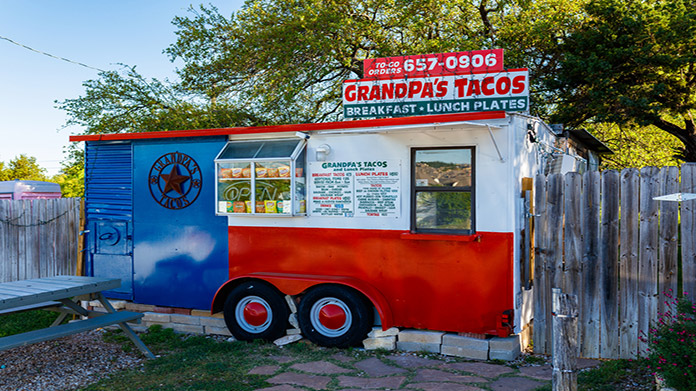
A food truck business is a restaurant on wheels. The owner prepares meals or snacks and serves customers from a truck, van or trailer. The business owner should have culinary talents and the ability to quickly and efficiently serve tasty meals from a contained space, attract hungry customers and to deal with the business obligations of obtaining all necessary licenses and permits.
Our guide is in 3 parts:
Insurance, licensing and permit acquisition – This varies greatly depending on the requirements of your city or location and can cost several thousand dollars, including consultations with a lawyer. Most of the information can be found online.
Vehicle costs – This depends on the kind of vehicle you buy and how you have it outfitted. Will it include a kitchen or merely an area to warm up food prepared in a commissary? The low-end purchase price of a used trailer can be less than $20,000 while the cost of a new, fully outfitted truck can exceed $100,000. Visit RoadStoves.com to shop for used food vehicles of all kinds.
Vehicle exteriors – Designing your truck graphics and wrapping it can cost $1,000 or more, but it’s a necessary expense since your vehicle will be your mobile billboard.
Ingredients – This will also vary greatly, depending on your menu, but it can easily exceed $1,000 a month.
Commissary/commercial kitchen – If you need a place to store and prepare your food, many cities have shared-space commercial kitchens for this purpose. The cost can be $400 a month or more. Some of these places also offer space for parking your vehicle off-hours. Explore less costly options for food prep/storage, such as renting kitchen space in a nearby restaurant, school, church or other place with health inspection licensing. Better yet if your food truck business is an extension of a restaurant you already own.
Fuel and vehicle maintenance – This will depend on how far your vehicle roams on a daily basis and the cost of gasoline at a given time.
Employees – This will cost at least a couple thousand dollars a month per employee.
Sales and marketing – Consider printing and distributing flyers. Other associated costs can include website development and advertising (if budgets allow). But most of your promotion costs only your time on social media.
Read our food truck business purchasing guide to learn about the materials and equipment you’ll need to start a food truck business, how much to budget, and where to make purchases.
Your most consistent ongoing expenses will be for food, gasoline and maintenance, and employee costs, if any. Food and fuel have both gone through recent periods of price escalation, so your challenge here is to shop for the best deals possible.
Defining your customers will be your first and perhaps most critical job. You can’t finalize your menu unless you can get inside their heads and understand their motivation for ordering from you. Workers in an industrial park on a half-hour break are looking for a quick lunchtime meal that won’t cost much. If you’re on the fairs and festivals circuit, they might be more in the market for elephant ears than a nutritious and costly dinner. Once you’ve identified your customers and understand their motivations, everything else springs from that, from designing your vehicle wrap to finalizing your location and developing your menu and pricing.
You must draw customers who will love your menu offerings and spread the word. In addition to your culinary abilities, your profitability will be affected by your location or locations. If you have a taco truck in an area of overcapacity of Hispanic food trucks, you won’t stand out. Similarly, you might not do enough business to break even if you exhibit at under-attended festivals or events.
To answer this question, you must first conduct a survey of options in your marketing area. If you’re going to be located downtown during lunchtime, for instance, how many restaurants are there within walking distance of major employers? What do they charge, on average? Keep in mind, one reason foot traffic will consider your offering is out of convenience. You’ll feed them quickly. So don’t consider restaurants as competitors if they’re a long walk or drive away or they serve leisurely sit-down meals. Your competitors are fast-food establishments and restaurants offering minimal service and quick response. And other food trucks, of course. Try to stay within cost range of your customers’ other options.
Observe other food trucks in or near your desired location. How many meals do they serve on a typical lunch hour? Be conservative in your estimation, and figure out how much you must make to be profitable on a daily basis. Divide the number of meals you expect to serve into this number and this is what each meal should cost to hit that number. Does that figure make competitive sense? If not, you might need to further retool your menu or ingredients to bring costs down or sales up.
Here’s a good article with more about pricing strategies.
A 30 percent profit margin is ideal, but it will depend on your location, competition, and efficiency, among other factors.
Consider expanding your market through after-hour locations. For instance, if your regular gig is to serve lunchtime diners at an industrial park, explore evening bookings to serve private parties and special events. Perhaps you can handle wedding receptions and festivals on the weekends. Furthermore, your menu should always be a work in progress. Constantly experiment with offerings that might carry a larger profit margin because the ingredients are less expensive or easier to prepare, or your customers are more receptive to them, increasing the popularity of your truck.
Here’s how your day might typically be spent:
Start early by picking up your vehicle and heading to the commercial kitchen space where you’ll prepare your menu items. Keep in mind the laws in your location. Some cities require that food preparation takes place in an inspected commercial kitchen rather than in a truck. Some commissaries provide space for your truck, which is a handy time-saver.
Head to your parking location as soon as possible. If you’re working in a city, your parking spot can’t be reserved, so you’ll want to get there as early as possible in your quest to set up business as close to where your customers expect to find you as possible.
Serve your customers as quickly and efficiently as possible, especially if you have a weekday lunchtime location. It’s still a novelty practice in many locations, so make it fun.
Take your truck back to the commissary or storage location where you can legally dispose of grease, wastewater and other cooking waste, and thoroughly clean your vehicle.
In your spare time, communicate to your market via social media, through the production of flyers and other means of marketing your business. Be sure to remind your loyal customers where and when they’ll next see you.
Gas up your vehicle and inspect it for any needed repairs.
Place and pick up your food ingredients order daily or every few days. Your storage space will be limited, so you’ll shop often.
Your culinary skills will enable you to offer food that your customers will crave and return to regularly. Knowing the tastes and budgets of customers at your location is critical. Can you identify an unfulfilled niche and deliver the menu that fits your market’s needs and tastes?
Furthermore, you must thoroughly understand your truck’s specialty equipment, which might include refrigeration, steam tables, warming ovens, and propane or generator power. Keeping your vehicle and its food prep equipment in good running order requires at least enough mechanical skills to recognize problems before they fully arise. You’ll save downtime and money if you can do some of the work yourself, but be sure to make the acquaintance of good vehicle and equipment mechanics.
One way to expand in this business category is to lease or buy additional food trucks. Another approach is to franchise your business. Either way will depend on the initial success of your first truck, and that will depend on your concept and location. This article points out that one business generated $300,000 in revenue from one truck its first year on just $60,000 in initial costs. Another massively successful operation made $800,000 annually before franchising and pulling in millions of dollars a year. But both of these are much more successful than typical single-truck returns—but they provide inspiration and show that it can be done.
It’s likely that you’ll start your business alone or with trusted family members. There are practical as well as economic reasons for starting small. There’s only so much room in your vehicle. But it makes sense to train at least a few people when you’re financially able. Two-person teams work well, in that one person can primarily interact with customers and make sales while another prepares the order. If you can put together a two-person team without you, it will allow your operation to roll smoothly when you’re unavailable or would like a day off or time to undertake other responsibilities of the business.
Once you’ve gotten to the point where you’re making a profit on one truck you might consider expanding your operation with additional vehicles.
Business Evaluation & Strategy Tool
We'll walk you through the four pillars every business needs: Points of Leverage, Marketing Strategy, Financial Model, and Personal Compatibility. At the end you'll see a personalized report and your action plan below will be tailored to your answers.
Every viable business has natural advantages. Below are common leverage points across four categories. Pick the ones that apply to your Food Truck business. We've pre-suggested a few based on your idea — review and adjust.
Without a way to connect with customers, even great businesses fail. Pick the channels you plan to use to reach your customers.
Enter your monthly baseline costs — the minimum overhead to keep the business running. Then we'll calculate how many sales per month you need to break even.
A business that doesn't fit your life will fail no matter how good the numbers look. Tell us how this business fits you.
Complete the four pillars and your personalized summary will appear here.
Nine concrete steps to take you from idea to open business, grouped into 30-day phases. Complete the planner above and we'll highlight what's most important for your situation.
An LLC keeps your personal assets separate from business debts and lawsuits — the most common reason small business owners choose this structure. Sole proprietorships and partnerships do not provide this protection.
Apply for your free Employer Identification Number through the IRS, then register for any state or local taxes that apply to your business (sales tax, franchise tax).
A dedicated business account is required to maintain personal asset protection. Mixing personal and business finances ('piercing the corporate veil') can void your LLC's liability shield.
Recording expenses and income from day one makes tax filing easier and lets you see when the business is actually profitable. Use software (QuickBooks, Wave) or a part-time bookkeeper.
State and local requirements vary widely. Brick-and-mortar businesses typically need a Certificate of Occupancy; service businesses may need specific professional licensing; food businesses need health permits.
General Liability Insurance is the most common starting point. If you'll have employees, most states require Workers' Compensation. Specific industries need additional coverage (product liability, professional liability, etc.).
Your brand is how customers perceive and remember you. A clear name, logo, and visual identity make every later marketing decision easier and protect you legally as you grow.
Every legitimate business needs a website. Social media pages are not a substitute — you don't own the platform. Modern website builders mean you can launch a clean site in a weekend without a developer.
A dedicated business number keeps your personal life private, makes the business look legitimate, and lets you route calls professionally. Cloud phone services start under $20/month.
Starting a Food Truck business typically costs $20,000 to $100,000. It is considered a high capital-intensity business.
A Food Truck business runs roughly a 30% net profit margin, and most owners reach break-even in about 9 to 24 months.
You can usually launch a Food Truck business in about 12 to 36 weeks, and it is commonly run full time.
A Food Truck business is generally an intermediate-skill business to start, with stable demand. TRUiC rates it 66 out of 100 on our Idea Score.
Most Food Truck businesses register as an LLC or other legal entity and obtain a general business license. Depending on your state and city you may also need industry-specific permits, sales tax registration, and zoning or health approvals, so check your local requirements before you launch.