Startup cost
$50k–$500k
TRUiC Business Ideas
Decision Snapshot
Idea Score
34
Startup cost
$50k–$500k
Profit margin
3%
Break-even
4 mo–12 mo
Time to launch
12 wk–36 wk
Demand trend
Rising
5-yr failure rate
—
Capital intensity
Very high
Time commitment
Full time
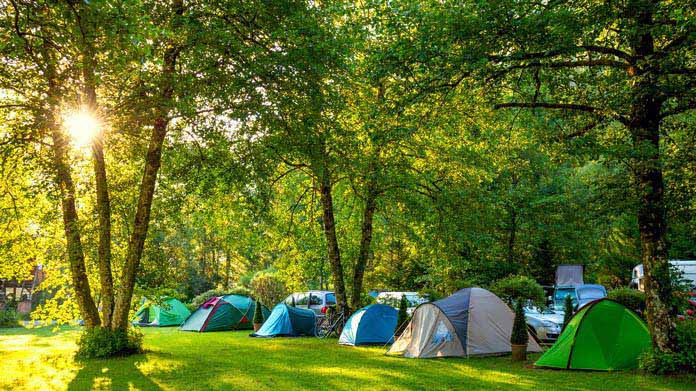
If you love the outdoors and some hard work, you could start a campground business. Whether you have land or are purchasing land, you could start enjoying the great outdoors and working for yourself as soon as you get everything set up. You’ll provide a place for people who are passing through on their way to another destination and for those who want to enjoy some time connecting with nature. Campers use all sorts of shelters from tents to fully contained RVs.
Before you start a campground business, you’ll need the knowledge and willingness it takes to do many things, including accounting, repairs, road maintenance, plumbing, electrical maintenance, and management. You may be able to farm some of these things out, but it is much more cost-effective to do these things yourself.
Our guide is in 3 parts:
The costs to open a campground business depend on what you are starting with. Assuming it’s nothing, costs include:
The purchase of land. These costs vary depending on location and the number of acres being purchased. Land may range from $1,000 an acre if has a lot of “unusable” land or upwards of $10,000 an acre if most of the land is flat, it’s on a lake or river, or it has outstanding views.
For buying an existing campsite, prices range from about $100,000 to over $2 million.
Licensing and permitting, including sales tax and occupancy certificates. These fees also depend on the size of the operation, what you are offering and the location. For example, you may have to pay a fee for each soda machine you have on the premises, or a fee for each employee.
Designing the campground, including roads, the locations of the sites, and locations of amenities you are providing. These may include playgrounds, a dog walk area, rec room, boat ramp, hiking trails, roads and bridges.
Clearing of the land and creating the roads.
Installing electric, plumbing and septic systems.
Building bathhouses, bathrooms, fencing, rec buildings, installing a pool and building any other amenities you plan.
Expenses will vary, depending on how you set your business up. They may include:
Garbage disposal
Septic tank maintenance and cleaning
Utilities
Cleaning supplies
Payroll
Licenses and permits that need to be renewed
Inventory
Gas for camp vehicles
Maintenance on camp vehicles
Gravel for roads, if applicable
Patch materials for paved roads
Entertainment, such as paying performers
Customer types will depend on the type of campground you are running. If you are running a campground that has only primitive sites, your customers will like tent camping. If your campground also features sites with utilities, you’ll attract “glampers,” those with RVs that enjoy having all the comforts of home.
A campground makes its main income by renting out sites. It may also have a small store that is stocked with camping gear, non-perishable food and other items that campers may find useful. A popular seller is ice, so adding an ice freezer will also make some money for the business.
The charge per night depends on the amenities, the location of your campground, the location of the site and the type of site. Sites might go from $10 per night to over $100 per night. Primitive sites would be the cheapest, while sites that provide electric, water and WiFi hookups might cost more.
Also, if you have amenities, such as a pool, a rec room, a playground and more, you need to charge a little more per site so that you can cover the cost of putting those amenities in, and cover the cost of maintenance for them.
Profit is dependent on many things, including the number of sites you have, whether you have cabins for rent, the business expenses and start-up liabilities, such as loans for land. A smaller campground with extensive liabilities will make less profit than a larger campground with the same amount of liabilities.
If you are able to keep costs down, your profit will be larger. Before you set pricing for your sites, you’ll need to figure your monthly overhead. This includes mortgage payments, utilities, employee costs, licensing and permitting fees and inventory. For items that are not paid monthly, divide yearly payments by 12 to get the monthly cost. Once you get your monthly overhead, you’ll be able to figure how much you need to charge for each campsite.
If you charge different prices at different times of the year, or if you give discounts, you’ll also have to figure that in. If your monthly overhead is $3,500 and you have 100 sites, you’ll have to charge $35 a night just to break even, unless you have a camp store or other amenities that you charge for.
Make your business more profitable by taking several steps:
Add more sites
Check your accounting to ensure that you are charging a fair amount that covers utilities and your liabilities
Ensure that you are sold out by making your campground the best place to go in your locations
Create a budget and stick to it
Add additional services that you might charge for, such as ice, firewood, and a store
A campground business owner will have several daily activities to do, unless he or she hires some help. Assuming that at startup, the business owner will be doing all of the work, his or her duties include:
Checking campers in and out;
Accounting;
Emptying trash containers at each campsite;
Cleaning bathhouses and bathrooms;
Interacting with campers in person and on the phone;
Setting reservations;
Planning events;
Handling campers’ complaints about other campers, the site or the campground;
Opening and cleaning rec rooms and other amenities the campground offers; and
Seasonal duties such as snow plowing, picking up debris from trees and cleaning up after storms.
Campground owners need a plethora of skills if they want to do all of the work without hiring anything out. Skills that will help include:
Carpentry
Plumbing
Electrical
Office management
Customer service
Accounting
Working with heavy equipment
Landscaping and design
The growth potential depends on how much adjoining land is available. Campground owners could make over $1 million per year if the campground is large enough and is popular. If a campground is small, but is always booked to capacity, the owner could buy adjoining land to create more campsites and significantly increase business.
Another avenue for growth is to create a franchise. Franchises give you unlimited growth potential, since you could open campgrounds across the country. In a franchise, franchisees – those who buy the franchise – would be operating the campground. You would make money from franchise fees and a portion of the profits for each campground.
You’ll spend much less if you already have land that you are able to convert into a campground. Think about what the area has to offer. If there is a river on the property, you might cater to those who like to fish. If most of the land is flat, you may want to cater to the handicapped, especially if you are able to make concrete hiking trails that would be easy for those in wheelchairs to navigate. Depending on what you offer, you may need several different licenses and permits. Campers are there to enjoy the experience, so you may want to have a small store, playgrounds for children, a dog park area, and a recreation room for those rainy days. Additional tips include:
Make curves and turns in the roads wide enough for longer rigs.
Be sure to have plenty of pull-through sites to make it easier for the larger rigs.
While “glamping” is quite popular, you will also find that there are many who like to rough it. Be sure to have plenty of primitive sites for tents.
Offer a good variety of 50-amp and 30-amp hookups.
It’s time to build a team when the number of sites you have is too high for you to maintain them all by yourself each day. You may have to clean each site, and at a minimum, empty the trash. If you are by yourself, you also need to be able to complete site maintenance early in the morning so that you are in the office to check people in and out.
If you have grown to the point where it’s difficult to manage yourself, or even with a spouse, you should have the income to hire at least a part-timer to help you with some of the physical work. You might also hire someone to mind the office.
Once you decide to hire outside help, be sure to check references and do a background check. The person has to be trustworthy enough. Even if the person is working the grounds, you want someone you can trust not to break into your customer’s campers or lift some of the camping gear your customers might leave outside when they go to town or go sightseeing.
Read our campground hiring guide to learn about the different roles a campground typically fills, how much to budget for employee salaries, and how to build your team exactly how you want it.
Business Evaluation & Strategy Tool
We'll walk you through the four pillars every business needs: Points of Leverage, Marketing Strategy, Financial Model, and Personal Compatibility. At the end you'll see a personalized report and your action plan below will be tailored to your answers.
Every viable business has natural advantages. Below are common leverage points across four categories. Pick the ones that apply to your Campground business. We've pre-suggested a few based on your idea — review and adjust.
Without a way to connect with customers, even great businesses fail. Pick the channels you plan to use to reach your customers.
Enter your monthly baseline costs — the minimum overhead to keep the business running. Then we'll calculate how many sales per month you need to break even.
A business that doesn't fit your life will fail no matter how good the numbers look. Tell us how this business fits you.
Complete the four pillars and your personalized summary will appear here.
Nine concrete steps to take you from idea to open business, grouped into 30-day phases. Complete the planner above and we'll highlight what's most important for your situation.
An LLC keeps your personal assets separate from business debts and lawsuits — the most common reason small business owners choose this structure. Sole proprietorships and partnerships do not provide this protection.
Apply for your free Employer Identification Number through the IRS, then register for any state or local taxes that apply to your business (sales tax, franchise tax).
A dedicated business account is required to maintain personal asset protection. Mixing personal and business finances ('piercing the corporate veil') can void your LLC's liability shield.
Recording expenses and income from day one makes tax filing easier and lets you see when the business is actually profitable. Use software (QuickBooks, Wave) or a part-time bookkeeper.
State and local requirements vary widely. Brick-and-mortar businesses typically need a Certificate of Occupancy; service businesses may need specific professional licensing; food businesses need health permits.
General Liability Insurance is the most common starting point. If you'll have employees, most states require Workers' Compensation. Specific industries need additional coverage (product liability, professional liability, etc.).
Your brand is how customers perceive and remember you. A clear name, logo, and visual identity make every later marketing decision easier and protect you legally as you grow.
Every legitimate business needs a website. Social media pages are not a substitute — you don't own the platform. Modern website builders mean you can launch a clean site in a weekend without a developer.
A dedicated business number keeps your personal life private, makes the business look legitimate, and lets you route calls professionally. Cloud phone services start under $20/month.
Starting a Campground business typically costs $50,000 to $500,000. It is considered a very high capital-intensity business.
A Campground business runs roughly a 3% net profit margin, and most owners reach break-even in about 4 to 12 months.
You can usually launch a Campground business in about 12 to 36 weeks, and it is commonly run full time.
A Campground business is generally an intermediate-skill business to start, with rising demand. TRUiC rates it 34 out of 100 on our Idea Score.
Most Campground businesses register as an LLC or other legal entity and obtain a general business license. Depending on your state and city you may also need industry-specific permits, sales tax registration, and zoning or health approvals, so check your local requirements before you launch.