Startup cost
$1.0k–$5k
TRUiC Business Ideas
Decision Snapshot
Idea Score
65
Startup cost
$1.0k–$5k
Profit margin
21%
Break-even
4 mo–12 mo
Time to launch
12 wk–36 wk
Demand trend
Stable
5-yr failure rate
—
Capital intensity
Low
Time commitment
Flexible
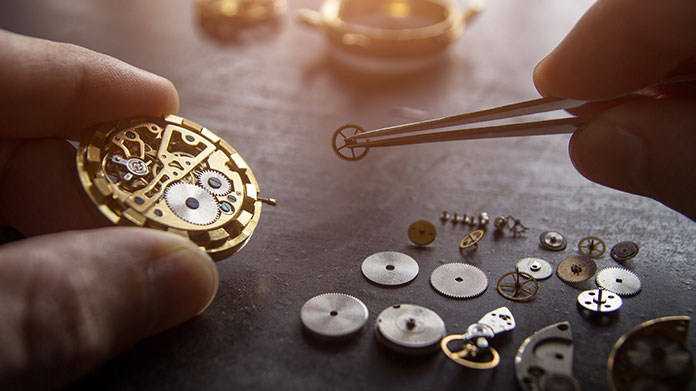
Despite the recent influx of smartwatches, people have continued to show a strong preference for old-fashioned clocks. These are clocks that need regular maintenance and occasionally break down, requiring a professional to fix them.
Clock repair businesses service worn-out and malfunctioning clocks. The industry has traditionally been dominated by older men, who are now retiring and leaving opportunities for young business owners. Many established businesses report backlogs of six weeks up to one year, which shows that there is demand for this type of work.
Our guide is in 3 parts:
The costs involved with starting a clock repair service business are minimal. In addition to training, business owners need a:
Space to repair clocks
Vehicle for making house calls
Set of specialized tools
In order to keep the initial outlay low, business owners can set up a space in their home for completing repairs and use their personal vehicles when on house calls.
Together, tool costs may total a few hundred dollars. Clockworks, which sells repair tools, has one tool that costs $250. The other tools are $55 or less, with many priced under $20.
Business owners who want to purchase an established operation will still find that clock repair service businesses are affordable. Spokane Clock, for instance, is available for $40,000.
When run out of a home, the ongoing expenses for a clock repair service business are minimal. They include a portion of the business owner’s utility and vehicle costs, along with any advertising fees. A retail location adds a lease payment, more utilities and other fees, which is why many business owners avoid getting one.
Many repairs require parts, but parts costs are built into customers’ bills. They may be charged separately or included in a flat fee.
A clock repair service business attracts a wide swath of customers. Typical customers include collectors and people who inherit family clocks as heirlooms. Many customers who have inherited a clock get the clock serviced even if repair costs are greater than the value of the clock.
A clock repair service business makes money by servicing clocks. Dale Foust and Jason Hahn, two professional in the industry, explain that the typical clock service involves:
Ultrasonically cleaning the clock
Polishing visible parts
Testing and troubleshooting parts
Replacing worn-out and broken parts
Cleaning and testing the clock a final time
The prices charged by clock repair service businesses vary a fair bit, but most repairs end up costing several hundred dollars. On the low end, a new business owner made $150 fixing two cuckoo clocks. The work took 5 to 6 hours and required no parts. On the high end, Mike Murray charges between $300 and $1,400 for most services. He also marks parts up by between 100 and 300 percent (occasionally 1,000 percent for rare parts).
A clock repair business can make a significant amount for a simple small business. Spokane Clock averages $4,500 in repair work each month. If a business is run from home, almost all of that revenue will be profit. (Spokane Clock has a retail location.)
To increase revenue, a business owner can become a wheel specialist (horological machinist). This requires advanced training, but once trained a business owner will be able to make the small wheels used inside clocks.
Few clock repair professionals are wheel specialists, so becoming one can help attract higher-paying work. Sometimes, other professionals in the industry will even order custom-made parts from a wheel specialist they know.
A typical day at a clock repair business involves:
talking to customers about their clocks
servicing clocks (in-house or at customers’ locations)
ordering or making parts as needed
testing clocks before returning to customers
Running a successful clock repair service business requires knowing how to service and repair clocks. Business owners have a few ways to gain this technical knowledge:
Some experienced clock repair professionals (e.g. Bob of Tascione and Mike Murray via Clocksmiths) offer training materials
A few junior colleges have certificates and associate degrees in clock repair
The National Association of Watch & Clock Collectors offers workshops, online courses and webinars
Above all, multiple people in the industry underscore the importance of working under an experience cock repair professional.
Most clock repair service businesses remain relatively small. They’re typically one- or two-person operations that serve the local area. For instance, repair professional Mike Murray maintains a service area of 25 miles from his business’ location.
Having said that, some well-established businesses have clocks shipped to them. This doesn’t account for a large portion of business for any clock repair professional, but a few receive the periodic order from a distant customer. Dale says these orders usually come from referrals of local customers.
When opening a clock repair service business, securing a traditional retail location is unnecessary. In fact, it can be detrimental to a business.
Many established professionals run their businesses from their home on a by-appointment basis. By doing so, they:
Keep overhead costs low
Do not have to maintain set hours
Can go on house calls anytime
Most clock repair businesses are one- or two-person operations. When businesses have an employee, the employee usually helps customers while the business owner does most of the repairs.
Business Evaluation & Strategy Tool
We'll walk you through the four pillars every business needs: Points of Leverage, Marketing Strategy, Financial Model, and Personal Compatibility. At the end you'll see a personalized report and your action plan below will be tailored to your answers.
Every viable business has natural advantages. Below are common leverage points across four categories. Pick the ones that apply to your Clock Repair business. We've pre-suggested a few based on your idea — review and adjust.
Without a way to connect with customers, even great businesses fail. Pick the channels you plan to use to reach your customers.
Enter your monthly baseline costs — the minimum overhead to keep the business running. Then we'll calculate how many sales per month you need to break even.
A business that doesn't fit your life will fail no matter how good the numbers look. Tell us how this business fits you.
Complete the four pillars and your personalized summary will appear here.
Nine concrete steps to take you from idea to open business, grouped into 30-day phases. Complete the planner above and we'll highlight what's most important for your situation.
An LLC keeps your personal assets separate from business debts and lawsuits — the most common reason small business owners choose this structure. Sole proprietorships and partnerships do not provide this protection.
Apply for your free Employer Identification Number through the IRS, then register for any state or local taxes that apply to your business (sales tax, franchise tax).
A dedicated business account is required to maintain personal asset protection. Mixing personal and business finances ('piercing the corporate veil') can void your LLC's liability shield.
Recording expenses and income from day one makes tax filing easier and lets you see when the business is actually profitable. Use software (QuickBooks, Wave) or a part-time bookkeeper.
State and local requirements vary widely. Brick-and-mortar businesses typically need a Certificate of Occupancy; service businesses may need specific professional licensing; food businesses need health permits.
General Liability Insurance is the most common starting point. If you'll have employees, most states require Workers' Compensation. Specific industries need additional coverage (product liability, professional liability, etc.).
Your brand is how customers perceive and remember you. A clear name, logo, and visual identity make every later marketing decision easier and protect you legally as you grow.
Every legitimate business needs a website. Social media pages are not a substitute — you don't own the platform. Modern website builders mean you can launch a clean site in a weekend without a developer.
A dedicated business number keeps your personal life private, makes the business look legitimate, and lets you route calls professionally. Cloud phone services start under $20/month.
Starting a Clock Repair business typically costs $1,000 to $5,000. It is considered a low capital-intensity business.
A Clock Repair business runs roughly a 21% net profit margin, and most owners reach break-even in about 4 to 12 months.
You can usually launch a Clock Repair business in about 12 to 36 weeks, and it is commonly run flexible.
A Clock Repair business is generally an expert-skill business to start, with stable demand. TRUiC rates it 65 out of 100 on our Idea Score.
Most Clock Repair businesses register as an LLC or other legal entity and obtain a general business license. Depending on your state and city you may also need industry-specific permits, sales tax registration, and zoning or health approvals, so check your local requirements before you launch.