Startup cost
$25k–$250k
TRUiC Business Ideas
Decision Snapshot
Idea Score
38
Startup cost
$25k–$250k
Profit margin
4%
Break-even
4 mo–12 mo
Time to launch
12 wk–36 wk
Demand trend
Stable
5-yr failure rate
—
Capital intensity
Very high
Time commitment
Flexible
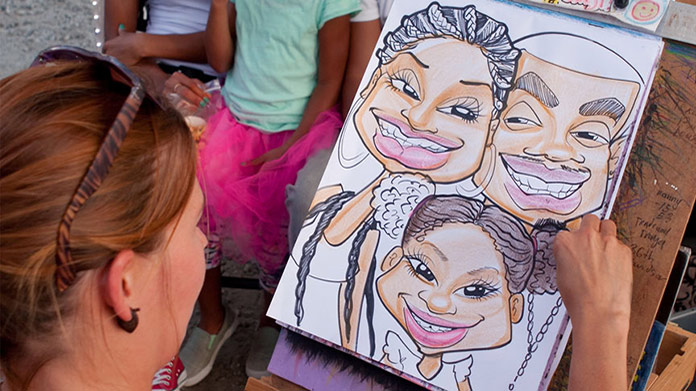
Whether at an art fair, business convention, or community event, caricatures are a fun way to lighten the mood and get people to laugh at themselves. Caricatures are spontaneous illustrations that exaggerate or “cartoonize” the individual’s features. Initially, this artistic expression was simply done on ink and paper. The tradition has now grown to include digital illustrations, with a variety of printing options available.
Our guide is in 3 parts:
One of the many benefits to choosing this as a career path, is that there are very few start-up costs. Business is generally conducted at events, making this a primarily mobile business. Unless you so choose, there is no need for a dedicated office. Many caricature artists now work with clients across the world, selling their digital pieces, so it is recommended that you create a workspace at home, if at all possible.
In addition to artist supplies, it is recommended that you have a simple website built. This is a great opportunity to showcase your work, attracting clients from all over the world. There are a number of options for entrepreneurs who wish to build their own, free websites. Work with a licensed professional to ensure your insurance policies are up-to-date and include any necessary coverages. Since much of your business will be mobile, make sure you have reliable transportation and an insurance policy that will provide coverage should something happen while you are on the road.
Ongoing expenses for a caricature artist business are minimal. Art supplies, website maintenance, and marketing materials should be budgeted for on a monthly basis. Travel expenses, even when only taking on local events, will likely be your largest expense. Should you decide to hire employees, be sure to consider the costs associated with payroll.
The earliest recorded caricature art was found in the works of Leonardo da Vinci, indicating that this art form has been enjoyed for hundreds of years. Intended to lighten the mood and bring smiles, caricature artists are hired to “perform” in settings ranging from carnivals to weddings and other social functions. When devising your marketing strategy, consider what social functions your art could be most enjoyed.
Clients hire caricature artists either by the hour or per person. Fees also vary depending upon materials, such as black and white, color, and digital works.
Caricature artist businesses charge an average of $150 to $250 per hour, depending upon whether the customer requests regular or digital caricatures.
Experienced caricature artist business owners indicate that artists with average speed and skill can bring in up to $600 per day. If you are able to work three events a week, at $600 per event, your business would generate a revenue of over $93,000. Subtract ongoing expenses from this figure and you have a significant profit, particularly for only working three days a week.
As a caricature artist, your business can charge a higher fee for digital work. This method also expands your potential client base, allowing you to reach a much broader audience. Once your work is more well-known, consider approaching syndication companies who might want to feature your work in upcoming newspaper space and want caricature artists who attract subscribers.
Until your business has realized significant growth, your days will be split between administrative and artistic work. When not creating caricatures for a client or attending events, there are emails to be answered, invoices to be dispersed, and client bookings to attend to. While much of your marketing strategy and networking will be hands-on, it will also be necessary for you to promote your business, both in-person and online, ensuring your work reaches a broad audience.
The most obvious skill a caricature artist must possess is artistic talent. Caricatures, however, go beyond just drawing a picture. While the final work will be “cartoonish,” it is critical that it resembles the model. Therefore, caricature artists must have a firm grasp of anatomy, with the ability to pick out a distinguishing feature in each subject. Once you have mastered this, it is all about developing your own style. Aspiring caricaturists are urged to practice as much as possible, in a variety of settings. This not only helps develop a unique style, it assists in fine-tuning the other necessary skills, such as observation, communication, and humor. Since this artistic form requires making creative decisions on the fly, both accurately and quickly, practice really is the most rewarding experience.
While a degree is not required, there are a number of programs across the country that specialize in illustration and cartooning. The Center for Cartoon Studies, located in Vermont, offers a variety of certifications, degrees, and workshops, designed to meet every aspiring caricaturist’s needs. Those who attend a focused school program are able to learn design software such as Adobe Illustrator or ArtRage, create a portfolio, exhibit their work, are able to take part in internship programs, and are provided university support in their job search upon graduation. Additionally, many offer business classes to ensure aspiring entrepreneurs have the knowledge and skills necessary to successfully manage an enterprise.
The introduction of digital technology offers a unique opportunity to modern day caricature artists, expanding their potential client pool to include virtually everyone. Artists who have found the greatest success go on to train a team of individuals across the country, ensuring their business reaches clients in need in every major town.
Since accuracy is critical to your success, veteran caricaturists urge those entering the industry to spend as many hours as possible practicing. And, whenever possible, practice in various settings, as you never know what your next client’s needs might be.
As you build your reputation, you will want to take care of all artistic and administrative duties. However, as your career takes off and you begin to travel, you will find it increasingly difficult to balance your business tasks. At this time, hiring an administrative assistant could prove beneficial. He/she could handle all booking, scheduling, email communication, and invoicing, leaving the creative tasks to you. A number of caricature artists have experienced such an increase in business, that they hired a team of artists to represent them across the country. Since your name and reputation is on the line, it is critical that you provide personalized, hands-on training to any artist that you add to your caricaturist team.
Business Evaluation & Strategy Tool
We'll walk you through the four pillars every business needs: Points of Leverage, Marketing Strategy, Financial Model, and Personal Compatibility. At the end you'll see a personalized report and your action plan below will be tailored to your answers.
Every viable business has natural advantages. Below are common leverage points across four categories. Pick the ones that apply to your Caricature business. We've pre-suggested a few based on your idea — review and adjust.
Without a way to connect with customers, even great businesses fail. Pick the channels you plan to use to reach your customers.
Enter your monthly baseline costs — the minimum overhead to keep the business running. Then we'll calculate how many sales per month you need to break even.
A business that doesn't fit your life will fail no matter how good the numbers look. Tell us how this business fits you.
Complete the four pillars and your personalized summary will appear here.
Nine concrete steps to take you from idea to open business, grouped into 30-day phases. Complete the planner above and we'll highlight what's most important for your situation.
An LLC keeps your personal assets separate from business debts and lawsuits — the most common reason small business owners choose this structure. Sole proprietorships and partnerships do not provide this protection.
Apply for your free Employer Identification Number through the IRS, then register for any state or local taxes that apply to your business (sales tax, franchise tax).
A dedicated business account is required to maintain personal asset protection. Mixing personal and business finances ('piercing the corporate veil') can void your LLC's liability shield.
Recording expenses and income from day one makes tax filing easier and lets you see when the business is actually profitable. Use software (QuickBooks, Wave) or a part-time bookkeeper.
State and local requirements vary widely. Brick-and-mortar businesses typically need a Certificate of Occupancy; service businesses may need specific professional licensing; food businesses need health permits.
General Liability Insurance is the most common starting point. If you'll have employees, most states require Workers' Compensation. Specific industries need additional coverage (product liability, professional liability, etc.).
Your brand is how customers perceive and remember you. A clear name, logo, and visual identity make every later marketing decision easier and protect you legally as you grow.
Every legitimate business needs a website. Social media pages are not a substitute — you don't own the platform. Modern website builders mean you can launch a clean site in a weekend without a developer.
A dedicated business number keeps your personal life private, makes the business look legitimate, and lets you route calls professionally. Cloud phone services start under $20/month.
Starting a Caricature business typically costs $25,000 to $250,000. It is considered a very high capital-intensity business.
A Caricature business runs roughly a 4% net profit margin, and most owners reach break-even in about 4 to 12 months.
You can usually launch a Caricature business in about 12 to 36 weeks, and it is commonly run flexible.
A Caricature business is generally an intermediate-skill business to start, with stable demand. TRUiC rates it 38 out of 100 on our Idea Score.
Most Caricature businesses register as an LLC or other legal entity and obtain a general business license. Depending on your state and city you may also need industry-specific permits, sales tax registration, and zoning or health approvals, so check your local requirements before you launch.