Startup cost
$50k–$500k
TRUiC Business Ideas
Decision Snapshot
Idea Score
45
Startup cost
$50k–$500k
Profit margin
21%
Break-even
4 mo–12 mo
Time to launch
12 wk–36 wk
Demand trend
Stable
5-yr failure rate
—
Capital intensity
Very high
Time commitment
Full time
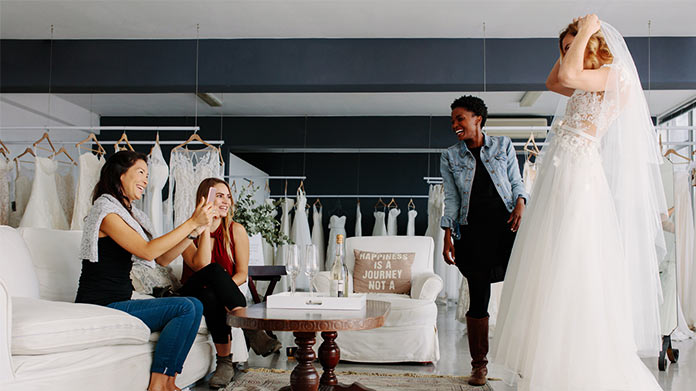
A bridal shop primarily sells dresses and accessories to brides-to-be and members of bridal party (e.g., the maid of honor, the mother of the bride, etc.) They also offer alteration services so everyone can get the perfect fit. Some bridal shops will also sell gowns for formal occasions, such as prom, etc.
Our guide is in 3 parts:
Owners have to calculate the cost of rent, inventory, staff salaries, marketing, and insurance. Costs can be anywhere from several thousand to $50,000 (or more) in the most competitive neighborhoods.
Bridal shop owners will need to account for their inventory, rent/mortgage, and insurance costs. They’ll also need to take into account the staff salaries as well as ongoing marketing costs and the acquisition of new designers.
The target market can theoretically be any socioeconomic group, as most brides prefer to wear a special frock for their special occasion. Owners will need to choose who they want to cater to when it comes to offering their fashions. For example, selling mainly to middle-class women, but also keeping an off-the-rack section for those who may be watching their pennies.
A bridal shop makes money buying selling wedding gowns, bridesmaid dresses, and other wedding accessories to customers.
Brides are usually willing to splurge on a quality dress, even when their wedding budgets aren’t exactly infinite. The average cost of a wedding gown is about $1,100, but brides have been known to spend well into five-figures.
Retail markups are substantial in wedding sales. The wholesale cost of a wedding gown is typically double that of the raw cost of materials, and the retail price is typically double that of wholesale costs. So a dress that cost $500 could easily be sold at $1,000 wholesale and $2,000 in a store.
From accessories to tailoring to autumn formal dresses, there are plenty of ways to entice a wide range of customers into a store. Bridal shops can also consider adding a ‘trunk party’ element to their business where they take their fashions to the bride’s home to show off.
A typical day in a bridal shop will likely involve being on the sales floor as much as possible and researching new trends in formal fashion. Owners will also need to allow time for basic administrative duties, marketing, and stocking merchandise.
Owners should ideally have experience in retail before getting started. They should be organized and have a knack for managing people and tricky situations. Those who design their own wedding dresses may find it difficult to transition from selling ad-hoc dresses to having a full-blown store.
Growth potential for brick-and-mortar bridal shops may be stunted by the growth of online sales, but it’s certainly not impossible to achieve lasting success. The abundance of choices on the market today can be not only overwhelming in terms of abundance but also overwhelming in terms of variety, quality, and costs. Those who can hone in on the most in-demand fashions of the day and provide genuine customer service can build up a steady clientele from the very beginning.
There are a variety of ways to achieve success from your bridal shop business. You may have an eye for designers and a knack for customer service. You may be a talented seamstress or designer who creates true masterpieces for their clients. You may even be able to buy a bridal shop and hire a talented right-hand assistant who can put their vision into reality.
However you choose to make it happen, you need to understand the people behind the purchase. Special occasions are a beloved way to get a break from day-to-day drudgery. You’re selling not just a pretty gown, but an entire experience. People who do well in this business are not only hard workers willing to take on a variety of roles, but also uniquely talented in their ability to put an overwhelmed bride’s mind at ease.
There are also franchise opportunities (e.g., Bride’s Entourage, etc.) for those who aren’t quite sure where to begin. Franchising ensures owners start with an established reputation, which can help their store get a leg-up in the very beginning. They’ll also have a set business model to follow that has already been proven to be successful with clients. However, even franchise owners need to be willing to think outside the box when it comes to stocking and selling truly unforgettable dresses.
Owners may also want to highlight what makes their store unique from online shopping. Despite the surge in popularity, most people still prefer the personal interaction of shopping in a store. Offering people a one-stop shop in their town is a great way to cut through the confusion and frustration of shopping for a special dress online. Not only is it completely impersonal to buy from a faceless buyer on a website, it also takes some of the magic away from the dress.
Bridal shop owners who choose to do appointment-only consultations don’t necessarily need to build a team right away. However, if you’re planning to run a more traditional store, then it only makes sense to hire people right away. Look for people who have experience in both fashion and customer service. Employees will need to understand the more unique points of the business to succeed.
Business Evaluation & Strategy Tool
We'll walk you through the four pillars every business needs: Points of Leverage, Marketing Strategy, Financial Model, and Personal Compatibility. At the end you'll see a personalized report and your action plan below will be tailored to your answers.
Every viable business has natural advantages. Below are common leverage points across four categories. Pick the ones that apply to your Bridal Shop business. We've pre-suggested a few based on your idea — review and adjust.
Without a way to connect with customers, even great businesses fail. Pick the channels you plan to use to reach your customers.
Enter your monthly baseline costs — the minimum overhead to keep the business running. Then we'll calculate how many sales per month you need to break even.
A business that doesn't fit your life will fail no matter how good the numbers look. Tell us how this business fits you.
Complete the four pillars and your personalized summary will appear here.
Nine concrete steps to take you from idea to open business, grouped into 30-day phases. Complete the planner above and we'll highlight what's most important for your situation.
An LLC keeps your personal assets separate from business debts and lawsuits — the most common reason small business owners choose this structure. Sole proprietorships and partnerships do not provide this protection.
Apply for your free Employer Identification Number through the IRS, then register for any state or local taxes that apply to your business (sales tax, franchise tax).
A dedicated business account is required to maintain personal asset protection. Mixing personal and business finances ('piercing the corporate veil') can void your LLC's liability shield.
Recording expenses and income from day one makes tax filing easier and lets you see when the business is actually profitable. Use software (QuickBooks, Wave) or a part-time bookkeeper.
State and local requirements vary widely. Brick-and-mortar businesses typically need a Certificate of Occupancy; service businesses may need specific professional licensing; food businesses need health permits.
General Liability Insurance is the most common starting point. If you'll have employees, most states require Workers' Compensation. Specific industries need additional coverage (product liability, professional liability, etc.).
Your brand is how customers perceive and remember you. A clear name, logo, and visual identity make every later marketing decision easier and protect you legally as you grow.
Every legitimate business needs a website. Social media pages are not a substitute — you don't own the platform. Modern website builders mean you can launch a clean site in a weekend without a developer.
A dedicated business number keeps your personal life private, makes the business look legitimate, and lets you route calls professionally. Cloud phone services start under $20/month.
Starting a Bridal Shop business typically costs $50,000 to $500,000. It is considered a very high capital-intensity business.
A Bridal Shop business runs roughly a 21% net profit margin, and most owners reach break-even in about 4 to 12 months.
You can usually launch a Bridal Shop business in about 12 to 36 weeks, and it is commonly run full time.
A Bridal Shop business is generally an intermediate-skill business to start, with stable demand. TRUiC rates it 45 out of 100 on our Idea Score.
Most Bridal Shop businesses register as an LLC or other legal entity and obtain a general business license. Depending on your state and city you may also need industry-specific permits, sales tax registration, and zoning or health approvals, so check your local requirements before you launch.