Startup cost
$2k–$15k
TRUiC Business Ideas
Decision Snapshot
Idea Score
53
Startup cost
$2k–$15k
Profit margin
3%
Break-even
4 mo–12 mo
Time to launch
12 wk–36 wk
Demand trend
Rising
5-yr failure rate
—
Capital intensity
Medium
Time commitment
Part time
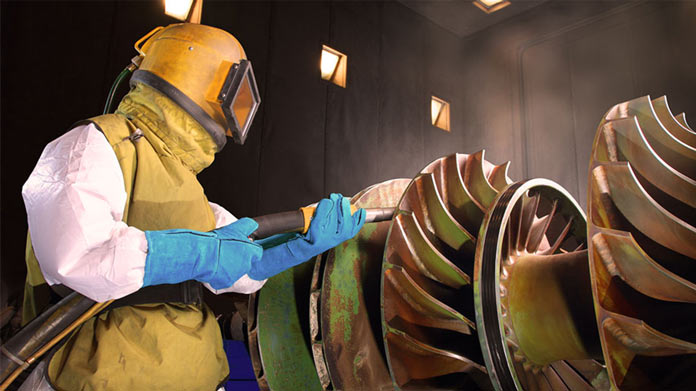
When they’re exposed to harsh conditions, paint and other coatings frequently wear out before the materials they cover. Before reapplying a new paint or coating, all old paint must be removed. This is commonly done by sandblasting it off of the surface to be painted.
Sandblasting businesses efficiently remove paints and coatings from a variety of durable materials, including metal, brick and wood. Some businesses also etch designs into these materials, usually to create signs or gravestone markers.
The term “sandblasting” is still widely used, but it’s becoming slightly archaic. While sand has historically been used, most businesses today use other abrasive substrates. To reflect this shift, sandblasting is sometimes now referred to as “abrasive blasting.”
Our guide is in 3 parts:
Jumping right into large commercial/industrial sandblasting is an expensive proposition. The work requires a facility with tens of thousands of square feet, a crane, forklifts, and not to mention the actual sandblasting equipment. Thankfully, there are much more affordable ways to get started in the industry.
Most sandblasting businesses can be started for between $2,000 and $10,000. The funds go toward:
A sandblaster rig
Substrates (the abrasive material used)
An air compressor
An abrasive hose
A reclaiming system (to gather used substrates)
Safety equipment
Businesses that sandblast small parts might purchase an all-inclusive sandblasting chamber that comes with this equipment installed. Such chambers cost anywhere from a few hundred to a few thousand dollars. These businesses also must secure a commercial space to operate in.
Businesses that go to customers’ sites usually get the equipment as separate items. They also need a vehicle and trailer for going to sites.
Regardless of the type of sandblasting services provided, business owners need a sandblasting hood, respirator, heavy-duty gloves, hearing protection, and protective clothing.
Business owners who have limited capital should purchase smaller equipment that’s more affordable. Smaller, new equipment that’s reliable is often more affordable in the long run than larger, used equipment that might break down. Because safety is so important, business owners should plan on investing in high-quality safety gear.
The ongoing expenses for a sandblasting business are reasonable. Businesses must purchase substrates to use and fuel to run sandblasting equipment. They also must cover the costs associated with having either a physical location or a vehicle.
The target market for a sandblasting business is determined by the precise services the business offers. Most businesses target commercial customers, but some also serve individuals (e.g. homeowners, vehicle owners or individuals planning funerals).
There are many sandblasting services that a business might specialize in. Some types of work that businesses charge for include:
Large commercial/industrial sandblasting (e.g. metal girders, airplanes, helicopters)
Smaller commercial/industrial sandblasting (e.g. buildings, cars, motorcycles)
Sandblasting signs (usually made from wood with a stencil)
Sandblasting gravestones (sometimes after a blank stone has been installed)
Aside from large commercial/industrial sandblasters, most business owners charge between $30 and $60 per hour regardless of their specialty. Larger commercial/industrial sandblasters must charge more to cover their higher overhead.
Charging between $30 and $60 per hour, sandblasting businesses can bring in a significant revenue. Working 20 hours a week part-time could produce an revenue of between $600 and $1,200 each week.
Sandblasting is often done to prep a surface for painting or some other coating. Thus, offering painting or other coating services is a natural progression for a growing sandblasting business.
A typical sandblasting begins with the business owner looking over the object that’s being sandblasted and confirming with the customer what work is to be done. This may be done at the sandblasting business’ or the customer’s location.
Once everything is confirmed, the business owner will normally:
Don their safety gear.
Set up the sandblasting equipment.
Complete the actual sandblasting.
Clean up the substrates that were used.
Throughout the entire process, business owners must be attentive to safety so that no one is injured or inhales the substrates. OHSA has some safety-related guidelines.
Business owners must know how to safely and effectively operate sandblasting equipment, which they may learn by taking a course. Most courses take less than a week to complete, and they may be offered by equipment manufacturers or industry experts. Pittsburgh Spray Equipment Co. and The Society for Protective Coatings are two organizations that have classes. Local vocational schools may also offer training.
After being formally trained, many business owners decide to work in the industry for a short time before starting their own operation. Industry experience frequently brings insights that aren’t learned in the classroom.
A sandblasting business can remain a part-time operation run by a single business owner, or it can grow to be a large company. For example, Dryden Monument Company is a small gravestone company that also provides sandblasting services. Secondary Services is a larger sandblasting company that has a sizable facility.
Before investing in a sandblasting business, business owners should thoroughly investigate what companies currently offer sandblasting services in the area and how much those companies are charging. In addition to searching for sandblasting companies, business owners must also check to see whether any nearby painters, monument companies or contractors offer sandblasting services.
Most business owners start out working by themselves. Those that want to grow their business usually hire employees as the workload requires and incoming revenue allows.
Business Evaluation & Strategy Tool
We'll walk you through the four pillars every business needs: Points of Leverage, Marketing Strategy, Financial Model, and Personal Compatibility. At the end you'll see a personalized report and your action plan below will be tailored to your answers.
Every viable business has natural advantages. Below are common leverage points across four categories. Pick the ones that apply to your Sandblasting business. We've pre-suggested a few based on your idea — review and adjust.
Without a way to connect with customers, even great businesses fail. Pick the channels you plan to use to reach your customers.
Enter your monthly baseline costs — the minimum overhead to keep the business running. Then we'll calculate how many sales per month you need to break even.
A business that doesn't fit your life will fail no matter how good the numbers look. Tell us how this business fits you.
Complete the four pillars and your personalized summary will appear here.
Nine concrete steps to take you from idea to open business, grouped into 30-day phases. Complete the planner above and we'll highlight what's most important for your situation.
An LLC keeps your personal assets separate from business debts and lawsuits — the most common reason small business owners choose this structure. Sole proprietorships and partnerships do not provide this protection.
Apply for your free Employer Identification Number through the IRS, then register for any state or local taxes that apply to your business (sales tax, franchise tax).
A dedicated business account is required to maintain personal asset protection. Mixing personal and business finances ('piercing the corporate veil') can void your LLC's liability shield.
Recording expenses and income from day one makes tax filing easier and lets you see when the business is actually profitable. Use software (QuickBooks, Wave) or a part-time bookkeeper.
State and local requirements vary widely. Brick-and-mortar businesses typically need a Certificate of Occupancy; service businesses may need specific professional licensing; food businesses need health permits.
General Liability Insurance is the most common starting point. If you'll have employees, most states require Workers' Compensation. Specific industries need additional coverage (product liability, professional liability, etc.).
Your brand is how customers perceive and remember you. A clear name, logo, and visual identity make every later marketing decision easier and protect you legally as you grow.
Every legitimate business needs a website. Social media pages are not a substitute — you don't own the platform. Modern website builders mean you can launch a clean site in a weekend without a developer.
A dedicated business number keeps your personal life private, makes the business look legitimate, and lets you route calls professionally. Cloud phone services start under $20/month.
Starting a Sandblasting business typically costs $2,000 to $15,000. It is considered a medium capital-intensity business.
A Sandblasting business runs roughly a 3% net profit margin, and most owners reach break-even in about 4 to 12 months.
You can usually launch a Sandblasting business in about 12 to 36 weeks, and it is commonly run part time.
A Sandblasting business is generally an intermediate-skill business to start, with rising demand. TRUiC rates it 53 out of 100 on our Idea Score.
Most Sandblasting businesses register as an LLC or other legal entity and obtain a general business license. Depending on your state and city you may also need industry-specific permits, sales tax registration, and zoning or health approvals, so check your local requirements before you launch.