Startup cost
$25k–$250k
TRUiC Business Ideas
Decision Snapshot
Idea Score
43
Startup cost
$25k–$250k
Profit margin
8%
Break-even
4 mo–12 mo
Time to launch
12 wk–36 wk
Demand trend
Stable
5-yr failure rate
—
Capital intensity
Very high
Time commitment
Flexible
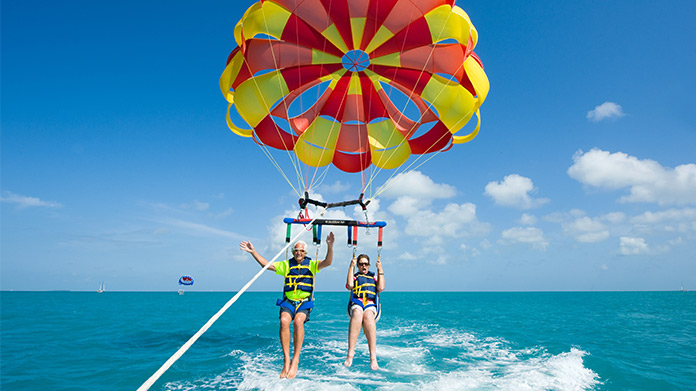
A parasailing business offers adventurous individuals the opportunity to experience sun, sea, and sand in an exciting and visually interesting way. Parasailing gives customers the freedom of flight and the exhilaration of skydiving in an accessible medium.
Our guide is in 3 parts:
A startup for this type of business can be fairly pricey as you will need a powerful boat, outfitted with a parasailing base and winch, at least one parasail, tethering rope, and single and double harnesses for your riders. You will also need insurance for the business and your customers riding the parasail.
Boat and equipment maintenance will be some of your biggest costs. Replacing the tow rope is essential for proper safety and should probably be replaced each year. Fuel for the boat(s) will also add up, over time. Also, rent and utilities for your shop and wet and dry storage of the boat(s) will add to your overall annual bills.
Your target market for a parasailing business will be tourists and visitors to your beach, lake, river, etc. Focus on safe excitement for individuals, families, and couples. Tandem harnesses are often quite popular, as two participants are likely to influence each other into joining the adventure.
Parasailing businesses make their money through customers, either from booked reservations or walk-ins looking for excitement on the spur of the moment.
Assuming you have chosen a location with minimal competition and a steady flow of customers, your business can be quite profitable. As mentioned previously, there will be a sizable start-up cost for equipment, brick and mortar location, and a boat or two. Once these costs are covered, your earning potential should remain consistent and in the black. An average 10 minute parasail ride will cost about $30. You will realistically see 25-40 customers per day, if not more in the summer months and holidays.
Your profits will fluctuate some, depending on if you’re in season or not. A successful parasail business could see profits in the range of $150,000-250,000, annually.
Since many of your customers will be enjoying parasailing for the first time, they may want to capture the experience for posterity and the memories. Consider adding a photography or videography package to go along with the parasail ride. Attaching a GoPro camera to the harness will help capture the experience for your customers. Also, a photographer at the beginning or end of the trip will give customers a chance to have an excellent memory, encapsulated through quality digital photographs. These additions are surprisingly inexpensive, yet become big attractions for your customers and extra revenue for you.
Day to day activities revolve around client interactions. The more people you can take out on your boat(s), the better the business does. The business, therefore, must continually work to entice customers through your doors and offer these same customers a memorable and safe experience. Additionally, these businesses will:
Advertise and promote their business locally and regionally.
Inspect, repair, replace, and clean all equipment. Safety is key.
Tune up and maintain tow boat(s).
Since parasailing is primarily a tourist-driven business, you need to be able to successfully communicate with and entice potential customers. Expressing your enthusiasm for parasailing to your customer base is a necessary trait to possess. You should also have experience in and around boats, both driving and repairing and maintaining, as the boat is an essential part of your business. You should also be somewhat obsessive about safety and proper procedure. Your reputation as a careful and cautious parasail operator will go very far in attracting and retaining customers, via your reputation.
Proper location will prove to be one of the biggest factors in your business’ success. If you are visible and easily accessible to customers, and have a reputation for safety and reliability, you can see your business venture take off…no pun intended.
Since this type of business often thrives on being a novelty attraction, you will need to research the potential customer traffic, as well as competition, for the location of your parasailing operation. You will need to be unique and stand out as a different option for enjoying the water and natural surroundings. Your storefront and beachside kiosk(s) must be visible and readily prepared to sign up customers for time slots. To increase customer recognition, employ social media, such as Facebook and Instagram, as marketing and advertising sources, as well as methods for booking parasailing expeditions.
There is also the option of buying an existing parasailing business, as a turnkey operation. This method will afford you an existing business model to work to improve upon and the boat, equipment, and location to get started. This way, you will be able to allocate a bit more of your energy towards generating excitement about the new ownership. A change sometimes spurns new interest in an already existing business, just by virtue of new resonating in customers’ minds. And a fresh perspective may see more options for generating a greater revenue stream.
To begin, you’ll probably only need one or two additional employees, as the bulk of the work will entail routine maintenance of the equipment and boat, as well as the piloting of the boat for parasailing outings. As your clientele numbers grow, so can your team. Eventually, you may even have more than one location in your area, effectively capturing more business. These satellite outposts will need a team member or two to operate, yet your team will still remain relatively conservative in size. Maximize your potential by minimizing your overhead and operating costs.
Business Evaluation & Strategy Tool
We'll walk you through the four pillars every business needs: Points of Leverage, Marketing Strategy, Financial Model, and Personal Compatibility. At the end you'll see a personalized report and your action plan below will be tailored to your answers.
Every viable business has natural advantages. Below are common leverage points across four categories. Pick the ones that apply to your Parasailing business. We've pre-suggested a few based on your idea — review and adjust.
Without a way to connect with customers, even great businesses fail. Pick the channels you plan to use to reach your customers.
Enter your monthly baseline costs — the minimum overhead to keep the business running. Then we'll calculate how many sales per month you need to break even.
A business that doesn't fit your life will fail no matter how good the numbers look. Tell us how this business fits you.
Complete the four pillars and your personalized summary will appear here.
Nine concrete steps to take you from idea to open business, grouped into 30-day phases. Complete the planner above and we'll highlight what's most important for your situation.
An LLC keeps your personal assets separate from business debts and lawsuits — the most common reason small business owners choose this structure. Sole proprietorships and partnerships do not provide this protection.
Apply for your free Employer Identification Number through the IRS, then register for any state or local taxes that apply to your business (sales tax, franchise tax).
A dedicated business account is required to maintain personal asset protection. Mixing personal and business finances ('piercing the corporate veil') can void your LLC's liability shield.
Recording expenses and income from day one makes tax filing easier and lets you see when the business is actually profitable. Use software (QuickBooks, Wave) or a part-time bookkeeper.
State and local requirements vary widely. Brick-and-mortar businesses typically need a Certificate of Occupancy; service businesses may need specific professional licensing; food businesses need health permits.
General Liability Insurance is the most common starting point. If you'll have employees, most states require Workers' Compensation. Specific industries need additional coverage (product liability, professional liability, etc.).
Your brand is how customers perceive and remember you. A clear name, logo, and visual identity make every later marketing decision easier and protect you legally as you grow.
Every legitimate business needs a website. Social media pages are not a substitute — you don't own the platform. Modern website builders mean you can launch a clean site in a weekend without a developer.
A dedicated business number keeps your personal life private, makes the business look legitimate, and lets you route calls professionally. Cloud phone services start under $20/month.
Starting a Parasailing business typically costs $25,000 to $250,000. It is considered a very high capital-intensity business.
A Parasailing business runs roughly a 8% net profit margin, and most owners reach break-even in about 4 to 12 months.
You can usually launch a Parasailing business in about 12 to 36 weeks, and it is commonly run flexible.
A Parasailing business is generally an intermediate-skill business to start, with stable demand. TRUiC rates it 43 out of 100 on our Idea Score.
Most Parasailing businesses register as an LLC or other legal entity and obtain a general business license. Depending on your state and city you may also need industry-specific permits, sales tax registration, and zoning or health approvals, so check your local requirements before you launch.