Startup cost
$25k–$250k
TRUiC Business Ideas
Decision Snapshot
Idea Score
56
Startup cost
$25k–$250k
Profit margin
22%
Break-even
4 mo–12 mo
Time to launch
12 wk–36 wk
Demand trend
Stable
5-yr failure rate
—
Capital intensity
Very high
Time commitment
Full time
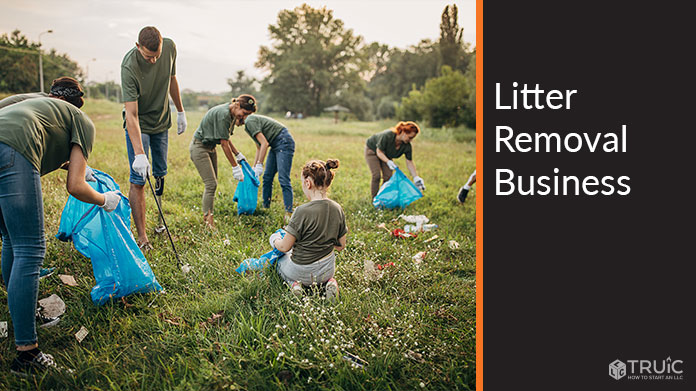
Future business owners who want to positively impact the environment, enjoy clean spaces, and want to help their town or city may find success and satisfaction in starting a litter removal business. Litter removal businesses may cater to public places (such as parks and walkways) or may prefer to work with private clients. No matter what combination of clientele a litter removal business chooses to cater to, it’s likely that they’ll always have a busy roster of clients to serve.
Our guide is in 3 parts:
Costs involved with opening a litter removal business may include:
Contracts with a waste management company to dispose of collected litter
Supplies, including trash removal items and trash bags
Uniforms or other forms of employee identification
Transportation capable of moving litter removal equipment from one job to another
Advertising, marketing, and accounting costs
Ongoing expenses for a litter removal business may include:
Updating reusable equipment
Keeping an inventory of single-use equipment (like trash bags)
Payroll
Insurance
Transportation
Bills for large-scale removal of collected litter by a waste management company
Anyone who owns, manages, or takes care of large amounts of public or private property may be interested in litter removal. The target market for this type of business can be vast and can include owners and managers of both indoor and outdoor spaces.
A litter removal business makes money by contracting with clients to remove litter in a public or private space. Jobs may be ongoing (such as contracting with a city government to remove litter on a daily basis at a local landmark) or one-time (such as contracting with a festival to remove litter after the event).
It’s hard to say exactly how much a litter removal service can charge, as the price of the service will change depending on what the customer needs. It’s important that litter removal business owners learn more about the going rate for their services in the area. The cost charged likely depends on several factors, including the expected manpower needed for the job, the frequency of the job, the space that needs to be covered, and the amount of litter present.
Similar to the hourly pay for a janitorial service, many litter removal companies charge about $50 per hour. Larger events, of course, allow litter removal companies to charge higher fees. Some litter removal companies may make deals with regular customers to lower the fee in exchange for a long-term contract.
Like any business, one of the most important factors of a profitable operation is working with well-trained, trustworthy employees. Putting extra time into the screening and training processes can help ensure that a litter removal business becomes as profitable as possible.
A litter removal business owner must complete several tasks throughout each day. Litter removal daily business tasks may include:
Taking inventory of supplies and ordering new supplies when necessary
Scheduling employees
Interviewing potential new employees
Talking with potential customers about possible upcoming jobs
Talking with current customers about current jobs
Troubleshooting with unsatisfied customers about how to improve their litter removal experience
Developing digital and print marketing campaigns
Invoicing clients and managing payroll (if these tasks are not outsourced to a private accounting company)
Working with trash removal companies to coordinate litter drop off
While a basic understanding of litter management is important, people skills and communication skills are also key for a successful litter management business. Contacts with local businesses or government workers who could utilize litter removal services can also come in handy when launching a litter removal business.
The growth potential for a litter removal business is nearly limitless, as long as the owner of the business is willing to delegate management tasks to others. A litter removal business may start by working with a small local area and eventually branch out to offer services to a larger area.
Relationships are key for a litter removal business. Trash on the ground can make or break an event, and customers need to know that they can depend on their litter management service to get the job done right. It’s important that litter removal businesses complete every single job and work tirelessly to correct any mistakes.
It’s quite difficult to run a litter removal service as a one-person operation, especially when the service is working on large events. It can be a smart move to build a team right away. At first, the owner of the litter removal service may need to be present at each vent, but that can change over time as the owner begins to notice leadership qualities in employees and decides to promote them to middle management.
Business Evaluation & Strategy Tool
We'll walk you through the four pillars every business needs: Points of Leverage, Marketing Strategy, Financial Model, and Personal Compatibility. At the end you'll see a personalized report and your action plan below will be tailored to your answers.
Every viable business has natural advantages. Below are common leverage points across four categories. Pick the ones that apply to your Litter Removal business. We've pre-suggested a few based on your idea — review and adjust.
Without a way to connect with customers, even great businesses fail. Pick the channels you plan to use to reach your customers.
Enter your monthly baseline costs — the minimum overhead to keep the business running. Then we'll calculate how many sales per month you need to break even.
A business that doesn't fit your life will fail no matter how good the numbers look. Tell us how this business fits you.
Complete the four pillars and your personalized summary will appear here.
Nine concrete steps to take you from idea to open business, grouped into 30-day phases. Complete the planner above and we'll highlight what's most important for your situation.
An LLC keeps your personal assets separate from business debts and lawsuits — the most common reason small business owners choose this structure. Sole proprietorships and partnerships do not provide this protection.
Apply for your free Employer Identification Number through the IRS, then register for any state or local taxes that apply to your business (sales tax, franchise tax).
A dedicated business account is required to maintain personal asset protection. Mixing personal and business finances ('piercing the corporate veil') can void your LLC's liability shield.
Recording expenses and income from day one makes tax filing easier and lets you see when the business is actually profitable. Use software (QuickBooks, Wave) or a part-time bookkeeper.
State and local requirements vary widely. Brick-and-mortar businesses typically need a Certificate of Occupancy; service businesses may need specific professional licensing; food businesses need health permits.
General Liability Insurance is the most common starting point. If you'll have employees, most states require Workers' Compensation. Specific industries need additional coverage (product liability, professional liability, etc.).
Your brand is how customers perceive and remember you. A clear name, logo, and visual identity make every later marketing decision easier and protect you legally as you grow.
Every legitimate business needs a website. Social media pages are not a substitute — you don't own the platform. Modern website builders mean you can launch a clean site in a weekend without a developer.
A dedicated business number keeps your personal life private, makes the business look legitimate, and lets you route calls professionally. Cloud phone services start under $20/month.
Starting a Litter Removal business typically costs $25,000 to $250,000. It is considered a very high capital-intensity business.
A Litter Removal business runs roughly a 22% net profit margin, and most owners reach break-even in about 4 to 12 months.
You can usually launch a Litter Removal business in about 12 to 36 weeks, and it is commonly run full time.
A Litter Removal business is generally an intermediate-skill business to start, with stable demand. TRUiC rates it 56 out of 100 on our Idea Score.
Most Litter Removal businesses register as an LLC or other legal entity and obtain a general business license. Depending on your state and city you may also need industry-specific permits, sales tax registration, and zoning or health approvals, so check your local requirements before you launch.