Startup cost
$25k–$250k
TRUiC Business Ideas
Decision Snapshot
Idea Score
58
Startup cost
$25k–$250k
Profit margin
23%
Break-even
4 mo–12 mo
Time to launch
12 wk–36 wk
Demand trend
Stable
5-yr failure rate
—
Capital intensity
Very high
Time commitment
Full time
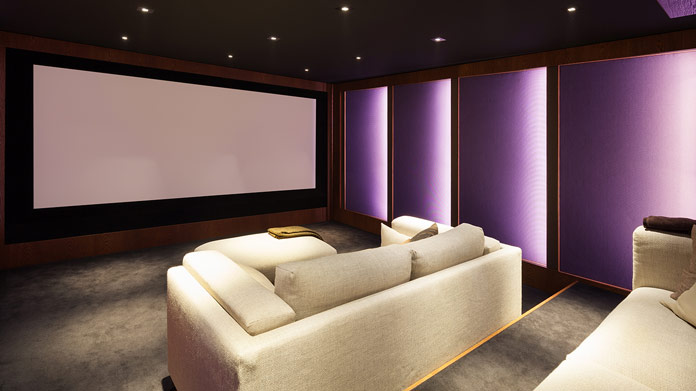
A home theater installation business specializes in setting up assorted audio and video equipment for individual home theaters. Many of these businesses branch out and offer their services to schools, businesses, universities, churches, and other organizations that may need specialized assistance. In this way, a home theater installation business can almost immediately assert itself as a vital component of the community.
Our guide is in 3 parts:
Perhaps the best thing about a home theater installation business is that it has a truly low start-up cost. In fact, you could likely start your business for about $3000, with $500 of that going towards a professional website, $500 going towards getting insurance, and the rest going towards a mixture of radio, newspaper, and online advertisement. The nature of the business requires traveling to your clients’ homes, so you have no real overhead of your own. Similarly, clients will have already paid (or will order themselves) any of the equipment they want to set up. In short: you show up, you set things up.
Aside from paying approximately $500 for insurance per year and $100 per year to maintain your website hosting, this job has no ongoing expenses aside from fuel spent driving to customer’s homes. Also, you may periodically decide to run more advertisements offline, online, or both. Other than this, your customers will be paying for and providing all of the materials, so you have no need to store large amounts of equipment.
While you will appeal to many demographics, your target market will typically be men in their mid to late thirties. This is a demographic that is likelier to be settling into a permanent home and have enough disposable income to set this up, possibly as part of a “man cave.”
Typically, you will make money by charging fixed fees for particular services (such as mounting a flat screen TV, setting up a stereo, and so on). You may consider offering “bundles” that allow customers who need a variety of services to save money.
Your prices may vary considerably based on the exact service you are performing, how much competition you have, and the general economy of the area. For instance, you might charge between $300-$1000 for a full setup that includes setting up a TV and surround sound stereo system. This charge would include installing any relevant boxes and completing any relevant wiring and any relevant cable setup. Typically, you would create a chart of prices, though, that allows compares to pay less for a single specific service. You may also charge separate fees for consultation (simply helping people plan their home theaters) and possibly more specialized services, such as any home automation in the room.
The nature of this business means that the amount of profit that you make is entirely up to the amount of customers you have and the array of services they require. For instance, if you charge $500 for basic home theater installation and service two hundred customers in the area, then you can turn this into a six-figure job. Realistically, you will make less than that (at least, initially), but this is also a job that can easily be performed “part-time” while you are starting out. This allows you to gauge how regularly your services will be required in this area.
The main key to making this business more profitable is expansion. Specifically, expanding the services that you offer to include things like home automation automatically increases your potential customer base. And expanding your customers to schools, universities, and corporations that may need help setting up media rooms not only gives you more customers, but may give you a regular client that calls upon you for years to come. Finally, you may consider offering more services in terms of finding home theater equipment and procuring it. Realistically, this doesn’t take you that long, but a customer who feels out of his depth will feel relieved that you are willing to do this.
With luck, most of your days will be spent inside customer’s homes, and you will be installing everything they require. Time not spent doing this may be spent advertising your business, communicating with customers (or prospective customers), and possibly ordering and receiving equipment for customers.
Obviously, previous experience setting up your own home entertainment system and those of your friends and family is really valuable. While not required, any formal education in audio and video related fields can also help you set this business up more quickly. Finally, any experience you may have had working in a similar field as an employer who offers this service (such as Best Buy) can help you understand how the competition works and to help you set your business apart,
The growth potential for this business is modest, with the Bureau of Labor Statistics estimating that the broader field of broadcast and sound engineer technicians to grow by seven percent between 2014 and 2024.
Be sure to call around your area and see what your competition charges and what services they offer. This lets you make both your prices and your services competitive and enticing for your customers.
The nature of this business ensures that you will spend most of your time working alone. One possible exception may occur if your business branches out to offer more complex services such as home automation. Because of the complexity (and possible local or state laws requiring certification), it may be worth it to periodically work with a certified electrician to help with these particular jobs.
Business Evaluation & Strategy Tool
We'll walk you through the four pillars every business needs: Points of Leverage, Marketing Strategy, Financial Model, and Personal Compatibility. At the end you'll see a personalized report and your action plan below will be tailored to your answers.
Every viable business has natural advantages. Below are common leverage points across four categories. Pick the ones that apply to your Home Theater business. We've pre-suggested a few based on your idea — review and adjust.
Without a way to connect with customers, even great businesses fail. Pick the channels you plan to use to reach your customers.
Enter your monthly baseline costs — the minimum overhead to keep the business running. Then we'll calculate how many sales per month you need to break even.
A business that doesn't fit your life will fail no matter how good the numbers look. Tell us how this business fits you.
Complete the four pillars and your personalized summary will appear here.
Nine concrete steps to take you from idea to open business, grouped into 30-day phases. Complete the planner above and we'll highlight what's most important for your situation.
An LLC keeps your personal assets separate from business debts and lawsuits — the most common reason small business owners choose this structure. Sole proprietorships and partnerships do not provide this protection.
Apply for your free Employer Identification Number through the IRS, then register for any state or local taxes that apply to your business (sales tax, franchise tax).
A dedicated business account is required to maintain personal asset protection. Mixing personal and business finances ('piercing the corporate veil') can void your LLC's liability shield.
Recording expenses and income from day one makes tax filing easier and lets you see when the business is actually profitable. Use software (QuickBooks, Wave) or a part-time bookkeeper.
State and local requirements vary widely. Brick-and-mortar businesses typically need a Certificate of Occupancy; service businesses may need specific professional licensing; food businesses need health permits.
General Liability Insurance is the most common starting point. If you'll have employees, most states require Workers' Compensation. Specific industries need additional coverage (product liability, professional liability, etc.).
Your brand is how customers perceive and remember you. A clear name, logo, and visual identity make every later marketing decision easier and protect you legally as you grow.
Every legitimate business needs a website. Social media pages are not a substitute — you don't own the platform. Modern website builders mean you can launch a clean site in a weekend without a developer.
A dedicated business number keeps your personal life private, makes the business look legitimate, and lets you route calls professionally. Cloud phone services start under $20/month.
Starting a Home Theater business typically costs $25,000 to $250,000. It is considered a very high capital-intensity business.
A Home Theater business runs roughly a 23% net profit margin, and most owners reach break-even in about 4 to 12 months.
You can usually launch a Home Theater business in about 12 to 36 weeks, and it is commonly run full time.
A Home Theater business is generally an intermediate-skill business to start, with stable demand. TRUiC rates it 58 out of 100 on our Idea Score.
Most Home Theater businesses register as an LLC or other legal entity and obtain a general business license. Depending on your state and city you may also need industry-specific permits, sales tax registration, and zoning or health approvals, so check your local requirements before you launch.