Startup cost
$6.0M
TRUiC Business Ideas
Decision Snapshot
Idea Score
50
Startup cost
$6.0M
Profit margin
35%
Break-even
4 mo–12 mo
Time to launch
12 wk–36 wk
Demand trend
Stable
5-yr failure rate
—
Capital intensity
Very high
Time commitment
Full time
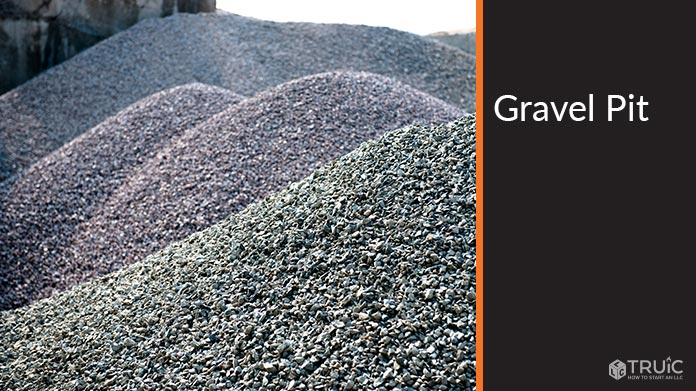
This business extracts stones from the ground and transforms them into large quantities of gravel. It may also deliver the product to customers. When you own a gravel pit, you don’t merely produce and sell a commodity, you provide an affordable, long-lasting surface material for driveways, walking paths, parking areas, and rural roads.
Our guide is in 3 parts:
You’ll need to buy land that contains suitable stones in large numbers. Before you can start producing gravel, you must acquire multiple permits. You will also have to remove trees and soil. A tall fence with a gate provides vital security.
These facilities use a variety of heavy-duty equipment. A used crusher typically costs over $20,000. While you might spend $65,000 on a new backhoe loader, pre-owned machines start at around $15,000. Water pumps and pipes often prove necessary as well. You can serve more customers when you own a dump truck and offer delivery. The price of a high-capacity truck ranges from about $25,000 for a 30-year-old vehicle to $120,000 for a new model. To minimize initial costs, pay a contractor to perform crushing tasks. They will bring their own equipment. The same goes for blasting.
If you don’t want to prepare a new site or buy individual pieces of machinery, you could purchase a fully functional business instead. These companies frequently cost over $1 million. You might pay $800,000 for a small facility or $4 million for a much larger operation.
You’ll need to budget funds for utilities, property taxes, loan interest, advertising, wages, equipment upkeep, and fuel. Most dump trucks only travel four to seven miles per gallon. A replacement tire will cost at least $400. In addition to buying workers’ compensation coverage, you should insure expensive equipment. Liability insurance premiums add around $1,000 to your annual expenses.
Gravel businesses have a tremendous variety of potential customers. Residential buyers include landlords and homeowners who maintain driveways, gardens, or private roads. Local and county governments may have their own gravel pits, but some of them buy this commodity from businesses. Contractors such as landscapers and construction companies often purchase gravel. The same goes for concrete manufacturers. You could also supply it to establishments that resell this product, such as garden centers or hardware stores.
People tend to buy more gravel in rural areas. However, this material isn’t desirable for anyone who uses a snow blower. Individual homeowners might pay higher prices because they order smaller quantities, but large businesses and municipalities will spend more consistently.
Customers usually pay for gravel by the ton. Separate delivery charges may apply as well. Your company might sell other raw materials harvested from the same land, such as sand or lumber. Sales fluctuate depending on the weather and local construction activity. In many regions, spring and summer represent the best times of year to lay fresh gravel.
Prices often range from $12 to $45 for each ton. They vary depending on the level of demand and number of competitors in the vicinity. The smallest stones cost significantly more than larger rock fragments. Delivery adds around $5 per ton.
Profits vary considerably; net margins range from about 10 to 35%. You might earn $25,000 to $100,000 after expenses. Relatively large facilities have the potential to produce over $1 million in revenue.
Use a fleet fuel card or other discount program that reduces gasoline and diesel prices for business owners. Make sure it lets you fill up at conveniently located stations. Don’t overlook fuel efficiency ratings when buying trucks. The difference between four and five mpg may seem trivial at first, but it represents a 25% increase.
Try to employ people who can maintain and fix equipment. Choose models that are comparatively easy to repair. Consider diversifying your business by using some of the same machines and materials to provide other services, such as excavation, equipment rentals, or drainage improvements.
You’ll use heavy equipment like bulldozers and backhoes to extract stones. Next, you have to screen, crush, and sort them. Customers might travel to your pit and ask you to load their vehicles with gravel. Others may request deliveries. If you provide this service, you’ll need to load a truck and travel to the buyer’s home, facility, or work site.
You can benefit from knowing how to operate heavy equipment and repair machinery. A commercial driver’s license is helpful. To learn how to run a gravel business, check out Pit & Quarry University. It provides 14 free online lessons consisting of detailed information, photos, and quizzes.
Around two-thirds of producers experienced sales growth of at least 5% in 2019, according to Pit & Quarry. Experts predict further increases in the industry. Successful businesses can create additional pits on the same property or establish separate locations, allowing them to serve larger geographic areas. For example, Thelen Sand and Gravel opened its first facility over 70 years ago. It eventually added two more locations in Wisconsin and Illinois. Keep in mind that extraction gradually depletes a pit. It may continue to produce gravel for decades or run empty in as few as five years.
Don’t put off the acquisition of high-quality safety gear. Masks shield workers from particles that may cause cancer, heart disease, and other serious conditions. It’s crucial to protect your eyes and ears as well. To prevent accidents and health problems, strive to limit the road dust around your facility. You can accomplish this by applying water or magnesium chloride to dry surfaces.
The weight of gravel makes it costly to transport. Try to choose a pit location near potential commercial, municipal, and industrial clients. Avoid sites close to homes because locals may complain about the noise and pollution. Too much water can force these businesses to stop serving customers. Pits at higher elevations don’t flood as easily. A tall levee also reduces the risk. Income may rise significantly if your pit remains open while others flood.
Equipment failure could disrupt production or sales even as you continue paying wages and overhead expenses. It’s important to purchase reliable machinery, maintain it well, and train operators thoroughly. Keep maintenance logs and routinely inspect the equipment.
You’ll probably need employees to run an efficient gravel pit. Look for responsible individuals with equipment operation skills. Keep in mind that state law may require them to undergo safety training for a certain number of hours. Workers at gravel pits and other quarries get paid about $46,400 per year on average, according to ZipRecruiter.
Business Evaluation & Strategy Tool
We'll walk you through the four pillars every business needs: Points of Leverage, Marketing Strategy, Financial Model, and Personal Compatibility. At the end you'll see a personalized report and your action plan below will be tailored to your answers.
Every viable business has natural advantages. Below are common leverage points across four categories. Pick the ones that apply to your Gravel Pit business. We've pre-suggested a few based on your idea — review and adjust.
Without a way to connect with customers, even great businesses fail. Pick the channels you plan to use to reach your customers.
Enter your monthly baseline costs — the minimum overhead to keep the business running. Then we'll calculate how many sales per month you need to break even.
A business that doesn't fit your life will fail no matter how good the numbers look. Tell us how this business fits you.
Complete the four pillars and your personalized summary will appear here.
Nine concrete steps to take you from idea to open business, grouped into 30-day phases. Complete the planner above and we'll highlight what's most important for your situation.
An LLC keeps your personal assets separate from business debts and lawsuits — the most common reason small business owners choose this structure. Sole proprietorships and partnerships do not provide this protection.
Apply for your free Employer Identification Number through the IRS, then register for any state or local taxes that apply to your business (sales tax, franchise tax).
A dedicated business account is required to maintain personal asset protection. Mixing personal and business finances ('piercing the corporate veil') can void your LLC's liability shield.
Recording expenses and income from day one makes tax filing easier and lets you see when the business is actually profitable. Use software (QuickBooks, Wave) or a part-time bookkeeper.
State and local requirements vary widely. Brick-and-mortar businesses typically need a Certificate of Occupancy; service businesses may need specific professional licensing; food businesses need health permits.
General Liability Insurance is the most common starting point. If you'll have employees, most states require Workers' Compensation. Specific industries need additional coverage (product liability, professional liability, etc.).
Your brand is how customers perceive and remember you. A clear name, logo, and visual identity make every later marketing decision easier and protect you legally as you grow.
Every legitimate business needs a website. Social media pages are not a substitute — you don't own the platform. Modern website builders mean you can launch a clean site in a weekend without a developer.
A dedicated business number keeps your personal life private, makes the business look legitimate, and lets you route calls professionally. Cloud phone services start under $20/month.
Starting a Gravel Pit business typically costs $6,020,000. The largest cost is usually build-out and space. It is considered a very high capital-intensity business.
A Gravel Pit business runs roughly a 35% net profit margin, and most owners reach break-even in about 4 to 12 months.
You can usually launch a Gravel Pit business in about 12 to 36 weeks, and it is commonly run full time.
A Gravel Pit business is generally an intermediate-skill business to start, with stable demand. TRUiC rates it 50 out of 100 on our Idea Score.
Most Gravel Pit businesses register as an LLC or other legal entity and obtain a general business license. Depending on your state and city you may also need industry-specific permits, sales tax registration, and zoning or health approvals, so check your local requirements before you launch.