Startup cost
$50k–$300k
TRUiC Business Ideas
Decision Snapshot
Idea Score
56
Startup cost
$50k–$300k
Profit margin
23%
Break-even
18 mo–36 mo
Time to launch
12 wk–36 wk
Demand trend
Stable
5-yr failure rate
—
Capital intensity
Very high
Time commitment
Full time
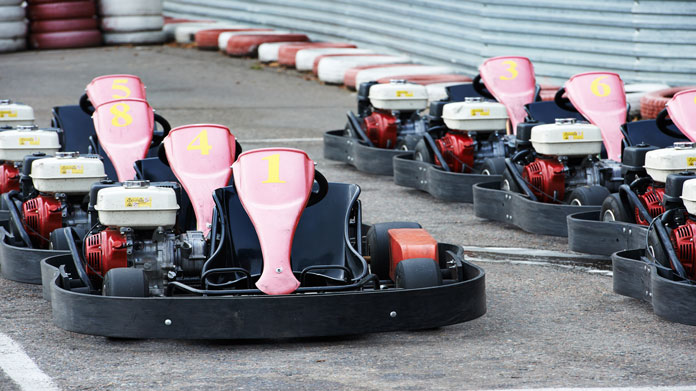
A go-kart business offers indoor racing opportunities for go-kart enthusiasts. Races include go-kart rentals, track use, and other race-related activities. Modern go-kart businesses grant drivers the opportunity to engage in low, medium, or high-speed races on indoor race tracks. Services include go-kart rental, safety gear rental, custom race options, and by-the-hour track use. A go-kart business can be a standalone entity or exist as part of a larger entertainment center, park, or public attraction.
Our guide is in 3 parts:
The average go-kart business can cost up to $300,000 to start, due to a plethora of startup costs. Owners will need to supply a warehouse, a multitude of karts, gasoline, maintenance tools, insurance, track materials, and safety equipment. Facility rent is approximately $2,400 to $4,000 per month, depending on the facility’s size and maintenance needs.
A go-kart business can expect to pay for kart depreciation, gas, kart maintenance, track maintenance, facility cooling, heating, and insurance. Employees will be paid between $8 and $20 per hour, depending on their roles. On a monthly basis, you can expect to pay between $200 and $400 for your warehouse’s utility needs. Heating will also be included in your ongoing expenses as your customers will like to stay warm, and large warehouses often lost heat quickly.
Because go-kart racing can be incredibly dangerous, preferred clients are those who abide by location rules and who don’t drive recklessly. Understandably, go-karting caters to younger crowds. For this reason, family units are great customer types—if only to enhance a younger rider’s safety.
Go-kart tracks are normally found within arcade complexes, so consistent memberships, on average, are more profitable than single-use riders. A go-kart track profits from ongoing bulk service packages, as they assure consistent services and a constant stream of revenue.
An independent go-kart track makes money from either individual rides or monthly memberships. Again, successful tracks utilize ongoing payment “packages” to ensure visitors return. Basic go-kart tracks make money from races, but some may charge extra for site-provided safety equipment. Small amenities, like food and drinks, can make a go-kart track money, too.
If a go-kart track is part of a larger complex, it will either be treated as the part complex or as its own entity serving under the complex. If the latter is true, money is earned after the overarching complex makes revenue.
Customers can be charged, on average, about $5 per ride. Safety gear should be rented for between $5 and $10 as their use limits overall track usage. If you want to make more money, consider offering yearly memberships for between $100 and $200, or you can offer special memberships for quick-access riding. Fortunately, go-kart pricing is incredibly variable. Since you’re dealing with kart depreciation, gasoline, and maintenance as expenses, you needn’t worry too much about each kart’s value compared to its use.
While a go-karting business can cost a lot to open, its profits can be large. LLC go-kart businesses can make between $500,000 and $700,000 yearly, if they’re smart about attracting and retaining visitors. However, it’s a good idea to join a franchise to increase service reliability. Individual facilities can spend thousands of dollars on financial and marketing advice.
Reduce the liabilities as much as possible. New go-kart businesses face a lot of difficulty, expense-wise, with insurance and property upkeep. Once your business has grown, join a franchise or become part of an entertainment complex. You could also enter the high-speed racing market niche, and attract long-term customers with unique, competitive membership plans.
Go-kart business owners handle insurance plans, kart maintenance, track timing systems, part sourcing, safety gear sourcing, barrier setup, and day-to-day racing governance. Looking through an administrative lens, successful go-kart business owners handle finances, marketing, management, and location maintenance. Successful tracks are run by personnel who are experienced with driver safety, since it is important to monitor every race.
Firstly, a firm understanding of driver safety, insurance, and premises maintenance is important. Go-karting is incredibly dangerous, and many go-kart businesses must stand strong against legal scrutiny for their sake and for the sake of their customers.
Go-kart business owners also need to understand the fundamentals of motor vehicle management, safe driving procedures, mechanics, racing procedures, warehouse operation, and general business planning. Go-kart racing is a profitable opportunity, but it fails to be sustainable if it isn’t approached by a responsible someone with an entrepreneurial mindset.
Since most go-kart businesses operate as contractor entities, many simply serve larger complexes. In these cases, a go-kart business’s growth potential will eventually be tied to the complex’s. Larger complexes absorb many go-kart businesses, too. This mostly happens because individual go-kart businesses struggle to compete against larger entertainment complexes.
As an individual entity, however, a go-kart business can become an area’s preferred provider. Go-kart businesses are far and few between, making them a unique service in the market. If a go-kart business manages to stay independent, it can benefit from a healthy environment of returning customers. However, it is quite difficult to become a multi-state go-kart racing provider.
At the beginning, a go-kart track shouldn’t exist as a sole proprietorship or a partnership. It should exist as a limited liability corporation (LLC) to be protected against accident and risk claims. Jump-starting a go-kart business isn’t necessarily difficult if you have the capital, but liability coverage must be incredibly sustainable. Every jurisdiction has specific laws regarding LLC coverage.
As for jump-starting in a local market, pricing matters. Your go-kart business should price competitively, pricing family races at about $5.
You’ll need a team of at least five before opening day. Your workers will include technicians, track operators, safety instructors, and payment processors. Once your go-kart track is sustainable, consider increasing your team to about 10. Go-kart tracks tend to become popular quickly, if they offer a solid pricing incentive, so scaling can be rapid, difficult, and dangerous.
Business Evaluation & Strategy Tool
We'll walk you through the four pillars every business needs: Points of Leverage, Marketing Strategy, Financial Model, and Personal Compatibility. At the end you'll see a personalized report and your action plan below will be tailored to your answers.
Every viable business has natural advantages. Below are common leverage points across four categories. Pick the ones that apply to your Go Kart business. We've pre-suggested a few based on your idea — review and adjust.
Without a way to connect with customers, even great businesses fail. Pick the channels you plan to use to reach your customers.
Enter your monthly baseline costs — the minimum overhead to keep the business running. Then we'll calculate how many sales per month you need to break even.
A business that doesn't fit your life will fail no matter how good the numbers look. Tell us how this business fits you.
Complete the four pillars and your personalized summary will appear here.
Nine concrete steps to take you from idea to open business, grouped into 30-day phases. Complete the planner above and we'll highlight what's most important for your situation.
An LLC keeps your personal assets separate from business debts and lawsuits — the most common reason small business owners choose this structure. Sole proprietorships and partnerships do not provide this protection.
Apply for your free Employer Identification Number through the IRS, then register for any state or local taxes that apply to your business (sales tax, franchise tax).
A dedicated business account is required to maintain personal asset protection. Mixing personal and business finances ('piercing the corporate veil') can void your LLC's liability shield.
Recording expenses and income from day one makes tax filing easier and lets you see when the business is actually profitable. Use software (QuickBooks, Wave) or a part-time bookkeeper.
State and local requirements vary widely. Brick-and-mortar businesses typically need a Certificate of Occupancy; service businesses may need specific professional licensing; food businesses need health permits.
General Liability Insurance is the most common starting point. If you'll have employees, most states require Workers' Compensation. Specific industries need additional coverage (product liability, professional liability, etc.).
Your brand is how customers perceive and remember you. A clear name, logo, and visual identity make every later marketing decision easier and protect you legally as you grow.
Every legitimate business needs a website. Social media pages are not a substitute — you don't own the platform. Modern website builders mean you can launch a clean site in a weekend without a developer.
A dedicated business number keeps your personal life private, makes the business look legitimate, and lets you route calls professionally. Cloud phone services start under $20/month.
Starting a Go Kart business typically costs $50,000 to $300,000. It is considered a very high capital-intensity business.
A Go Kart business runs roughly a 23% net profit margin, and most owners reach break-even in about 18 to 36 months.
You can usually launch a Go Kart business in about 12 to 36 weeks, and it is commonly run full time.
A Go Kart business is generally an intermediate-skill business to start, with stable demand. TRUiC rates it 56 out of 100 on our Idea Score.
Most Go Kart businesses register as an LLC or other legal entity and obtain a general business license. Depending on your state and city you may also need industry-specific permits, sales tax registration, and zoning or health approvals, so check your local requirements before you launch.