Startup cost
$5k
TRUiC Business Ideas
Decision Snapshot
Idea Score
74
Startup cost
$5k
Profit margin
36%
Break-even
4 mo–12 mo
Time to launch
2 wk–8 wk
Demand trend
Stable
5-yr failure rate
—
Capital intensity
Low
Time commitment
Part time
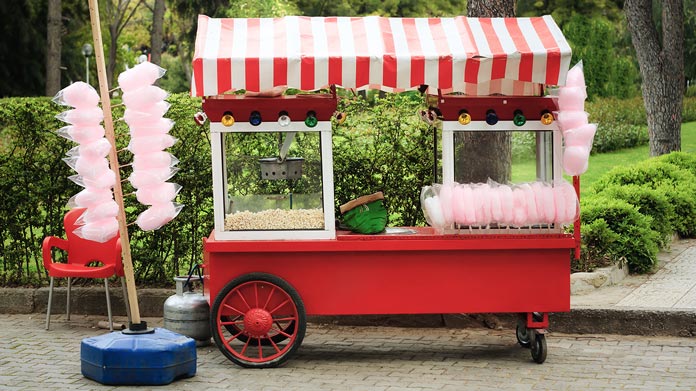
Does serving lots of customers their favorite treats sound like a fabulous day to you? A food kiosk business may be right up your alley. Generally situated in high traffic locations like malls, amusement parks or office towers, you may be selling exquisite chocolate bon bons, freshly squeezed juice and smoothies, or perhaps a little bit of everything. This venture requires a low capital investment with the possibility of rapid growth built right in.
Our guide is in 3 parts:
There are a number of ways to open your own food kiosk business. You can rent a pre-built kiosk, buy into a franchise that provides specs and plans for the kiosk and product, or start from scratch. If you are selling pre-packaged nom-noms, you can open shop at a rented kiosk for about $5,000. Purchasing a franchise may require an investment between $10,000 and $50,000 depending on how complicated your recipes and equipment might be. If designing and constructing a walk-up restaurant with commercial grill and kitchen, your costs can run up to $100,000.
You will need to maintain enough stock on hand for one to two weeks of business while ensuring that consumables like napkins, tableware, and trays are available. There will be maintenance for equipment, tech support for your point-of-sale computers and the rent or lease. Your food expenses will vary depending on the type of menu you offer.
Your location will in part dictate your menu. Middle-aged professionals will walk past you in their office park, teens and young adults crowd the malls while entire families jam tourist attractions. Electric blue gummy candy won’t work for the professionals and hand-carved chocolate treats will be out of the teenagers’ budget.
You will turn a profit on each item that you sell to the hungry public.
You can expect to charge between $4 and $15 per item on your food kiosk.
Your busy snack shop in the office park lobby can generate an income of $40,000/yr for you. If you are operating a popular spot at a crowded tourist attraction, it is possible to take home $100,000 a year after operating costs.
You will always need to monitor your food costs to maximize profit. Prepare or stock only enough product that can be sold by its “Best By” date. Find that perfect price point that generates return business while delivering the highest profit margin possible.
Your food kiosk can be a one-stop shop for coffee, muffins, and daily newspapers or perhaps it will have a mini-kitchen that churns out freshly pressed sandwiches. Whatever you are serving, you will:
Open and close on time every day of business, according to your hours of operation
Maintain a clean and attractive kiosk
Balance your books, order supplies, restock the shelves
Wait on each customer while providing exemplary service
Hire and train part-time assistants
Cook and prepare food
Maintain positive relationships with a variety of vendors
Market using social media
The difference between running an ordinary kiosk and one that is crazy busy lies in research before you start your business. To make the biggest splash in the neighborhood, you will need to know:
Popular fast food trends–what is the snack everybody wants to eat right now?
The local hole in your neighborhood market–what location needs a new option for grab-and-go treats?
Basic business knowledge
Certification in food safety standards
Depending on your product, the proper training in preparation of food in a high turnover environment
Basic money handling skills
The ability to serve thousands of people with a smile
If you are offering a unique and sensational menu, there is every opportunity to turn your kiosk into a franchise, especially if food preparation is fast and minimal. Should you have landed a spot in a large amusement park and are enjoying huge success and unable to control the lines, opening a second kiosk inside the park is an excellent possibility.
When selecting your menu, make sure your recipes are thoroughly tested before turning the public into guinea pigs. You must wow them from the very first bite. Foot traffic is your friend. While you are preparing to open the new kiosk make sure to post billboards, posters, and brochures advertising the new business. Once you are ready to sell, your grand opening budget should include staff hired to hand out free samples throughout the mall or office complex. If you are opening inside a tourist attraction, little marketing will be required beyond including your location on park maps and websites.
Most of the prelimanary tasks like developing the menu, finding a location and contacting vendors can be accomplished by you. If you intend to be open more than 8-10 hours a day, you will need to hire assistants two weeks ahead of the Grand Opening.
Business Evaluation & Strategy Tool
We'll walk you through the four pillars every business needs: Points of Leverage, Marketing Strategy, Financial Model, and Personal Compatibility. At the end you'll see a personalized report and your action plan below will be tailored to your answers.
Every viable business has natural advantages. Below are common leverage points across four categories. Pick the ones that apply to your Food Kiosk business. We've pre-suggested a few based on your idea — review and adjust.
Without a way to connect with customers, even great businesses fail. Pick the channels you plan to use to reach your customers.
Enter your monthly baseline costs — the minimum overhead to keep the business running. Then we'll calculate how many sales per month you need to break even.
A business that doesn't fit your life will fail no matter how good the numbers look. Tell us how this business fits you.
Complete the four pillars and your personalized summary will appear here.
Nine concrete steps to take you from idea to open business, grouped into 30-day phases. Complete the planner above and we'll highlight what's most important for your situation.
An LLC keeps your personal assets separate from business debts and lawsuits — the most common reason small business owners choose this structure. Sole proprietorships and partnerships do not provide this protection.
Apply for your free Employer Identification Number through the IRS, then register for any state or local taxes that apply to your business (sales tax, franchise tax).
A dedicated business account is required to maintain personal asset protection. Mixing personal and business finances ('piercing the corporate veil') can void your LLC's liability shield.
Recording expenses and income from day one makes tax filing easier and lets you see when the business is actually profitable. Use software (QuickBooks, Wave) or a part-time bookkeeper.
State and local requirements vary widely. Brick-and-mortar businesses typically need a Certificate of Occupancy; service businesses may need specific professional licensing; food businesses need health permits.
General Liability Insurance is the most common starting point. If you'll have employees, most states require Workers' Compensation. Specific industries need additional coverage (product liability, professional liability, etc.).
Your brand is how customers perceive and remember you. A clear name, logo, and visual identity make every later marketing decision easier and protect you legally as you grow.
Every legitimate business needs a website. Social media pages are not a substitute — you don't own the platform. Modern website builders mean you can launch a clean site in a weekend without a developer.
A dedicated business number keeps your personal life private, makes the business look legitimate, and lets you route calls professionally. Cloud phone services start under $20/month.
Starting a Food Kiosk business typically costs $5,000. It is considered a low capital-intensity business.
A Food Kiosk business runs roughly a 36% net profit margin, and most owners reach break-even in about 4 to 12 months.
You can usually launch a Food Kiosk business in about 2 to 8 weeks, and it is commonly run part time.
A Food Kiosk business is generally an intermediate-skill business to start, with stable demand. TRUiC rates it 74 out of 100 on our Idea Score.
Most Food Kiosk businesses register as an LLC or other legal entity and obtain a general business license. Depending on your state and city you may also need industry-specific permits, sales tax registration, and zoning or health approvals, so check your local requirements before you launch.