Startup cost
$10k–$20k
TRUiC Business Ideas
Decision Snapshot
Idea Score
73
Startup cost
$10k–$20k
Profit margin
41%
Break-even
4 mo–12 mo
Time to launch
2 wk–8 wk
Demand trend
Stable
5-yr failure rate
—
Capital intensity
Medium
Time commitment
Flexible
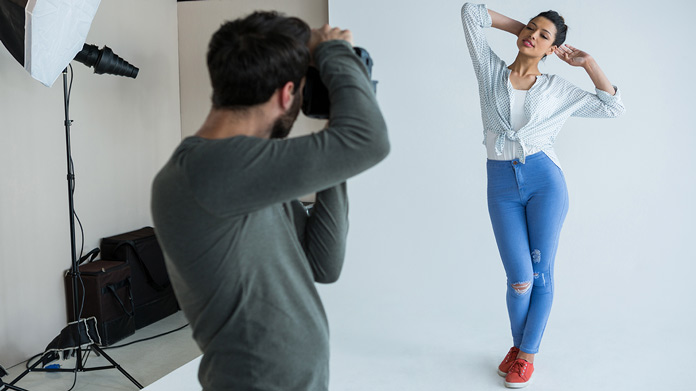
A fashion photographer is responsible for capturing images at fashion shoots and editing the photos they’ve captured. While they’re not usually involved in directing the shoot, they utilize their knowledge of lighting and eye for design to provide creative direction.
Our guide is in 3 parts:
While there are a number of items you’ll need to get started, your most valuable business tool is your talent and experience.
Industry leaders recommend budgeting for a minimum of $10,000 for camera and studio equipment. This should include:
Camera and various lenses
Modifiers – giant umbrella, octabank, scrims, and beauty dishes
Studio equipment – lighting, stands, backdrops, modifiers, props, floors, backgrounds, and remote triggers
Computer and editing software
Backup storage devices
Professional album creation software
Your startup needs are not limited to just photography equipment. The following business tools will help ensure you stay organized and on track with your marketing strategy:
Insurance
Website
Accounting software
Portfolio – this should include some of your best work and show potential clients that you’re able to work in a variety of settings
Your ongoing expenses will be defined by your vision for the company. Many photo shoots will take place away from home, freeing you of the need to invest in a brick and mortar space. Your biggest expense will be time spent on networking, marketing, and travel. Between fashion events, meetings with clients, and photo shoots, much of your time will be spent away from home, where you will incur the typical expenses associated with jet setting across the country (or the world). You will also need to invest in maintenance of your equipment, photo editing software, and equipment replacement when necessary.
Ultimately, your target market is defined by your creative vision, personally and professionally. Designers require photographers to capture images of their latest lines, which are displayed in look books. There is at least one magazine that targets every demographic, each of them requiring a photographer who inspires readers. Think Vogue, Rolling Stone, and L’Officiel. Fashion bloggers also have a need for professional photographers and photo editors. Consider your creative goals and then research who has a direct need for those services.
Fashion photographers are paid a flat fee per shoot, which varies widely depending on the reputation of both the client and the photographer.
The amount you are able to charge will depend vastly on your experience, skill level, and the clients you work with. Many fashion photographers require a minimum of $1,000 per day, with many averaging anywhere from $2,500-10,000. A wide, yet accurate, range. Those more established you are in the community, the more you can charge; anywhere from $10,000 to $150,000 per shoot, depending upon the client.
Again, this varies, depending upon your region and the type of clients you choose to target. The average profit for fashion photographers is between $52,000 and $69,000. Should you choose to open a firm that includes multiple photographers or offers clients additional services, your profits stand to increase exponentially.
As a photographer, you are only limited by your imagination and the types of projects you choose to take on. Consider expanding your client base to include customers who require product photography for their online stores. Enterprises such as Neiman Marcus have thousands of products displayed on their websites – each item must be photographed from multiple angles. A photography agency, comprised of multiple photographers of varying skill levels and innovation, could prove profitable. If photo editing is your strong suit, market your talents. You would be surprised at how many businesses require such a skill.
Most fashion photographers work on a freelance basis, particularly when first starting out. Marketing and administrative duties are equally as important as photo shoots and should be treated as such. While no two days are exactly alike, most days are divided between building the business and expressing yourself artistically.
On the photography side, fashion photographers must attend photo shoots, copyright their work, edit photos, and update their portfolio. Much time is spent sifting through magazines and online photos, noting fashion trends, as well as ideas for future shoots.
On the business end, business owners must schedule shoots, book travel arrangements, manage finances, archive invoices and bills, and implement marketing strategies. Traveling and networking with others in the industry is also critical to a fashion photographer’s success. Many artists hire assistants to help them manage the business aspect, freeing up their time to focus on the creative aspect of the business.
While photography composition rules can be learned, those seeking long-term success should have a natural eye for both fashion and photography. A basic understanding of photography and fashion are critical. To ensure your very best work from the start, spend some time studying fashion: history, era-specific fashion, terminology, designers and image-makers, makeup, hairstyles, and current industry news.
Photography is about capturing a moment in time; a moment that cannot ever be recreated. Therefore, it is also critical that you be at one with your camera. Get to know the different setting, lighting concepts, as well as digital photography concepts. Even the best photographers must edit their photos, so image editing should also be a part of your skill set.
Industry leaders recommend working as an assistant, both in fashion and other photography realms. First-hand experience is the best teacher and will better equip you to predict and solve any issues that might arise. This will also serve as your first introduction into fashion photography, offering an opportunity to network with pioneers in the industry.
As mentioned, most fashion photographers start out working alone, or with a small team of assistants. As connections are made and experience in the industry is built, many choose to move on into other aspects of the business. Business growth opportunities include opening a fashion and commercial photography agency or a fashion marketing firm.
Pioneers of the fashion photography industry offer the following advice:
Read magazines and follow online fashion websites. Take note of the styles and photography traits that you’re most drawn to, as well as the artists behind such work.
In your research, also take note of how the demographics and aesthetics vary from publication to publication. This will help you when preparing your portfolio for a specific organization you may wish to work with.
Your portfolio should tell a story and reflect your true style.
Take big risks, be consistent, and work hard.
Your job goes beyond simply taking a good picture. Be the logistical mastermind and approach this role with confidence.
While many fashion photographers choose to work individually and on a freelance basis, they will also tell you they couldn’t do it without their support team. When building your portfolio, work with stylists, makeup artists, and art directors who share the same goals and creative vision as you. Many fashion photographers have also found success working with a photo agent, who can assist you in making industry connections that might otherwise take years to build.
If you do not possess strong business acumen, consider hiring an attorney and/or accountant to keep your books in order. An assistant can also prove to be an invaluable asset, as they handle the day-to-day specifics, while you focus on the creative details.
Business Evaluation & Strategy Tool
We'll walk you through the four pillars every business needs: Points of Leverage, Marketing Strategy, Financial Model, and Personal Compatibility. At the end you'll see a personalized report and your action plan below will be tailored to your answers.
Every viable business has natural advantages. Below are common leverage points across four categories. Pick the ones that apply to your Fashion Photography business. We've pre-suggested a few based on your idea — review and adjust.
Without a way to connect with customers, even great businesses fail. Pick the channels you plan to use to reach your customers.
Enter your monthly baseline costs — the minimum overhead to keep the business running. Then we'll calculate how many sales per month you need to break even.
A business that doesn't fit your life will fail no matter how good the numbers look. Tell us how this business fits you.
Complete the four pillars and your personalized summary will appear here.
Nine concrete steps to take you from idea to open business, grouped into 30-day phases. Complete the planner above and we'll highlight what's most important for your situation.
An LLC keeps your personal assets separate from business debts and lawsuits — the most common reason small business owners choose this structure. Sole proprietorships and partnerships do not provide this protection.
Apply for your free Employer Identification Number through the IRS, then register for any state or local taxes that apply to your business (sales tax, franchise tax).
A dedicated business account is required to maintain personal asset protection. Mixing personal and business finances ('piercing the corporate veil') can void your LLC's liability shield.
Recording expenses and income from day one makes tax filing easier and lets you see when the business is actually profitable. Use software (QuickBooks, Wave) or a part-time bookkeeper.
State and local requirements vary widely. Brick-and-mortar businesses typically need a Certificate of Occupancy; service businesses may need specific professional licensing; food businesses need health permits.
General Liability Insurance is the most common starting point. If you'll have employees, most states require Workers' Compensation. Specific industries need additional coverage (product liability, professional liability, etc.).
Your brand is how customers perceive and remember you. A clear name, logo, and visual identity make every later marketing decision easier and protect you legally as you grow.
Every legitimate business needs a website. Social media pages are not a substitute — you don't own the platform. Modern website builders mean you can launch a clean site in a weekend without a developer.
A dedicated business number keeps your personal life private, makes the business look legitimate, and lets you route calls professionally. Cloud phone services start under $20/month.
Starting a Fashion Photography business typically costs $10,000 to $20,000. It is considered a medium capital-intensity business.
A Fashion Photography business runs roughly a 41% net profit margin, and most owners reach break-even in about 4 to 12 months.
You can usually launch a Fashion Photography business in about 2 to 8 weeks, and it is commonly run flexible.
A Fashion Photography business is generally an intermediate-skill business to start, with stable demand. TRUiC rates it 73 out of 100 on our Idea Score.
Most Fashion Photography businesses register as an LLC or other legal entity and obtain a general business license. Depending on your state and city you may also need industry-specific permits, sales tax registration, and zoning or health approvals, so check your local requirements before you launch.