Startup cost
$10k–$40k
TRUiC Business Ideas
Decision Snapshot
Idea Score
68
Startup cost
$10k–$40k
Profit margin
50%
Break-even
4 mo–12 mo
Time to launch
12 wk–36 wk
Demand trend
Stable
5-yr failure rate
—
Capital intensity
Medium
Time commitment
Full time
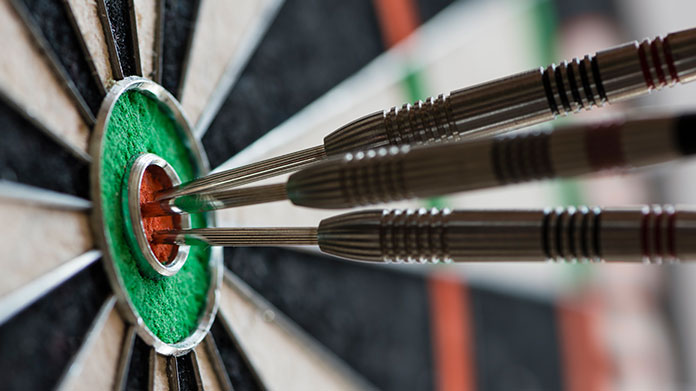
A dart store sells all the accessories desired by those who enjoy playing the game of darts. From flights to boards to scoring devices, there’s a wide range of gear for aficionados. Dart stores can sell either commercial or personal equipment.
You may also be interested in additional unique business ideas.
Our guide is in 3 parts:
Costs are generally determined based on rent for the location and the price of the wholesale materials. You will need to secure permits from local officials, who may or may not charge additional fees for setting up the store. If you plan to employ help, you’ll need to budget for their salaries as well.
Ongoing expenses for dart stores tend to be low, depending on how often you need to replenish your product. Other than that, all you’ll need to do is pay your rent, utilities, and employees.
The target market for dart store owners doesn’t necessarily have to be hard-core players, though they will certainly be the most enthusiastic bunch when it comes to new products or developments. Bars are popular establishments no matter where you live, and drinking can be more fun when there’s an activity to do. The target market can be anyone who enjoys games or any establishment owners who want to give their clientele a better experience.
Dart stores set profit margins based on public demand and the original cost of the item. If you’re planning on making your own custom dart boards and accessories, you’ll need to account for not just the cost of the items, but also the time you spent making it and the space you needed to sell it. For example, if it took you 10 hours to make one board and $40 in raw materials, you may want to charge $300 for the completed product.
People are willing to pay to ensure their equipment is top-notch. A specialty dartboard can cost $300 or more, and specialty darts can sell for up $1,000! An electronic dartboard can cost around $250, and a standard cork dartboard may cost anywhere from $50 to $100. Most people will pay between $50 to $100 for a solid set of quality darts too. New flights are typically just a few bucks, but owners can charge more for specialty flights.
Profits are highly dependent on your clientele and marketing strategies. For luxury clients, you can set your gross profit margins at about 40 – 50%. For general goods, you may want to set your profit margins closer to 20 – 30% (subject to demand.)
You may want to consider offering lessons to your clientele as a way of boosting business, or setting up a lounge where people can pay by the hour. They might be willing to pay to practice without being hassled by a fellow bar member asking to be a part of the game. You could even consider taking your business to local corporations as a way to encourage creativity and recreation among busy professionals.
Owners may handle the following in any given day:
Selling/customer service
Marketing and website maintenance
Researching dart opportunities (e.g., tournaments, etc.)
Managing employees
Sourcing/making products
Being a notable player in the world of darts can be a great start. People will come to you for advice they can’t find anywhere else. Master dartboard craftsmen will also start with an advantage because they can build a clientele based on unusual dartboard designs.
Growth potential may be limited in the beginning, especially if you’re living in an area where darts aren’t very popular. Most equipment is built to last, meaning a bar may not buy a board for a decade or two. However, it’s possible to create public demand if you can get the word out, or capitalize on existing demands in highly populated areas.
The key is to look for opportunities when it comes to selling dart equipment. There are millions of casual dart players around the world, even if the sport isn’t as popular as it used to be. Owners may be able to generate interest by starting dart leagues around their area. There aren’t a lot of hurdles to playing darts, and a dart league can provide some much needed novelty in people’s lives.
Leagues will increase your business right off the bat, and turn your store into a staple around town. You can also consider specializing in selling either electronic or standard dartboards. Bars typically prefer electronic dartboards because they can charge for every game a customer plays. However, some players may not like them and may avoid bars that have them. Knowing your clientele can help you decide the best path to get started.
You don’t necessarily have to build a team if you’re just getting started. You may choose to have your dart store open only during certain hours, or to make it by appointment only. Once you get a steady clientele, you can look for fellow dart lovers to take over the shifts you can’t cover.
Business Evaluation & Strategy Tool
We'll walk you through the four pillars every business needs: Points of Leverage, Marketing Strategy, Financial Model, and Personal Compatibility. At the end you'll see a personalized report and your action plan below will be tailored to your answers.
Every viable business has natural advantages. Below are common leverage points across four categories. Pick the ones that apply to your Darts business. We've pre-suggested a few based on your idea — review and adjust.
Without a way to connect with customers, even great businesses fail. Pick the channels you plan to use to reach your customers.
Enter your monthly baseline costs — the minimum overhead to keep the business running. Then we'll calculate how many sales per month you need to break even.
A business that doesn't fit your life will fail no matter how good the numbers look. Tell us how this business fits you.
Complete the four pillars and your personalized summary will appear here.
Nine concrete steps to take you from idea to open business, grouped into 30-day phases. Complete the planner above and we'll highlight what's most important for your situation.
An LLC keeps your personal assets separate from business debts and lawsuits — the most common reason small business owners choose this structure. Sole proprietorships and partnerships do not provide this protection.
Apply for your free Employer Identification Number through the IRS, then register for any state or local taxes that apply to your business (sales tax, franchise tax).
A dedicated business account is required to maintain personal asset protection. Mixing personal and business finances ('piercing the corporate veil') can void your LLC's liability shield.
Recording expenses and income from day one makes tax filing easier and lets you see when the business is actually profitable. Use software (QuickBooks, Wave) or a part-time bookkeeper.
State and local requirements vary widely. Brick-and-mortar businesses typically need a Certificate of Occupancy; service businesses may need specific professional licensing; food businesses need health permits.
General Liability Insurance is the most common starting point. If you'll have employees, most states require Workers' Compensation. Specific industries need additional coverage (product liability, professional liability, etc.).
Your brand is how customers perceive and remember you. A clear name, logo, and visual identity make every later marketing decision easier and protect you legally as you grow.
Every legitimate business needs a website. Social media pages are not a substitute — you don't own the platform. Modern website builders mean you can launch a clean site in a weekend without a developer.
A dedicated business number keeps your personal life private, makes the business look legitimate, and lets you route calls professionally. Cloud phone services start under $20/month.
Starting a Darts business typically costs $10,000 to $40,000. It is considered a medium capital-intensity business.
A Darts business runs roughly a 50% gross profit margin, and most owners reach break-even in about 4 to 12 months.
You can usually launch a Darts business in about 12 to 36 weeks, and it is commonly run full time.
A Darts business is generally an intermediate-skill business to start, with stable demand. TRUiC rates it 68 out of 100 on our Idea Score.
Most Darts businesses register as an LLC or other legal entity and obtain a general business license. Depending on your state and city you may also need industry-specific permits, sales tax registration, and zoning or health approvals, so check your local requirements before you launch.