Startup cost
$1.0k–$10k
TRUiC Business Ideas
Decision Snapshot
Idea Score
63
Startup cost
$1.0k–$10k
Profit margin
14%
Break-even
4 mo–12 mo
Time to launch
2 wk–8 wk
Demand trend
Stable
5-yr failure rate
—
Capital intensity
Medium
Time commitment
Full time
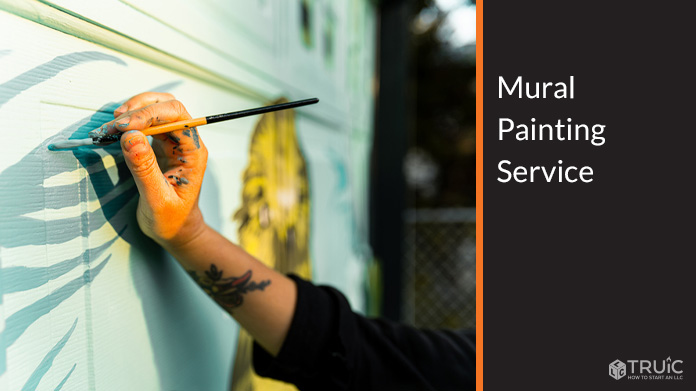
Mural painters are artists who specialize in painting works of art on such physical structures as the interior walls, ceilings or floors of private, corporate, nonprofit or governmental settings. Muralists can also work on the exterior sides of buildings, or on gates, roofs or other surfaces.
Our guide is in 3 parts:
Your business can start slowly, with a minimal cost investment. Here’s how your start-up costs might break down:
Paint supplies and equipment — $200 or less. This includes the brushes and other basic painting supplies you’ll need to get started. Once you get an assignment and the upfront half of the fee, you can buy additional equipment necessary for that specific job. However, if you’re going to work primarily outdoors, you’ll need ladders, scaffolding and more paint than if you’re painting a residential room. You can rent scaffolding and get started for probably as little as $1,000 in this scenario.
Website, portfolio and business cards — $750 or less. You might hire someone to create your website and hire a professional photographer to shoot your portfolio pieces. Designing your own business cards and other promotional materials can help you save on marketing costs, and it can also show off your artistic talent.
Storage space — Zero to a few hundred dollars a month. Depending on the scale of your work, you might be able to store your paint and other equipment in your own home or apartment. However, if your focus will be on such large-space projects as exterior walls or roofs, you might need to rent self-storage or warehouse space for your ladders and other supplies.
Show attendance as an exhibitor — A few hundred to several thousand dollars.The determination here is how often you exhibit your work at expos, fairs, home shows and other events. Start small by attending one show and gauge your success rate.
Travel and expenses — At least several hundred dollars. Again, this is variable. One determining factor is your market region. If it’s a large area, you might have to travel relatively far and perhaps stay overnight. You should either build these costs into your estimate or charge extra for such expenses.
Your largest ongoing expense will be for paint, painting supplies, and travel to and from jobs. If you price your work accurately, your fee will cover these expenses.
That will depend on your niche or niches. Some mural painters work exclusively with residential clients, in which case you’ll deal with homeowners who want to beautify a nursery or other spaces. Other muralists might focus on corporate clients, non-profits, civic planners or building owners. Regardless of who you’re trying to reach, your prospective clients are people who want to improve the aesthetics of their interior or exterior space. Or, in the case of corporate clients, they might be looking for a unique way to promote their message — such as with their logo or new campaign imagery.
Mural artists generally charge in one of two ways for their work: by an hourly rate or by the square foot of painted space. Since you’ll have to give your client an estimated cost before starting the job, you shouldn’t charge by the hour unless you have the ability to accurately estimate the time commitment. If you greatly misjudge, you might end up working quite a few free hours. It is normal to request and receive half of the estimated cost as a down payment before you start the mural.
Some muralists price their work to generate an hourly rate of at least $50-$60 per hour. Others work on a per-square-foot basis. Either way, consider the time and difficulty when pricing your services. Will you be working on tall surfaces, which will slow you down? Will you require paid assistance? Are there windows and multiple doorways to add difficulty? Consider this source for pricing your services.
The U.S. Bureau of Labor Statistics gives a median pay rate of nearly $50,000 for crafts and fine artists, but this includes many other categories of artists besides muralists.
Your earnings will be set by your reputation, the rates of competitors, your marketing zeal and ingenuity, and even such factors as your region’s climate if you primarily work outdoors.
Do not be afraid to cold-call building owners to market your business. If you see a building that could be beautified with your work, contact the landlord. Reaching out to advertising agencies can also result in your being commissioned to paint large billboards or walls for corporate clients who are willing to pay more for a mural than the average residential client.
Most of your time will be taken up in the actual work, since a mural can involve several weeks or more of full-time work. For this reason, it is essential that you constantly self-promote your service. You must regularly update your portfolio and website, communicate via social media, and attend expos, shows, and exhibits where you can showcase your work and connect with prospective clients. You will also need to complete the necessary tasks of buying art supplies, invoicing clients, paying bills, and promoting and marketing your business.
It is essential to put together a portfolio of your works that will prove to your customers that you have the necessary talent and ability to adequately complete the job the want you to do. Having a social media page or website can be a creative way to expose yourself to new clients.
The U.S. Bureau of Labor Statistics in 2016 gave the Craft and Fine Artists field a “slower than average” job outlook for the 2014-2024 time period. As with any sort of home or building improvement project, clients are better positioned to contract an expensive when the economy (or at least their economy) is good.
Though you can initially work alone fairly easily, once business starts to pick up you should consider whether you need to hire interns to help with the painting or the scaffolding, or commission sales people to help generate additional business.
Business Evaluation & Strategy Tool
We'll walk you through the four pillars every business needs: Points of Leverage, Marketing Strategy, Financial Model, and Personal Compatibility. At the end you'll see a personalized report and your action plan below will be tailored to your answers.
Every viable business has natural advantages. Below are common leverage points across four categories. Pick the ones that apply to your Mural Painting business. We've pre-suggested a few based on your idea — review and adjust.
Without a way to connect with customers, even great businesses fail. Pick the channels you plan to use to reach your customers.
Enter your monthly baseline costs — the minimum overhead to keep the business running. Then we'll calculate how many sales per month you need to break even.
A business that doesn't fit your life will fail no matter how good the numbers look. Tell us how this business fits you.
Complete the four pillars and your personalized summary will appear here.
Nine concrete steps to take you from idea to open business, grouped into 30-day phases. Complete the planner above and we'll highlight what's most important for your situation.
An LLC keeps your personal assets separate from business debts and lawsuits — the most common reason small business owners choose this structure. Sole proprietorships and partnerships do not provide this protection.
Apply for your free Employer Identification Number through the IRS, then register for any state or local taxes that apply to your business (sales tax, franchise tax).
A dedicated business account is required to maintain personal asset protection. Mixing personal and business finances ('piercing the corporate veil') can void your LLC's liability shield.
Recording expenses and income from day one makes tax filing easier and lets you see when the business is actually profitable. Use software (QuickBooks, Wave) or a part-time bookkeeper.
State and local requirements vary widely. Brick-and-mortar businesses typically need a Certificate of Occupancy; service businesses may need specific professional licensing; food businesses need health permits.
General Liability Insurance is the most common starting point. If you'll have employees, most states require Workers' Compensation. Specific industries need additional coverage (product liability, professional liability, etc.).
Your brand is how customers perceive and remember you. A clear name, logo, and visual identity make every later marketing decision easier and protect you legally as you grow.
Every legitimate business needs a website. Social media pages are not a substitute — you don't own the platform. Modern website builders mean you can launch a clean site in a weekend without a developer.
A dedicated business number keeps your personal life private, makes the business look legitimate, and lets you route calls professionally. Cloud phone services start under $20/month.
Starting a Mural Painting business typically costs $1,000 to $10,000. The largest cost is usually equipment. It is considered a medium capital-intensity business.
A Mural Painting business runs roughly a 14% net profit margin, and most owners reach break-even in about 4 to 12 months.
You can usually launch a Mural Painting business in about 2 to 8 weeks, and it is commonly run full time.
A Mural Painting business is generally an intermediate-skill business to start, with stable demand. TRUiC rates it 63 out of 100 on our Idea Score.
Most Mural Painting businesses register as an LLC or other legal entity and obtain a general business license. Depending on your state and city you may also need industry-specific permits, sales tax registration, and zoning or health approvals, so check your local requirements before you launch.