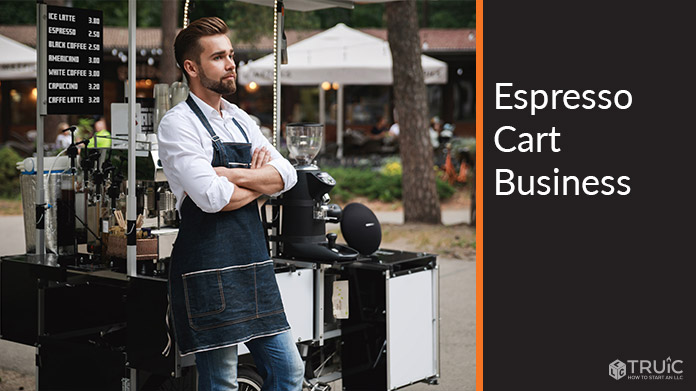
Part 1 - How to Start an Espresso Cart Business - Background
Everyone loves the smell of fresh coffee in the morning, and an espresso cart business allows people to get a delicious morning cup of joe while they’re on the run. An espresso cart business may choose to operate at different locations each day or may choose one spot to set up shop every morning. An espresso cart business allows a business owner to have full control over their small shop and can provide opportunities to expand in the future.
This guide uses a mobile espresso cart selling prepared drinks directly to customers. A fixed café or event-dominant catering service has different premises, contracts and classification. Mobility does not create permission to sell at any site; confirm actual food-service, landowner, street/event and utility requirements before committing.
Our guide is in 3 parts:
- Part 1 - How to start an Espresso Cart business - Background
- Part 2 - Our planner tool to see if this idea is the right fit for you
- Part 3 - Action plan to get started
What are the costs involved in opening an Espresso Cart Business?
Costs involved in opening an espresso cart business include:
-
The espresso cart and espresso machines
-
Supplies, including espresso, dairy, sweeteners, and other drink additives
-
Disposable cups, stirrers, and napkins
-
Payment for a water hookup where the cart will be parked (or payment for a stand-alone water source purchased in advance as needed)
-
Payment for a waste removal service to dispose of trash at the end of the day
-
Payment for any seller permits needed to operate along the street
Define the approved menu, unit and sites before buying/building. As one local example, King County requires plan approval before construction and requests menu/flow, water design, commissary, unit drawings, site/route and restroom information. Actual health, city/site, event, electrical/fire and other permissions can differ.
A supplier example checked November 14, 2026 is Espresso Parts’ Ascaso Baby T × F4 EVO cart espresso kit at $7,210.03; a separately listed Klassy Kart collapsible cart was $4,975. These offers are not necessarily additive or a complete approved cart budget. Confirm exact inclusions, commercial use/acceptance, power/water, menu throughput, installation, tax, shipping and support in actual quotes.
Add appropriate grinder/filtering, refrigeration and approved milk handling, handwashing/cleaning, potable water and wastewater arrangements, reliable safe power, transport/storage/commissary, site/event charges, food-worker requirements, coverage, payment systems, full owner/staff work and ramp cash. No universal $25,000–$250,000 startup total is established.
What are the ongoing expenses for an Espresso Cart Business?
Ongoing expenses include maintenance of espresso equipment, cost of both food supplies and non-food supplies (such as paper products), payroll, insurance, and maintenance of the cart itself.
Include owner preparation/transport/setup/service/cleaning/admin work, milk and ingredient spoilage, commissary/storage and site/event charges, permits/renewals, potable water and approved waste handling, power/fuel, payment fees, marketing, servicing and downtime cash. Maintain the actual approved food-handling and sanitation arrangements rather than assume supplies and machine maintenance cover every duty.
Who is the target market?
The target market for an espresso cart business is anyone who enjoys coffee in the morning, but on a smaller scale, anyone who enjoys coffee and happens to pass the location of the espresso cart is a likely customer. Catchy signs, delicious smells, and a welcoming smile can all help people decide to stop at an espresso cart.
Validate actual foot traffic at an authorized site by time/day, how many people can and will stop, local alternatives, weather/seasonality, queue tolerance and collected paid transactions. Passersby or general coffee consumption are not guaranteed customers; event contracts need their own bookings, payment and service-capacity terms.
How does an Espresso Cart Business make money?
An espresso cart business makes money by charging customers for their drinks. An espresso cart owner may also be asked to provide services at morning events, such as conferences, athletic events, and more.
How much can you charge customers?
Compare dated local menus for the same drink size, espresso dose, milk/add-ons, taxes, setting and service. For events, define guest count, service hours, travel/setup, power/water supplied, minimum commitment and cancellation/payment terms. The old 2017 cost article and unspecified $3–$7 range do not establish current typical cart prices.
Price against actual ingredients, consumables, fees, waste, site charges and full service/support work. Test paid demand and contribution rather than assume a complex drink always justifies a premium.
How much profit can an Espresso Cart Business make?
No representative $1,000–$5,000 daily profit, 3.1% net margin or 4–12-month investment recovery is established. At an assumed $5 collected per drink, $1,000–$5,000 would require 200–1,000 drinks before any expenses. That is gross sales arithmetic, not evidence of demand, sustainable machine/barista throughput or earnings.
For an entirely assumed daily worksheet, 150 drinks at $5 each less $2 per drink ingredients/consumables/payment/waste cost leave $450 contribution. If site, transport, appropriate owner/staff compensation and other daily fixed costs total $500, the result is a $50 operating loss before tax, financing and omitted costs. At those assumptions, cost coverage needs 167 drinks, rounded up, if safe service capacity and actual demand permit. These are teaching inputs, not observed prices, costs or sales.
Track setup/travel/cleaning and admin time, peak queues, cancellations/weather, spoilage, equipment downtime, deposits/service still owed, debt/capex and cash between events. Operating cost coverage differs from repaying the launch investment.
How can you make your business more profitable?
Investing in high-quality equipment and top-notch ingredients can make drinks taste better and can go a long way in keeping customers coming back for more. Like with any small business, if an espresso cart business owner decides to hire employees, it’s important that they spend time offering quality training. Training should support safe food handling, consistent drinks, service and efficient work. Measure actual queue times, waste, repeat paid orders and full costs; quality equipment or training alone does not guarantee a higher profit margin.
Day-to-Day and Growth
What happens during a typical day at an Espresso Cart Business?
During a typical day at an espresso cart business, a business owner may need to:
-
Pull the espresso cart out of storage and transport it to the correct location in the morning
-
Load the cart with supplies
-
Use the approved potable-water, handwashing, cleaning and wastewater arrangements for the unit and site, with appropriate safe power and refrigeration
-
Interact with customers, making their favorite drinks
-
Provide a payment system (it’s smart to offer both cash and card options)
What are some skills and experiences that will help you build a successful Espresso Cart Business?
While knowledge of and passion for espresso are important, people skills are also a must. Espresso cart owners should be able to pleasantly interact with their customers each day, remembering the drinks of regulars and sending customers off with a smile. Espresso cart business owners also need to be able to manage inventory and cash flow.
What is the growth potential for an Espresso Cart Business?
Measure actual paid conversion, collected contribution, repeat/event bookings, peak service capacity, cancellations, weather and full owner/staff work at each authorized site. High foot traffic or interest in coffee does not establish a large profitable market for a particular cart.
Add carts only when each unit/menu/site is appropriately permitted and equipped, trained coverage and food-safety arrangements work, and cash supports transport, storage/commissary, maintenance and full compensation.
What are some insider tips for jump starting an Espresso Cart Business?
Even though a cart is mobile, businesses like these may need permits to sell on the streets. Check with your local government to ensure that you have the proper permits needed to legally operate your business.
It’s important that an espresso cart business owner is able to function well under high levels of stress. When people are rushing to get their morning coffee, they can be short and may not be as pleasant as they would normally be. It’s important that an espresso cart owner can continue to serve delicious drinks with a smile.
Coordinate the actual menu/unit/site plan with the relevant food and site authorities before purchase or construction. A seller permit alone does not establish health, landowner/street/event, water/waste or electrical/fire approval. Use the approved food-storage, milk handling, handwashing, cleaning and wastewater plan and confirm appropriate training/coverage. King County’s process is one local example of the information and preconstruction review involved.
How and when to build a team
If the line at an espresso cart business becomes unmanageable, it may be time to bring on some additional staff members who can help with the ins and outs of getting customers what they need. Over time, an espresso cart business owner may decide to expand and have multiple carts, each led by a qualified barista.
Plan trained food-service coverage from actual safe capacity, setup/transport/cleanup and peak service needs before queues become unmanageable. Confirm lawful work arrangements, required training, full compensation, site/unit permissions and adequate working cash for every cart.
Part 2 - Is this business right for you?
Business Evaluation & Strategy Tool
We'll walk you through the four pillars every business needs: Points of Leverage, Marketing Strategy, Financial Model, and Personal Compatibility. At the end you'll see a personalized report and your action plan below will be tailored to your answers.
This guide's benchmarks are under editorial review. Enter your own figures and choose the assumptions that fit your business.
Step 1 of 4 — Points of Leverage
Every viable business has natural advantages. Below are common leverage points across four categories. Pick the ones that apply to your Espresso Cart business.
Step 2 of 4 — Marketing Strategy
Without a way to connect with customers, even great businesses fail. Pick the channels you plan to use to reach your customers.
Step 3 of 4 — Financial Model
Enter your monthly baseline costs — the minimum overhead to keep the business running. Then we'll estimate how many customer transactions would cover that overhead before variable costs.
Step 4 of 4 — Personal Compatibility
A business that doesn't fit your life will fail no matter how good the numbers look. Tell us how this business fits you.
Your Espresso Cart Evaluation Report
Complete the four pillars and your personalized summary will appear here.
Points of Leverage
Marketing Strategy
Financial Model
Personal Compatibility
Part 3 - Your business launch action plan
Before committing to launch costs, test your business idea with potential customers. Use the free worksheet to record the offer, evidence and next decision.
Nine concrete steps to take you from idea to open business, grouped into 30-day phases. Adjust the phases to fit your funding, permits, and operating needs. Complete the planner above and we'll highlight what's most important for your situation.
First 30 days — Foundation
-
Choose a permitted business structure
Compare structures permitted for your activity, location, ownership and tax situation. Professional practices can have special entity and ownership rules. Check those requirements before filing; an LLC does not protect against every kind of personal liability.
-
Check tax IDs and registrations
Determine whether you need an EIN based on ownership, tax treatment, employees and applicable tax obligations. Some sole-owner businesses do not need one for federal income-tax purposes, while a bank or state may still require it. Apply directly with the IRS when needed and check applicable state or local registrations.
-
Separate business finances
Choose an appropriate business account and keep clear financial records. Separating business and personal transactions supports bookkeeping and entity formalities. Banks have their own eligibility and documentation requirements; a separate account is not a guarantee against personal liability.
-
Set up business accounting
Recording expenses and income from day one makes tax filing easier and lets you see when the business is actually profitable. Use software (QuickBooks, Wave) or a part-time bookkeeper.
Days 30–60 — Compliance & Risk
-
Get permits and licenses
Check the authorities responsible for your business activity and operating location. Professional authorization, tax registration, facility permits and product requirements are different questions. Online or mobile operations can still have licensing and other regulatory obligations.
-
Get business insurance
Identify the risks and coverage obligations for your activities, workers and location. Review applicable liability, property, professional or product coverage and workers’ compensation with the relevant state authority and a licensed insurance professional. Required coverage varies by jurisdiction and operation.
Days 60–90 — Launch
-
Define your brand
Choose a name, message and visual identity that help your intended customers understand the business. Check relevant name and trademark requirements before investing in a brand; a logo or business-name registration alone does not establish complete legal protection.
-
Create your business website
Choose a web presence that fits how your customers research and buy. A website can explain your offer, support inquiries or sales, and connect your marketing channels. Plan the content, accessibility, privacy and maintenance requirements for the features you need.
-
Set up your business phone system
Choose a customer-contact setup that fits your sales and service process. Compare current provider terms, business-use eligibility, routing features and ongoing costs, and decide how you will keep personal contact details separate.