Startup cost
$10k–$50k
TRUiC Business Ideas
Decision Snapshot
Idea Score
57
Startup cost
$10k–$50k
Profit margin
8%
Break-even
4 mo–12 mo
Time to launch
12 wk–36 wk
Demand trend
Rising
5-yr failure rate
—
Capital intensity
High
Time commitment
Full time
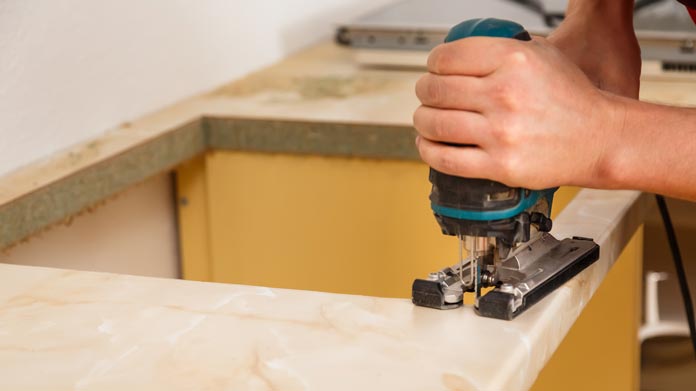
Countertops are difficult to install. More importantly: They’re heavy. It takes professional skill, planning, and tools to install, remove, or repair a countertop. Because the homeowner decides on a countertop’s style, materials, and installation needs, services geared towards custom schedules are incredibly valued. Normally, countertop business operators are incredibly skilled maintenance workers. They understand home repairs, style needs and safety requirements.
Our guide is in 3 parts:
Before starting a countertop business, you’ll need to acquire a city business license. This regularly costs between $50 and $100 dollars. Next, you’ll need to acquire liability insurance—which will vary depending upon your insurance provider. As a provider who sells countertops, you’ll need to source either raw materials—crafting them in-house—or source them from another provider. Wholesale materials are significantly cheaper than their installation costs. Raw-slab granite costs between $10 and $40 per square foot, uninstalled. Marble slabs, meanwhile, cost between $50 and $250 per square foot, uninstalled.
Don’t forget about your business’s utilities, rent and employee costs, either. You’ll need to calculate your rent costs by square footage. On average, a small workshop near a shopping area will cost around $23 per square foot. So, every month, such a space would carry a $3,642 expense if it were 1,900 square feet. If you’re in need of starting revenue, consider working out of a garage.
As for employee costs, average payment is between $13 and $17 per hour for fabricators and installers. Your sales associates, as your company grows, will likely expect payment at the upper end.
As a countertop business owner, you’ll need to pay for your materials. If you’re fabricating them yourself, you’ll need to pay for specialized workers. Utilities, rent, and installation tools, of course, are part of the ongoing costs—as well as equipment depreciation.
Most of your clients will be homeowners. Preferred clients are those that are looking for someone to offer more than just installation of countertops. These people will be employing your services to help them select designs and materials in addition to installing the countertop once the desired top has been chosen. You will be able to charge these customers for design plans as well as for installation. Not only do these customers present your with a better opportunity for profit, they also have the potential to become more comfortable and satisfied with your business; therefore, they are more likely to share their experience and promote your services to others.
Individual contractors and countertop business owners make money by installing, removing, and maintaining countertops. A lot of countertop businesses have ongoing client relationships. Countertops can wear down over time, and it takes professional skill to repair cracks, buffer out scratches, and install customized additions. While the initial purchase of a countertop pays well, ongoing repair and addition services are the most consistent revenue streams.
On average, you can charge clients between $20 and $100 dollars per square foot of high-grade material installation. This adds up, averaging to between $2,500 and $3,500 per installation. That said, materials matter. Wood, for example, costs far less to install than a quartz slab. Once a business’ expenses are paid, a small countertop business manager can expect to earn about $46,000. That said, a countertop business financial controller can make approximately $69,000 per year. Ideally, a countertop business conducts a couple thousand jobs per year.
A small countertop business owner can still make a lot of money. While annual revenue is hard to pin down—due to the sheer variety in countertop services—a typical profit margin, per installation, is about $80 to $120 dollars per square foot. Yes, this means a successful countertop business can make hundreds of thousands of dollars, yearly, if they’re providing consistent work. That said, small countertop businesses may find it difficult to obtain a consistent client flow.
At the end of the day, your business’s profitability will depend on its service quality. There are a lot of countertop businesses out there, and many offer unique styles and competitive pricing. So, to be profitable, you’ll need to both offer unique designs and assure great services. It is essential to be quick, available, and able to communicate well with your clients.
Countertop businesses operate on a service call basis. So, they’re likely to answer a variety of service needs. Countertop business owners must be familiar with granite, marble, and other popular countertop materials. Day-to-day activities include giving homeowners quotes, choosing countertop styles, formatting a countertop’s installation plans, and cutting countertop materials. As for actual installation, maintenance, and removal, countertop business workers perform basic maintenance operations. Meanwhile, the business owner strategizes services by creating effective price plans. There’s a lot of competition in the countertop industry. For this reason, a lot of business owners focus on marketing. Printed ads, internet ads, and even mobile ads are important. As with any contracting-centric business, a countertop business owner spends most of their time planning finances, sourcing materials, and targeting niche markets.
First and foremost, you’ll need to understand the basics of home improvement. Kitchen renovations, utility maintenance, concrete maintenance, and general home repair are incredibly important. You’ll need to secure education which fosters these skills, too. From a business ownership standpoint, it pays off to have skills in management, financing, and marketing. As a starting entrepreneur or small business owner, it’s a good idea to develop interpersonal skills, as well.
Like many contractor-focused businesses, a countertop business has incredible scale. Again, it isn’t rare to see an individual countertop contractor. Large-scale countertop businesses also have a niche in the grand scheme of home improvement. If your business grows, scales effectively and can handle mass amounts of material and human resources, it can even become a specialized provider, favored by high-quality home décor lovers.
Be unique. While it might be cheaper to initiate a generic countertop installation business, granite, marble, and even fine wood countertops have it easier, industry-wise. This is because homeowners already have basic-material countertops. Countertops are included in a home’s base price, and a lot of homeowners turn to countertop businesses for rustic, high-style, rare, or otherwise exotic countertops. A lot of countertop businesses focus on differentiation. If you can give homeowners a reason to select your styles, your materials, or your overall “vibe,” you’ll have a higher chance of success. Installation tactics, in the countertop world, don’t matter much.
A team should be built as soon as you’ve become more than an individual contractor. If you’re intending to grow, you’ll need to secure at least five additional workers to conduct finances, marketing, and on-site work. As your business grows, it can cover as many workers as it needs.
Business Evaluation & Strategy Tool
We'll walk you through the four pillars every business needs: Points of Leverage, Marketing Strategy, Financial Model, and Personal Compatibility. At the end you'll see a personalized report and your action plan below will be tailored to your answers.
Every viable business has natural advantages. Below are common leverage points across four categories. Pick the ones that apply to your Countertop business. We've pre-suggested a few based on your idea — review and adjust.
Without a way to connect with customers, even great businesses fail. Pick the channels you plan to use to reach your customers.
Enter your monthly baseline costs — the minimum overhead to keep the business running. Then we'll calculate how many sales per month you need to break even.
A business that doesn't fit your life will fail no matter how good the numbers look. Tell us how this business fits you.
Complete the four pillars and your personalized summary will appear here.
Nine concrete steps to take you from idea to open business, grouped into 30-day phases. Complete the planner above and we'll highlight what's most important for your situation.
An LLC keeps your personal assets separate from business debts and lawsuits — the most common reason small business owners choose this structure. Sole proprietorships and partnerships do not provide this protection.
Apply for your free Employer Identification Number through the IRS, then register for any state or local taxes that apply to your business (sales tax, franchise tax).
A dedicated business account is required to maintain personal asset protection. Mixing personal and business finances ('piercing the corporate veil') can void your LLC's liability shield.
Recording expenses and income from day one makes tax filing easier and lets you see when the business is actually profitable. Use software (QuickBooks, Wave) or a part-time bookkeeper.
State and local requirements vary widely. Brick-and-mortar businesses typically need a Certificate of Occupancy; service businesses may need specific professional licensing; food businesses need health permits.
General Liability Insurance is the most common starting point. If you'll have employees, most states require Workers' Compensation. Specific industries need additional coverage (product liability, professional liability, etc.).
Your brand is how customers perceive and remember you. A clear name, logo, and visual identity make every later marketing decision easier and protect you legally as you grow.
Every legitimate business needs a website. Social media pages are not a substitute — you don't own the platform. Modern website builders mean you can launch a clean site in a weekend without a developer.
A dedicated business number keeps your personal life private, makes the business look legitimate, and lets you route calls professionally. Cloud phone services start under $20/month.
Starting a Countertop business typically costs $10,000 to $50,000. It is considered a high capital-intensity business.
A Countertop business runs roughly a 8% net profit margin, and most owners reach break-even in about 4 to 12 months.
You can usually launch a Countertop business in about 12 to 36 weeks, and it is commonly run full time.
A Countertop business is generally an intermediate-skill business to start, with rising demand. TRUiC rates it 57 out of 100 on our Idea Score.
Most Countertop businesses register as an LLC or other legal entity and obtain a general business license. Depending on your state and city you may also need industry-specific permits, sales tax registration, and zoning or health approvals, so check your local requirements before you launch.