Startup cost
$50k–$500k
TRUiC Business Ideas
Decision Snapshot
Idea Score
50
Startup cost
$50k–$500k
Profit margin
36%
Break-even
4 mo–12 mo
Time to launch
12 wk–36 wk
Demand trend
Stable
5-yr failure rate
—
Capital intensity
Very high
Time commitment
Part time
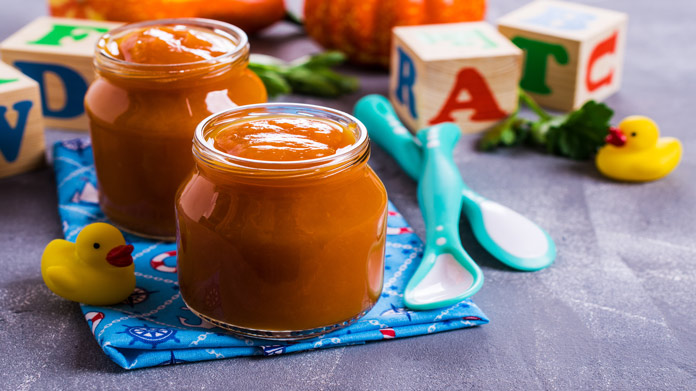
Babies need specialized food when they first begin eating. The food must be mushy yet nutritious, and it’s preferable if the food is conveniently packaged. Baby food businesses make this type of food. They create the food itself, package the food, and then sell it directly to customers or through retailers.
Many parents want to give their children the most delicious and nutritious baby food possible. This impulse has led to significant growth in the industry in recent years. According to Zion Market Research, the global baby food market is on course to be a $76.48 billion industry by 2021.
Our guide is in 3 parts:
A baby food business can be started for fairly little money.
Business owners need a commercial kitchen to prepare food in and a retail space to sell food at. The cost of a kitchen can be kept low by renting a commercial kitchen at a church, VFW or other nonprofit organization. At first, an inexpensive booth at a farmer’s market can be used to sell in-person to customers.
Other initial expenses include the price of ingredients and packaging supplies. These can be purchased in small quantities at first to keep upfront expenses down, though. As a business grows, more supplies can be bought with the revenue that’s brought in from sales.
The ongoing expenses for a baby food business include rental costs for a commercial kitchen and the cost of purchasing more supplies. These costs are minimal.
A baby food business’ ideal client is a new parent who wants to give their baby high-quality food and has discretionary income. Such a parent will likely be willing to pay a premium for good baby food, and they have the income required to buy premium baby food on a regular basis. Once hooked on a brand, a new parent will likely get baby food for several months or years. They’ll need baby food until their child can eat solid food.
A baby food business makes money by selling packaged baby food. Businesses may sell baby food to customers in person or online. Or, they may sell through other retailers.
Most baby food comes in a small package that lasts a few meals, at most. These packages generally sell for a few dollars, and sometimes even less than $1.00. Organic and premium baby foods command higher prices than non-organic foods.
While businesses can’t charge a lot for individual packages of baby food, parents usually buy several packages at once. Additionally, parents buy baby food for several months after their baby begins eating food. Investopedia places the amount parents spend on baby food each month at about $60.
Baby food businesses can be highly profitable. When she was selling baby food only at a local farmer’s market, Carlson brought in $30,000 a month. Businesses that get their foods into national retailers can bring in millions each year.
Baby food businesses can increase profitability by shipping baby food to customers. Little Spoon is a baby food business that does this.
A baby food business owner spends a lot of time making, packaging, and selling baby food. When not directly working with baby food, business owners take care of other tasks. They clean their kitchen, order supplies, pay bills, and market their baby food business.
At times, business owners also research new flavors. This is a trial-and-error process that involves creating many test batches.
To run a baby food business, owners must know how to make baby food.
Several companies offer classes on making baby food. Teeny Tiny Foodie and Sprout Right offer courses.
After taking a course, business owners may want to keep a baby food recipe book on hand for reference and inspiration. A few titles that might be helpful include The Big Book of Organic Baby Food, 201 Organic Baby Purees and The Baby and Toddler Cookbook.
A baby food business may be a small operation that only sells baby food locally, or it can be a national business that has food in stores throughout the country. Carlson grew her business from a stand at her local farmer’s market into a national company that has baby food in Wal-Mart, Target, and other major retailers. Similarly, Fran Free grew her baby food business from a small startup into a company that has food in many Whole Foods Market stores and offers private-label baby food.
How baby food is packaged impacts the final product in three ways. Packaging should be convenient so parents can use it without making a mess. It also should be affordable, so it doesn’t increase the cost of the final product too much. Finally, the packaging used ought to preserve the nutrients in the food.
Choosing the wrong packaging can devastate a business because parents won’t buy the product. When she packaged baby food in frozen form, Free struggled to sell Oh Baby Foods’ baby food. Once she switched to convenient pouches, her company’s sales increased severalfold. These shelf-stable pouches are now Free’s primary packaging solution.
Most baby food businesses start out with no or few employees. Business owners hire employees to help make and sell baby foods as their business grows and can support employees’ salaries.
Business Evaluation & Strategy Tool
We'll walk you through the four pillars every business needs: Points of Leverage, Marketing Strategy, Financial Model, and Personal Compatibility. At the end you'll see a personalized report and your action plan below will be tailored to your answers.
Every viable business has natural advantages. Below are common leverage points across four categories. Pick the ones that apply to your Baby Food business. We've pre-suggested a few based on your idea — review and adjust.
Without a way to connect with customers, even great businesses fail. Pick the channels you plan to use to reach your customers.
Enter your monthly baseline costs — the minimum overhead to keep the business running. Then we'll calculate how many sales per month you need to break even.
A business that doesn't fit your life will fail no matter how good the numbers look. Tell us how this business fits you.
Complete the four pillars and your personalized summary will appear here.
Nine concrete steps to take you from idea to open business, grouped into 30-day phases. Complete the planner above and we'll highlight what's most important for your situation.
An LLC keeps your personal assets separate from business debts and lawsuits — the most common reason small business owners choose this structure. Sole proprietorships and partnerships do not provide this protection.
Apply for your free Employer Identification Number through the IRS, then register for any state or local taxes that apply to your business (sales tax, franchise tax).
A dedicated business account is required to maintain personal asset protection. Mixing personal and business finances ('piercing the corporate veil') can void your LLC's liability shield.
Recording expenses and income from day one makes tax filing easier and lets you see when the business is actually profitable. Use software (QuickBooks, Wave) or a part-time bookkeeper.
State and local requirements vary widely. Brick-and-mortar businesses typically need a Certificate of Occupancy; service businesses may need specific professional licensing; food businesses need health permits.
General Liability Insurance is the most common starting point. If you'll have employees, most states require Workers' Compensation. Specific industries need additional coverage (product liability, professional liability, etc.).
Your brand is how customers perceive and remember you. A clear name, logo, and visual identity make every later marketing decision easier and protect you legally as you grow.
Every legitimate business needs a website. Social media pages are not a substitute — you don't own the platform. Modern website builders mean you can launch a clean site in a weekend without a developer.
A dedicated business number keeps your personal life private, makes the business look legitimate, and lets you route calls professionally. Cloud phone services start under $20/month.
Starting a Baby Food business typically costs $50,000 to $500,000. It is considered a very high capital-intensity business.
A Baby Food business runs roughly a 36% net profit margin, and most owners reach break-even in about 4 to 12 months.
You can usually launch a Baby Food business in about 12 to 36 weeks, and it is commonly run part time.
A Baby Food business is generally an intermediate-skill business to start, with stable demand. TRUiC rates it 50 out of 100 on our Idea Score.
Most Baby Food businesses register as an LLC or other legal entity and obtain a general business license. Depending on your state and city you may also need industry-specific permits, sales tax registration, and zoning or health approvals, so check your local requirements before you launch.