Startup cost
$50k–$250k
TRUiC Business Ideas
Decision Snapshot
Idea Score
53
Startup cost
$50k–$250k
Profit margin
8%
Break-even
18 mo–36 mo
Time to launch
2 wk–8 wk
Demand trend
Rising
5-yr failure rate
—
Capital intensity
Very high
Time commitment
Flexible
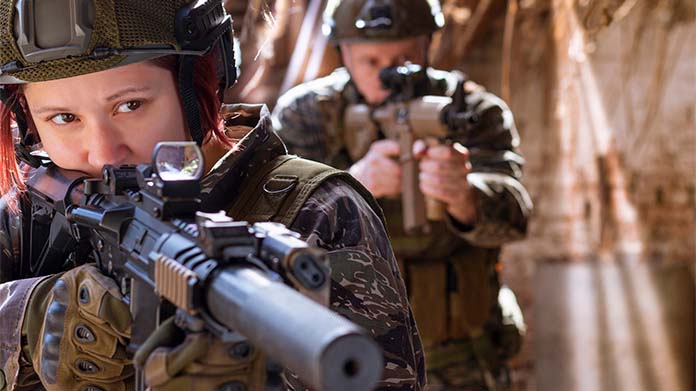
Starting an airsoft field business can be an exciting and rewarding business venture for entrepreneurs who are passionate about this sport and keen to share it with others.
Having said that, you should keep in mind that launching a successful airsoft field business requires careful planning, proper licensing, and a clear understanding of the relevant safety regulations.
In this comprehensive guide, we’ll walk you through all the essential steps you’ll need to take to start your own airsoft field business, from selecting the right location and securing necessary permits to setting up game areas and ensuring player safety.
Our guide is in 3 parts:
The airsoft industry has historically been quite robust — having reached an estimated market value of $1.93 billion in 2022 — and is only anticipated to continue expanding, given its predicted compound annual growth rate (CAGR) of 7.80% until 2030.
The main factors driving this growth include a rising interest among millennials and the growing accessibility of this sport to people of all experience levels as cost becomes less of a barrier to entry. In other words, its increasing affordability is making it more attractive to complete beginners, as they can give it a try without a hefty price tag.
In terms of the popular products within this industry, airsoft rifles are expected to see the fastest growth at a CAGR of 8.40% across the country throughout the coming years. With that being said, handguns have maintained the largest market share, largely due to their appeal to beginners and younger players as a result of their lightweight design and ease of use.
As airsoft’s popularity expands, particularly for the purposes of target shooting and tactical simulation, the demand for airsoft field businesses and equipment continues to grow. However, it’s also important to note that the industry’s expansion is being impacted by increasingly strict regulations, which have been brought about by concerns of the possible misuse of these devices.
For example, as a result of the rising popularity of airsoft sports, many areas in the US now require enthusiasts to join formal organizations or associations. While this added level of regulation helps to ensure responsible use of these devices, it can also create extra steps and costs for new players.
If you’re considering whether an airsoft field business is right for you, the first thing you’ll need to know is whether it’s a) affordable, and b) worth the investment. I mean, how much can you actually make running your own airsoft field business?
Well, it depends, and the initial investment for an airsoft field business varies widely based on factors such as your location, field size, and equipment quality.
With that being said, the main costs you’ll need to worry about when setting up your business will include:
Land and Setup Costs: In order to set up your airsoft field business, you’ll typically need to rent or purchase a large plot of wooded or open land, as well as pay for structures like cover, bunkers, trenches, and fox holes to be added. Generally, renting land may cost between $1,000 and $5,000 per month (depending on location and land size), while purchasing a plot could range from $30,000 to $150,000. Similarly, you can expect to spend a minimum of around $2,000 setting up a simple airsoft field business, with more advanced setups easily costing more than $15,000.
Airsoft Equipment: In order to adequately kit out your field, you should budget to spend anywhere upwards of $10,000 on weapons — depending on the number you want to be able to rent out — and around $2,000 on safety equipment like masks, goggles, and clothing. This is because quality airsoft guns often fall somewhere between $180 and $300 each, while more luxury, high-end models often exceed $800.
Insurance and Licensing: Due to the higher inherent risk associated with letting people shoot each other with airsoft guns on your property, getting the required liability insurance will likely represent a significant part of your initial expenses. Annual premiums for airsoft insurance typically start at around $1,000, though you’ll also be expected to pay for a handful of other basic policies (see Step 8), which could easily bring the total you end up spending on this to several thousand.
Bear in mind that the costs outlined above assume you’ll be setting up an outdoor-only course, which is the most common type of airsoft field business. However, if you plan to offer an indoor course, such as an old warehouse or repurposed facility, startup costs can easily increase by up to $50,000 or more.
This is primarily due to the fact that indoor setups also often require specialized safety infrastructure, such as reinforced walls and ceilings, impact-resistant barriers, and secure exits, which adds a significant amount to the initial cost associated with this business.
On top of this, indoor facilities will typically be faced with far bigger ongoing costs as — unlike outdoor-only courses — they’ll require you to spend extensively on utilities like electricity, heating, ventilation, and air conditioning (HVAC) to keep the environment comfortable and safe for players.
In spite of their lower profit margins due to the high initial and operating costs associated with this business model, airsoft field businesses have the potential to generate a significant amount of revenue.
For the most part, the main bulk of their income comes from admission fees paid by customers for access to the field. This should represent a pretty consistent source of revenue, with average daily rates around $30 to $40 per player and additional charges for equipment rentals such as guns and protective gear.
An easy way to maximize revenue from this source is to offer tiered admission packages, weekly passes, and discounts for multi-day access. This tactic not only boosts upfront income earned from clients, it also encourages repeat visits, which builds customer loyalty and turns occasional players into regulars.
Another potentially significant source of revenue for an airsoft field business lies in retail sales, with items like BB pellets, batteries, snacks, and basic protective gear commonly being sold to allow the business to capture additional revenue beyond admission fees.
While this won’t form the largest part of your revenue, it is perhaps one of the most profitable areas of your business as you’re able to mark up these products and sell them at a greatly inflated price.
This is because — on top of the discounts you’ll get from bulk buying these products from suppliers — selling in this way also allows you to capitalize on the convenience and accessibility for the customers of buying these goods on-site.
In fact, you’ll likely find that repeat customers are often willing to pay a premium to obtain these items on-site from you instead of buying online and taking a risk — not only because this lets them buy from a place they trust, but also because they’re able to talk through the purchase and quickly obtain advice.
Finally, if you’re prepared to invest the additional upfront capital, expanding your course to include weather-proof indoor arenas is an effective way to increase your profitability as it allows you to make earnings throughout the year.
The target market for your airsoft field business should primarily include young men aged 18 to 34, the demographic that’s typically drawn to the sport’s tactical and adventure elements.
However, airsoft is also increasingly appealing to smaller subsets, such as teenagers and women. Regardless of the specific demographics you target, ensuring they’re based locally is key as they are more likely to visit frequently.
On average, airsoft field business owners can charge around $30 to $40 per player for daily admission, with many customers also renting equipment for an additional fee of between $35 and $55 per day.
Offering discounts for multi-day passes or group packages is a powerful way to further increase customer retention and boost revenue through repeat visits.
The profit an airsoft field business can make varies, but on average, standard-sized airsoft field businesses tend to make between $100,000 and $400,000 per annum.
However, it’s unlikely your field will start out making profit like this — in fact, you should expect a lot of upfront investment and a lag time of around six months before you start to see any significant earnings.
Maximizing profitability can be achieved by expanding revenue streams through retail sales of accessories, snacks, and protective gear, which often bring higher profit margins.
Additionally, offering membership packages, multi-day passes, and indoor game options can increase customer loyalty and generate revenue consistently, even during poor weather.
Business Evaluation & Strategy Tool
We'll walk you through the four pillars every business needs: Points of Leverage, Marketing Strategy, Financial Model, and Personal Compatibility. At the end you'll see a personalized report and your action plan below will be tailored to your answers.
Every viable business has natural advantages. Below are common leverage points across four categories. Pick the ones that apply to your Airsoft Field business. We've pre-suggested a few based on your idea — review and adjust.
Without a way to connect with customers, even great businesses fail. Pick the channels you plan to use to reach your customers.
Enter your monthly baseline costs — the minimum overhead to keep the business running. Then we'll calculate how many sales per month you need to break even.
A business that doesn't fit your life will fail no matter how good the numbers look. Tell us how this business fits you.
Complete the four pillars and your personalized summary will appear here.
Nine concrete steps to take you from idea to open business, grouped into 30-day phases. Complete the planner above and we'll highlight what's most important for your situation.
An LLC keeps your personal assets separate from business debts and lawsuits — the most common reason small business owners choose this structure. Sole proprietorships and partnerships do not provide this protection.
Apply for your free Employer Identification Number through the IRS, then register for any state or local taxes that apply to your business (sales tax, franchise tax).
A dedicated business account is required to maintain personal asset protection. Mixing personal and business finances ('piercing the corporate veil') can void your LLC's liability shield.
Recording expenses and income from day one makes tax filing easier and lets you see when the business is actually profitable. Use software (QuickBooks, Wave) or a part-time bookkeeper.
State and local requirements vary widely. Brick-and-mortar businesses typically need a Certificate of Occupancy; service businesses may need specific professional licensing; food businesses need health permits.
General Liability Insurance is the most common starting point. If you'll have employees, most states require Workers' Compensation. Specific industries need additional coverage (product liability, professional liability, etc.).
Your brand is how customers perceive and remember you. A clear name, logo, and visual identity make every later marketing decision easier and protect you legally as you grow.
Every legitimate business needs a website. Social media pages are not a substitute — you don't own the platform. Modern website builders mean you can launch a clean site in a weekend without a developer.
A dedicated business number keeps your personal life private, makes the business look legitimate, and lets you route calls professionally. Cloud phone services start under $20/month.
Starting an Airsoft Field business typically costs $50,000 to $250,000. It is considered a very high capital-intensity business.
An Airsoft Field business runs roughly a 8% net profit margin, and most owners reach break-even in about 18 to 36 months.
You can usually launch an Airsoft Field business in about 2 to 8 weeks, and it is commonly run flexible.
An Airsoft Field business is generally an intermediate-skill business to start, with rising demand. TRUiC rates it 53 out of 100 on our Idea Score.
Most Airsoft Field businesses register as an LLC or other legal entity and obtain a general business license. Depending on your state and city you may also need industry-specific permits, sales tax registration, and zoning or health approvals, so check your local requirements before you launch.